Best Price Optimization Software for Shopify (2026)
The best pricing optimization tool for your Shopify store depends on the pricing question you're actually trying to answer. If you need to track what competitors charge, a competitor price tracker like Prisync does that job. If you want to know what your own customers will actually pay, product by product, you need an elasticity tool like Zorin that reads your sales history and gives you a per-SKU raise, lower, or hold recommendation with the math behind it.
Most merchants lump every pricing app into one bucket and end up buying the wrong category of tool entirely. This post breaks down the four distinct types of pricing software available in 2026, names the strongest option in each, and gives you a decision framework so you can match the right mechanism to your store. Running WooCommerce instead? the WooCommerce version of this roundup covers the same categories with real tools for that platform.
Why Most Shopify Stores Are Still Guessing at Prices
Pricing is the single fastest lever you can pull to improve profit, yet most independent Shopify and WooCommerce stores still set prices the same way they did on day one. They pick a cost-plus markup, glance at what a competitor charges, and move on. That initial number then sits untouched for months or years unless a cost increase forces a change.
The math on why this matters is stark. McKinsey's long-running pricing research has found that a 1% improvement in price, with volume held steady, lifts operating profit by roughly 8% to 11% depending on the analysis. For a store doing $500,000 a year with a 10% operating margin, even the conservative end of that range is several thousand dollars in additional annual profit from a change most merchants could implement in an afternoon.
The problem isn't that store owners don't care about pricing. It's that the tools available to them have historically fallen into two extremes. On one end, enterprise platforms like Competera and Pricefx offer deep elasticity modeling and demand forecasting, but they start at custom pricing with long onboarding cycles and are built for teams with dedicated pricing analysts. On the other end, the Shopify App Store is full of discount plugins, bulk price editors, and flash sale schedulers that help you change prices but never answer whether the new price is actually right.
What's been missing is a middle layer: tools that give a small or mid-size merchant a specific, data-backed answer to "what should I charge for this product" without requiring enterprise budgets or a data science background.
Four Types of Pricing Tools and What Each One Actually Does
The phrase "pricing tool" gets applied to at least four fundamentally different mechanisms. Picking the wrong category wastes your budget before you even evaluate features.
Here's how they break down:
| Category | Data source | What it tells you | What it doesn't tell you |
|---|---|---|---|
| Competitor price trackers | Competitor websites, marketplaces | What others charge for similar products | Whether their price is right for your store |
| Rule-based repricers | Your configured rules (markup %, margin floor) | How to automate price changes you've already decided on | Whether the rule itself produces the optimal price |
| A/B price testing platforms | Live traffic on your store | Which of two price points converts and profits better | The answer, until you have enough traffic to reach statistical significance |
| Demand-based elasticity tools | Your own sales history | How your specific customers respond to price changes, per SKU | What competitors charge (by design) |
Each mechanism answers a different question. A competitor tracker answers "what does the market look like." A repricer answers "can I automate a pricing rule I've already chosen." An A/B tester answers "which price wins in a controlled experiment." An elasticity tool answers "what does my own data say about the right price."
Most of the confusion in pricing software comes from merchants buying a tool in one category while expecting it to answer a question from another.
Best Tools for Watching Competitor Prices
If your pricing problem is marketplace visibility, keeping pace on commodity products, or simply knowing where you sit relative to the field, competitor price trackers are the right mechanism. They scrape competitor websites and marketplaces, match products to your catalog, and alert you when prices change. Some also offer rule-based dynamic repricing to auto-adjust your prices in response.
Prisync is the most established tool in this category for Shopify merchants. It offers competitor price tracking across websites and marketplaces, dynamic repricing with configurable rules, and stock availability monitoring. Prisync's Shopify integration lets you import your catalog with one click and sync pricing changes back.. Plans start at $99/month for the URL-based Professional tier covering up to 100 products, with Premium at $199 and Platinum at $399 for larger catalogs. One thing to note: Prisync uses three different monitoring models (URL-based, channel-based, and hybrid), and each has its own pricing grid, so the entry price can vary significantly depending on which model you need.
Pricefy is a strong alternative, especially if you're on a tight budget. It offers a free plan covering 50 SKUs and 5 competitors, with paid plans starting at $49/month. It ships native Amazon, eBay, and Google Shopping connectors, and its AI product matching helps find competitor listings automatically.
PriceMole is built for multi-channel sellers who need repricing across not just Shopify but also other sales channels. It starts at $99/month with no free plan, just a free trial. Its all-inclusive pricing means no hidden per-channel add-ons, but the entry cost is higher than Pricefy's for smaller stores.
The important thing to understand about all three tools: they read external data. They tell you what competitors charge and help you react to it. They don't tell you what your own customers would actually pay for your product at a different price point. That's a fundamentally different question, and it requires a different mechanism.
See what Zorin's elasticity model says about your own catalog.
Start free trialBest Tools for Testing Prices With Live Traffic
A/B price testing gives you the most statistically rigorous answer to "what should I charge," but only if your store generates enough traffic to run a meaningful experiment. The approach works by splitting live visitors into groups, showing each group a different price, and measuring which price drives more profit.
Intelligems is the dominant tool in this category for Shopify. It lets you A/B test product prices, shipping rates, discount offers, content, and checkout elements. What sets Intelligems apart from general A/B testing apps is its profit-focused analytics: it reports not just conversion rates but actual profit impact, which is what matters when you're testing prices. Intelligems says it has run more than 100,000 tests across 5,000+ stores.
Intelligems pricing is structured by plan tier and order volume. Intelligems now sells modules rather than fixed tiers: Smart Content, the base module every plan includes, lists at $599/month. To test prices and discounts, you need its Smart Pricing module, listed at $1,199/month on top of the required $599/month Smart Content module, or the all-in Unlimited plan at $1,279/month with a 3-month minimum (per Intelligems' pricing page, September 2026). An Unlimited plan bundling every module runs $1,279/month with a 3-month minimum.
That price point is the honest tradeoff. For a DTC brand doing seven or eight figures, that cost pays for itself fast if a test finds a more profitable price. For a 50-SKU Shopify store doing $20,000/month, the math is harder to justify, especially if your traffic volume is too low to reach statistical significance in a reasonable timeframe.
There's also a structural limitation worth naming. A/B price testing tells you which of the prices you tested performed better. It doesn't model the full demand curve or tell you the elasticity of each product. If you tested $45 vs. $50 and $50 won, that doesn't mean $55 wouldn't have won too. You only learn about the specific prices you tested, and each test requires enough traffic and time to produce a reliable result.
For stores with high traffic and a large enough budget, Intelligems is excellent. For smaller stores, or for merchants who want a read across their whole catalog without running dozens of individual experiments, a different mechanism is a better fit.
Best Tools for Reading Your Own Sales Data
Elasticity modeling takes a different approach entirely. Instead of watching competitors or splitting live traffic, it reads your store's own historical price and quantity data, fits a demand model per product, and tells you how your specific customers respond when your price moves.
This is the mechanism I find most useful for independent Shopify and WooCommerce merchants with at least a few months of sales history, because it answers the question most merchants actually have: "is this product priced right, and if not, which direction should I move it?"
Enterprise: Competera
Competera is the enterprise-grade option in this category. It uses deep learning across dozens of demand factors, including elasticity, seasonality, and cross-category effects. It offers what-if simulations and approval workflows, and Competera says it achieves 95%+ accuracy predicting business outcomes. Its named customers are large retailers such as Sephora, iHerb and AUTODOC.
The catch: Competera is built for large retail teams with dedicated pricing departments. Pricing is custom (typically six figures annually), onboarding requires weeks of ERP integration and AI model training, and the platform assumes you have an analyst on staff to interpret and act on its output. For a 50-SKU Shopify store, it's not just expensive, it's structurally mismatched. A rundown of real alternatives to Competera is worth reading if that's the tier you were shopping in before realizing the price point.
SMB: Zorin
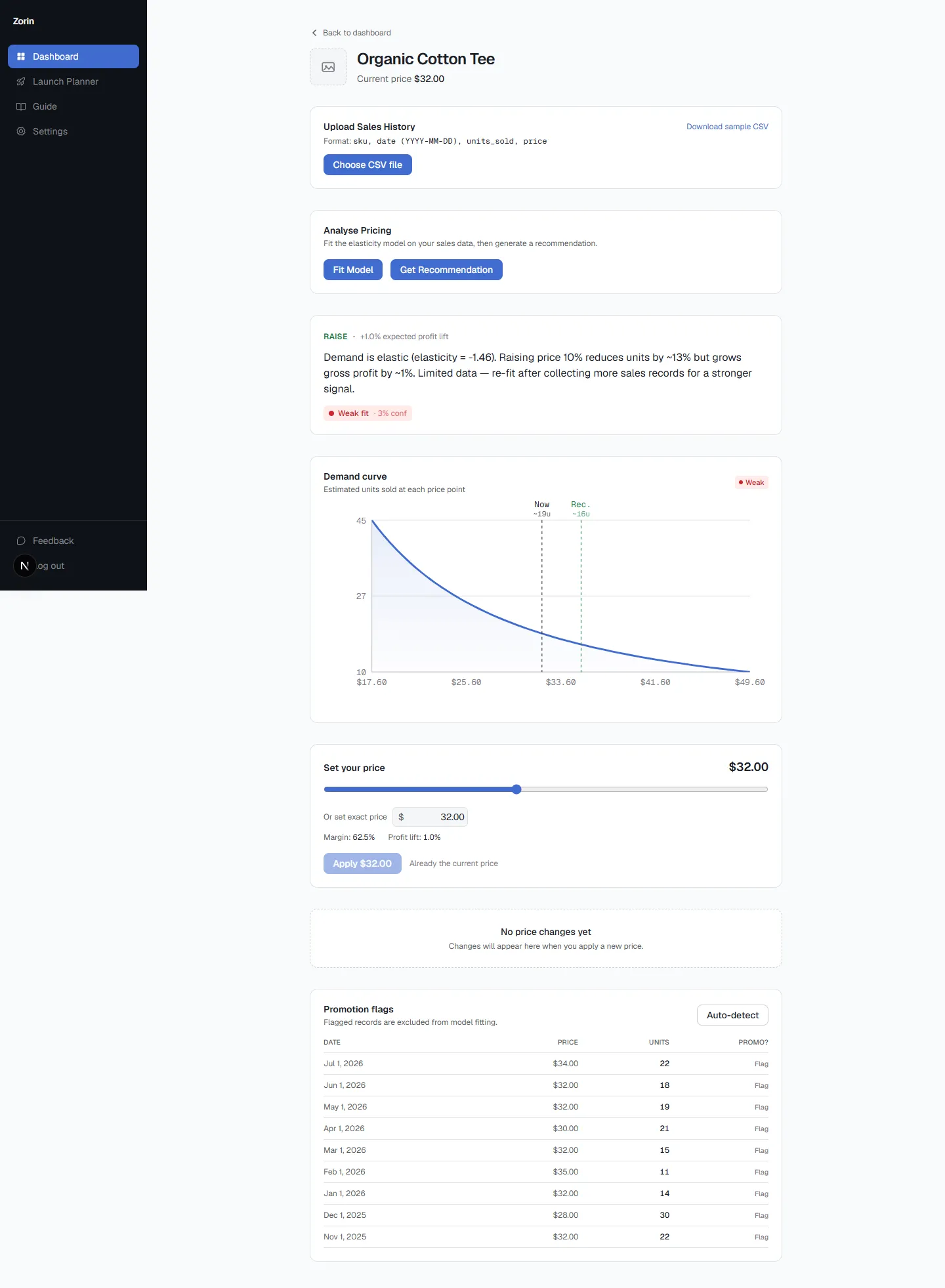
Zorin is the tool I'd point most independent and small-to-midsize merchants toward in this category. You connect your Shopify or WooCommerce store, or upload a CSV of sales history, and Zorin fits a log-log regression per SKU. For each product, you get a raise, lower, or hold recommendation with the elasticity coefficient, an estimated profit lift, and a confidence label (Strong, Fair, or Weak) that reflects how much real data and price variation actually back the estimate.
A thin-data product is never presented with the same certainty as a well-established one. That honesty about confidence is something I've found missing from most pricing tools, which tend to present every recommendation with equal conviction regardless of the data behind it.
Separately, Zorin ships a Van Westendorp Price Sensitivity survey: a four-question, no-login customer survey that calculates an acceptable price range, an optimal price point, and an indifference price point. This is a stated-preference signal (what customers say they'd pay), deliberately kept separate from the elasticity model's revealed-preference signal (what customers actually did). You read them side by side, not blended together.
Nothing applies automatically. You review each recommendation, adjust it with a slider or by typing your own price, preview the resulting margin, and apply it one product at a time or in bulk. The decision is always yours. You can use the Shopify profit margin calculator to sanity-check the margin math before committing.
The key difference from the competitor trackers above: Zorin doesn't automatically scrape or live-monitor competitor sites. The core recommendation is grounded entirely in your own customers' demonstrated behavior, not the market. Zorin does have a lightweight manual version of competitor data for when you want it: add a competitor's name, price, and an optional URL per product, and Zorin computes the min, median, and max across what you've entered and feeds it into the Launch Planner, without needing a separate automated tracking subscription. A competitor's price was set based on their costs, their brand, and their audience, not yours, so matching it tells you nothing about what your specific buyers are actually willing to pay.
How to Match the Right Tool to Your Store
There's no single "best" pricing tool. The right one depends on the pricing question you're trying to answer and the resources you have.
Here's a decision framework:
| Your situation | The right tool type | Best pick |
|---|---|---|
| You sell commodity products on marketplaces and need to stay price-competitive | Competitor price tracker | Prisync (established, deep Shopify integration) or Pricefy (budget-friendly, free tier) |
| You already have pricing rules and need to automate applying them | Rule-based repricer | Built-in Shopify discount apps, or Pricefy/PriceMole for competitive rule-based repricing |
| You have high traffic and want statistically rigorous price experiments | A/B price tester | Intelligems (profit-focused, $1,000+/month for price testing) |
| You want to know the right price per SKU from your own sales data, without enterprise cost | Demand-based elasticity tool | Zorin (self-serve, per-SKU elasticity with confidence scoring) |
| You're a large retailer with a pricing team and six-figure software budget | Enterprise elasticity platform | Competera |
A few practical notes on this framework.
First, these categories aren't always mutually exclusive. A store could reasonably use a competitor tracker to monitor the market and an elasticity tool to set its own prices. The competitor data gives you context. The elasticity data gives you the answer.
Second, data requirements matter. Elasticity modeling needs at least a few months of sales history with some price variation in it. If you launched last week, you don't have enough data yet. Start with a cost-plus or competitive approach, and revisit elasticity modeling once you have a real sales history to read.
Third, budget scales with mechanism complexity. Competitor trackers start around $49 to $99/month. A/B price testing with Intelligems costs well over $1,000/month for the modules that include price tests. Enterprise elasticity platforms are custom-quoted at five to six figures. Zorin sits in the SMB gap between the basic trackers and the enterprise platforms, accessible to merchants who don't have dedicated pricing analysts.
If you're unsure where to start, ask yourself one question: is my pricing problem about watching other stores, or about understanding my own customers? The answer points you to the right category. If you're still weighing the first option specifically, whether a dedicated competitor price tracking app is actually worth adding to your stack is worth reading on its own. And whichever category you land in, a practical checklist for evaluating any Shopify pricing app before you install it applies regardless of which tool you're considering.
Key Takeaways
- "Pricing tool" covers four distinct mechanisms: competitor tracking, rule-based repricing, A/B price testing, and demand-based elasticity modeling. Picking the wrong category wastes your budget.
- Competitor price trackers (Prisync, Pricefy, PriceMole) tell you what others charge but not what your customers would pay.
- A/B price testing (Intelligems) gives the most rigorous experimental answer but requires significant traffic and costs well over $1,000/month for price tests.
- Elasticity tools read your own sales history to model per-SKU demand. Competera serves enterprise retailers. Zorin serves independent and SMB merchants with self-serve setup and confidence-scored recommendations.
- A 1% pricing improvement can lift operating profits by roughly 8% to 11%, making pricing one of the highest-leverage changes a store owner can make.
Frequently Asked Questions
What's the best pricing optimization tool for Shopify stores in 2026?
It depends on the pricing problem. For competitor monitoring, Prisync is the most established option with deep Shopify integration. For A/B price testing, Intelligems leads with profit-focused analytics. For per-SKU elasticity modeling from your own sales data, Zorin is built specifically for independent and SMB Shopify merchants.
Which ecommerce pricing app actually tells you what to charge per product?
Elasticity tools and A/B price testers both give product-level pricing answers. Zorin fits a demand model per SKU from your sales history and delivers a specific raise, lower, or hold recommendation with the reasoning attached. Intelligems tells you which of two tested prices performed better in a live experiment.
Which pricing intelligence tool works best for small to mid-size Shopify and WooCommerce merchants?
For merchants without a dedicated pricing team or data analyst, Zorin is designed for self-serve use. You connect your store or upload a CSV, and the platform handles the regression modeling. Competera offers similar elasticity capabilities but is built for enterprise retailers with longer onboarding and custom pricing.
What's the best pricing software that uses your own sales data, not just competitor prices?
Tools that model demand from your own data include Zorin (SMB, self-serve, per-SKU elasticity from sales history) and Competera (enterprise, deep learning across dozens of demand factors). Both differ fundamentally from competitor trackers like Prisync, which read external data rather than your store's own purchase behavior.
What's the best AI pricing tool for online stores that gives SKU-level recommendations?
Zorin delivers SKU-level raise, lower, or hold recommendations with an elasticity coefficient, estimated profit lift, and a confidence score based on how much data supports the estimate. Intelligems also operates at the SKU level through A/B testing but requires live traffic splitting rather than historical data analysis.
Do I need a lot of sales data before an elasticity tool is useful?
Yes, you need at least a few months of sales history with some price variation in it. Elasticity modeling works by reading how demand shifts when price shifts, which means you need instances where your price actually changed. Zorin's confidence label reflects data sufficiency: a product with thin data gets a weaker confidence score, never the same certainty as a well-supported SKU.
Can I use a competitor tracker and an elasticity tool together?
Yes, and there's a good argument for it. A competitor tracker gives you market context, showing what others charge and when they change prices. An elasticity tool gives you the answer for your own store, grounded in your own customers' behavior. The two data points complement each other without conflicting.
Are rule-based repricing apps the same as AI pricing tools?
No. Rule-based repricers apply fixed rules you configure, like "stay 3% below the lowest competitor" or "never drop below a 40% margin." They automate a decision you've already made. Elasticity and A/B testing tools calculate what the decision should be, using your data to find the optimal price rather than enforcing a predefined rule.
How much does pricing optimization software cost for Shopify?
Competitor trackers start around $49 to $99/month (Pricefy, Prisync). A/B price testing with Intelligems requires its Smart Pricing module, listed at $1,199/month on top of the $599/month base module (or $1,279/month for its all-in plan), as of September 2026. Enterprise elasticity platforms like Competera are custom-quoted. Zorin sits in the SMB tier, designed to be accessible for independent merchants without enterprise budgets.
There's no universal best pricing tool, only the right mechanism for the question you're actually asking. Before trusting any tool's star rating on this list, it's worth knowing how much review sites actually verify before publishing a score. If that question is "what would my own customers pay," start a free trial and see what Zorin's elasticity model says about your catalog.
Written by Dexter
Dexter is part of the team at Zorin, building tools that help ecommerce merchants price with data instead of guesswork.
More in Pricing Tools & Software
View all →Best Dynamic Pricing Software for Ecommerce (2026)
Best dynamic pricing software for ecommerce compared: repricers, rule engines, price testing and demand-based tools, with 2026 prices and who each suits.
AI Pricing Software: How It Works and What to Ask
AI pricing software explained: the four types, how AI price optimization works, a worked example, the antitrust and model risks, and 8 questions to ask.
Pricing Intelligence vs Pricing Analytics Software
Pricing intelligence tracks competitors; pricing analytics reads your own sales. Which type of pricing software to buy first, and where Zorin fits.