Should You Trust an AI Pricing Recommendation?
You should trust an AI pricing recommendation exactly as much as its confidence score and stated reasoning support, no more and no less. A recommendation backed by strong data and a clear explanation deserves real weight. One with thin data and a vague justification deserves a test, not blind acceptance. The mistake most merchants make isn't trusting AI too much or too little in general, it's treating every recommendation with the same level of trust regardless of what's actually behind it.
The Real Question: How Much Evidence Is Behind the Call?
Framing this as a binary, trust AI or don't, misses what actually determines whether a recommendation is reliable. (If you're still choosing a tool, start with how AI pricing software works and what to ask before buying.) Two recommendations from the exact same model can deserve very different levels of trust if one is backed by a thousand data points across multiple price points and the other by a handful of sales at a single price that's never moved. The model isn't the variable that matters most. The evidence behind the specific recommendation is. This is really the same question as whether your store is ready for automated pricing tools at all, just asked at the level of a single recommendation instead of the whole rollout.
What "Explainable" Actually Looks Like
There's good research on why people distrust algorithms and what fixes it. In a series of experiments, Berkeley Dietvorst, Joseph Simmons and Cade Massey found that people often abandon an algorithm after watching it make a mistake, even when it's more accurate than they are. But when they were allowed to adjust its forecasts, even by a small, restricted amount, they were far more willing to use it, and their results improved. The takeaway for pricing: a recommendation you can see the reasoning for, and adjust before it goes live, is one you'll actually use. A bare instruction like "change this price to $24.99" gives you nothing to evaluate. A recommendation that shows the elasticity behind it and the projected profit impact lets you check the logic against what you know about the product.
This is the difference between a black box and a reasoning partner. One asks for faith. The other shows its work, so you're evaluating the logic, not just accepting a conclusion.
Confidence Scores Exist Specifically So You Don't Trust Uniformly
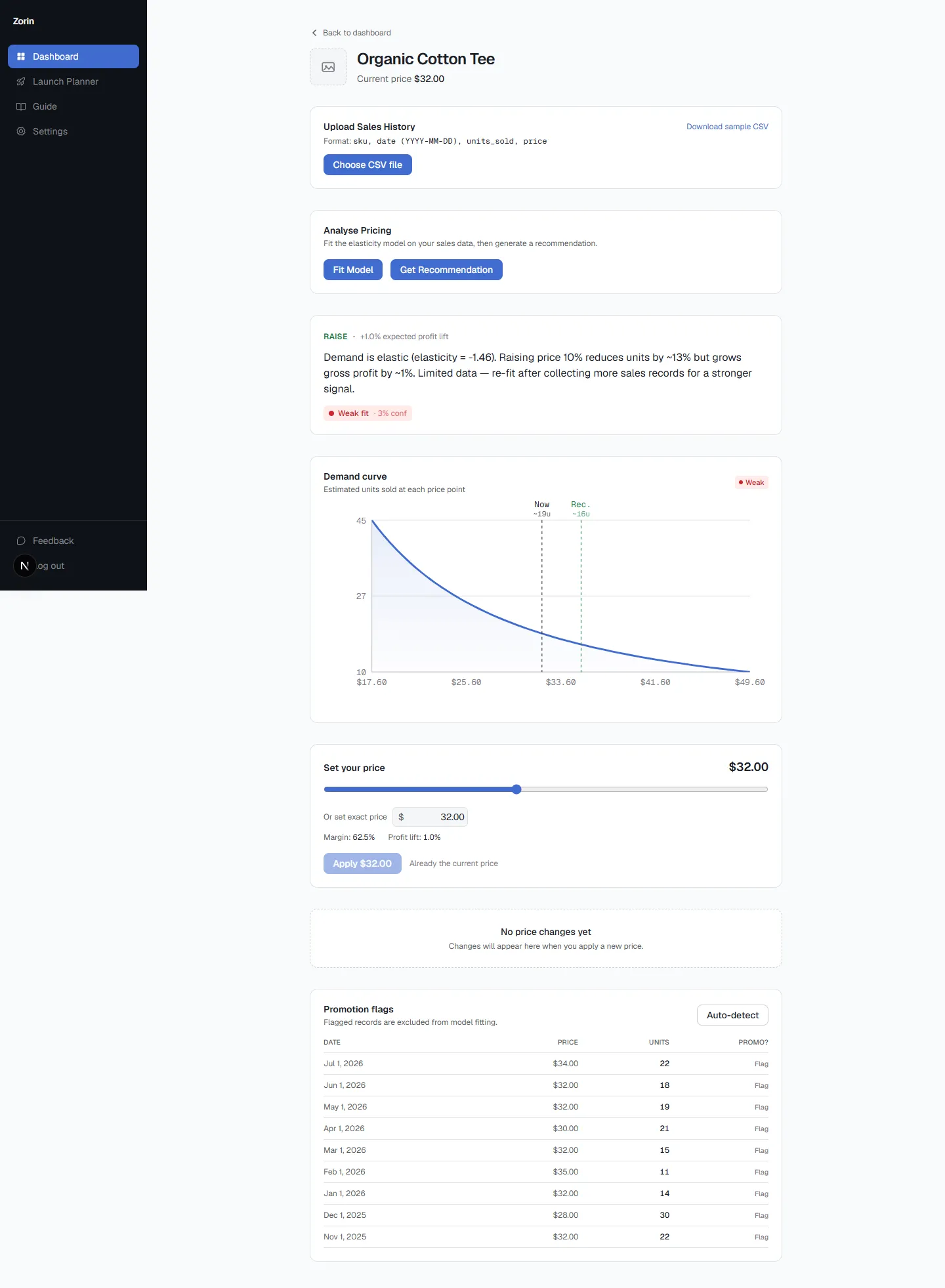
A model health indicator (commonly labeled something like Strong, Fair, or Weak fit, alongside an R-squared value) tells you directly how much statistical support exists behind a given recommendation. A Strong-fit recommendation on a bestseller with months of price history deserves real weight. A Weak-fit recommendation on a product that's only ever had one price is closer to an educated hypothesis than a settled answer, and should be treated that way, tested rather than applied outright. If you want to see how that elasticity number is actually calculated, the underlying math is straightforward once you know the formula.
| Confidence level | What it means | How much to trust it |
|---|---|---|
| Strong | High R-squared, substantial data points, real price variation in history | Reasonable to apply directly, especially for lower-risk changes |
| Fair | Moderate fit, some data, limited price variation | Worth testing with a what-if simulator before applying |
| Weak | Model exists but data is thin or has never varied in price | Treat as a starting hypothesis; gather more data before trusting fully |
What Happens When an Algorithm Prices Without Enough Checks
The most expensive example is Zillow. Its Zillow Offers business used an algorithm to price and buy homes at scale. When the housing market shifted in 2021, the model kept buying at prices the market wouldn't support. Zillow recorded a $304.4 million inventory write-down in the third quarter of 2021 for homes bought above what it now expected to sell them for, shut the business down, and cut about 25% of its workforce. Stanford GSB's analysis traces the failure to scaling automated purchase decisions faster than the model's accuracy could justify, in a market that was changing under it.
A small store isn't buying houses, but the pattern is the same one to avoid: letting a model act at full scale before you've checked how its recommendations perform on a few products first.
See what Zorin's elasticity model says about your own catalog.
Start free trialWhere Real Skepticism Is Warranted
Regulators are paying attention to algorithmic pricing too. The U.S. Department of Justice sued RealPage in August 2024, alleging that its rent-pricing software let competing landlords share confidential data and align their prices. The concern there is software that pools competitors' private data or adjusts prices in real time without limits or explanation. That skepticism is healthy and mostly applies to a different kind of system: fully automated repricers with no review step and no stated reasoning. A recommendation you review, understand, and choose to apply yourself is a fundamentally different risk profile than a black-box system silently changing prices on its own.
The practical guardrails worth insisting on from any pricing tool: a review-before-apply step, a stated reason for every recommendation, and a way to test a change before committing to it. Those three things do more for trustworthiness than any claim about how advanced the underlying model is.
What This Looks Like in a Pricing Tool
Every recommendation ships with the elasticity number, the R-squared fit, a confidence label, and the estimated profit lift, not a bare instruction. Nothing applies automatically. You review each raise, lower, or hold call and apply it yourself, one product at a time or in bulk, and a what-if simulator lets you preview a candidate price against your own demand curve before you commit to anything. The goal isn't to ask for blind trust. It's to make the reasoning visible enough that you can decide, case by case, how much a given recommendation deserves.
A Practical Test You Can Run Yourself
Pick one product with a Strong confidence score and one with a Weak one. Apply the Strong recommendation and watch the actual outcome against the projected lift. Test the Weak recommendation with the simulator first rather than applying it directly, and let more sales history accumulate before trusting it fully. Skipping that test on a Weak-fit call is exactly how a price increase can tank sales more than expected. This single comparison teaches you more about how much to trust the system than any general rule would. If you're ready to see your own numbers, connect your sales history and start with a handful of products before trusting it with your whole catalog.
Key Takeaways
- Trust should scale with the confidence score and data behind a recommendation, not be applied uniformly to every output.
- Explainability matters: a recommendation with a stated reason is more trustworthy than a bare number, because you can sanity-check the logic yourself.
- People trust and use an imperfect algorithm far more when they can adjust its output, even slightly, which is why review-and-edit beats all-or-nothing automation.
- A what-if simulator and a review-before-apply step let you verify a recommendation before committing, rather than trusting or rejecting it blind.
- Guardrails (a hard margin ceiling on how far a price can move, review before bulk apply) matter more than how advanced the underlying model is.
Frequently Asked Questions
How much should I trust an AI pricing recommendation?
Trust it in proportion to its confidence score and the reasoning behind it. A strong-fit recommendation with a clear explanation deserves real weight; a weak-fit one deserves testing first.
What makes a pricing recommendation trustworthy?
A stated reason (the elasticity number and projected impact), a confidence level based on how much data supports it, and the ability to test it before applying it.
Should I ever apply a recommendation without checking it?
For a Strong-confidence recommendation on a low-risk change, applying directly is reasonable. For anything with thin data or a Weak fit, test it with a simulator first.
Is fully automated pricing risky?
Fully automated systems that change prices in real time with no review step and no stated reasoning carry more real risk, both for trust and for regulatory scrutiny, than a system where you review and apply each recommendation yourself.
Why does explainability matter more than model sophistication?
A stated reason lets you sanity-check a recommendation against your own knowledge of the product. A bare number asks you to trust the system blindly, regardless of how advanced it actually is.
What's a confidence score based on?
Typically the statistical fit of the underlying model (such as an R-squared value) and how much real price variation and data volume support the estimate.
Can I test a recommendation before committing to it?
Yes. A what-if simulator lets you preview the projected impact of a candidate price against your own demand curve before applying anything.
The right amount of trust in an AI pricing recommendation isn't a fixed number, it's a function of the evidence behind that specific call. Look for a stated reason, a confidence score, and a chance to test before you apply, and you'll trust the right recommendations the right amount, not too much and not too little.
Written by Dexter
Dexter is part of the team at Zorin, building tools that help ecommerce merchants price with data instead of guesswork.
More in Price Elasticity
View all →How to Calculate Price Elasticity in WooCommerce
Where to find the data in WooCommerce Analytics, the midpoint formula on a real example, and why a pricing plugin isn't an elasticity read.
What Your Price Elasticity Score Actually Means
What your elasticity number means, how to know if it's solid enough to act on, and why products in the same category can have completely different scores.
How to Know If Your Prices Are Too High or Too Low
Declining sales and high close rates are lagging signals. Price elasticity tells you before you change anything, not after the damage is done.