AI Pricing Software: How It Works and What to Ask
AI pricing software uses machine learning to recommend or set prices from data, most often your own sales history, competitor prices or both. The better tools estimate how demand for each product responds to price and suggest the price that earns the most profit, with a measure of how confident the model is. Before you buy, check what data the "AI" actually learns from, whether it shows its uncertainty, whether a person approves changes, and whether it pools competitors' private data, which is now an antitrust risk.
What "AI" Means in Pricing Software
"AI pricing" covers very different products. Some are genuine demand models; some are competitor-matching rules with an AI label; some are chat assistants on top of a dashboard. Knowing which one you're looking at is the first step.
| Type | What it learns from | What it outputs | Best for | Watch out for |
|---|---|---|---|---|
| Demand or elasticity models (AI price optimization) | Your own prices and sales over time | A recommended price per product and the expected profit change | Stores with sales history and room to set their own prices | Needs past price variation; thin data means low confidence |
| Competitor-reactive repricers | Competitor and marketplace prices | Automatic price changes to match or beat rivals | Identical products on crowded marketplaces | Race to the bottom; "AI" may just be rules |
| Experimenting (reinforcement learning) systems | Live results from continuously testing prices | Prices that shift as the system learns | High-traffic catalogs that can absorb testing | Customers seeing different prices; hard to audit |
| Generative AI assistants | Your data plus a language model | Explanations, summaries and suggested rules in plain English | Making outputs easier to understand | Fluent answers aren't the same as a demand model |
For most small and mid-sized online stores, the first type is the one that answers the real question, "what should this product cost?", rather than "what does everyone else charge?". The difference is covered in more depth in rule-based vs algorithmic pricing.
How AI Price Optimization Works, Step by Step
- Collect the data. Orders, prices, dates and costs for each product, usually synced from Shopify, WooCommerce or a CSV.
- Clean it. Flag promotions, stockouts and unusual spikes so a clearance sale doesn't look like normal demand.
- Fit a demand model. Estimate how much each product's sales change when its price changes, its price elasticity.
- Apply your objective and limits. Usually maximize profit, subject to a cost floor, a maximum step size and any MAP or brand rules.
- Recommend a price with a confidence level. A good tool says how sure it is, and says "hold" when the data is too thin.
- A person reviews and applies it. Then the new price becomes new data, and the model updates.
How much history step three needs is covered in how much sales history you need for elasticity pricing.
Worked Example: Reading Two AI Recommendations
An AI pricing tool looks at two products in the same store:
| Product A: refillable cleaner | Product B: phone stand | |
|---|---|---|
| Current price / cost | $40 / $22 | $25 / $15 |
| Monthly units | 300 | 220 |
| Estimated elasticity | −0.7 | −2.4 |
| Model confidence | Strong (many price points, consistent response) | Weak (two price points, noisy data) |
| Recommendation | Raise 6% | Hold |
Product A: raising the price 6% to $42.40 with an elasticity of −0.7 means volume falls about 4.2%, to roughly 287 units. Profit goes from 300 × $18 = $5,400 to 287 × $20.40 = $5,855, about 8% more.
Product B: the model's best guess says it's very price-sensitive, but it's based on too little variation to trust. The honest recommendation is to hold, gather more data and revisit. A tool that confidently pushed a change here would be guessing. Knowing when to trust a recommendation is covered in should you trust an AI pricing recommendation.
See what Zorin's elasticity model says about your own catalog.
Start free trialWhat Can Go Wrong With AI Pricing
Model risk at scale
The most famous failure is Zillow Offers, where an algorithm priced homes to buy and resell. It overpaid in a shifting market, and Zillow took a $304.4 million inventory write-down in the third quarter of 2021 before shutting the business, as Stanford GSB's analysis describes. The lesson for a store: never let a model move prices faster or further than you can check, and watch confidence, not just the recommendation.
Algorithms that raise prices together
In a study published in the American Economic Review, Calvano and colleagues found that simple self-learning pricing algorithms, competing in a simulated market, consistently learned to charge prices above competitive levels without communicating with one another. Regulators have taken note. In November 2025 the U.S. Department of Justice announced a proposed settlement requiring RealPage, a rental pricing software company, to stop sharing competitively sensitive information and aligning prices among competing landlords. The practical rule for buyers: prefer tools that price from your own data, and be cautious with any product that pools nonpublic data from your competitors to set your price.
Customer backlash
Prices that change in ways customers can't explain feel unfair. Wendy's discovered this in 2024 when the phrase "dynamic pricing" triggered a backlash, covered in what dynamic pricing is.
Questions to Ask Before You Buy AI Pricing Software
- What data does the model learn from? Your own sales, competitor prices, or other companies' data?
- Does it estimate demand, or react to competitors? Ask what happens to the recommendation if no competitor changes price.
- Does it show confidence? Look for a clear signal when data is thin, and a "hold" option.
- Who approves price changes? Automatic changes are fine only with floors, ceilings and step limits you control.
- How does it handle promotions and stockouts? If it can't separate them, sale weeks will distort the model.
- Can it explain a recommendation? You should see the demand curve or elasticity behind a number, not just the number.
- How much history does it need? Tools that need years of data won't help a young store.
- What does it cost, and is pricing published? Many enterprise tools require a demo just to get a quote.
For a side-by-side of specific tools, see our roundups of price optimization software for Shopify and for WooCommerce.
What a Demand-Based AI Pricing Tool Looks Like
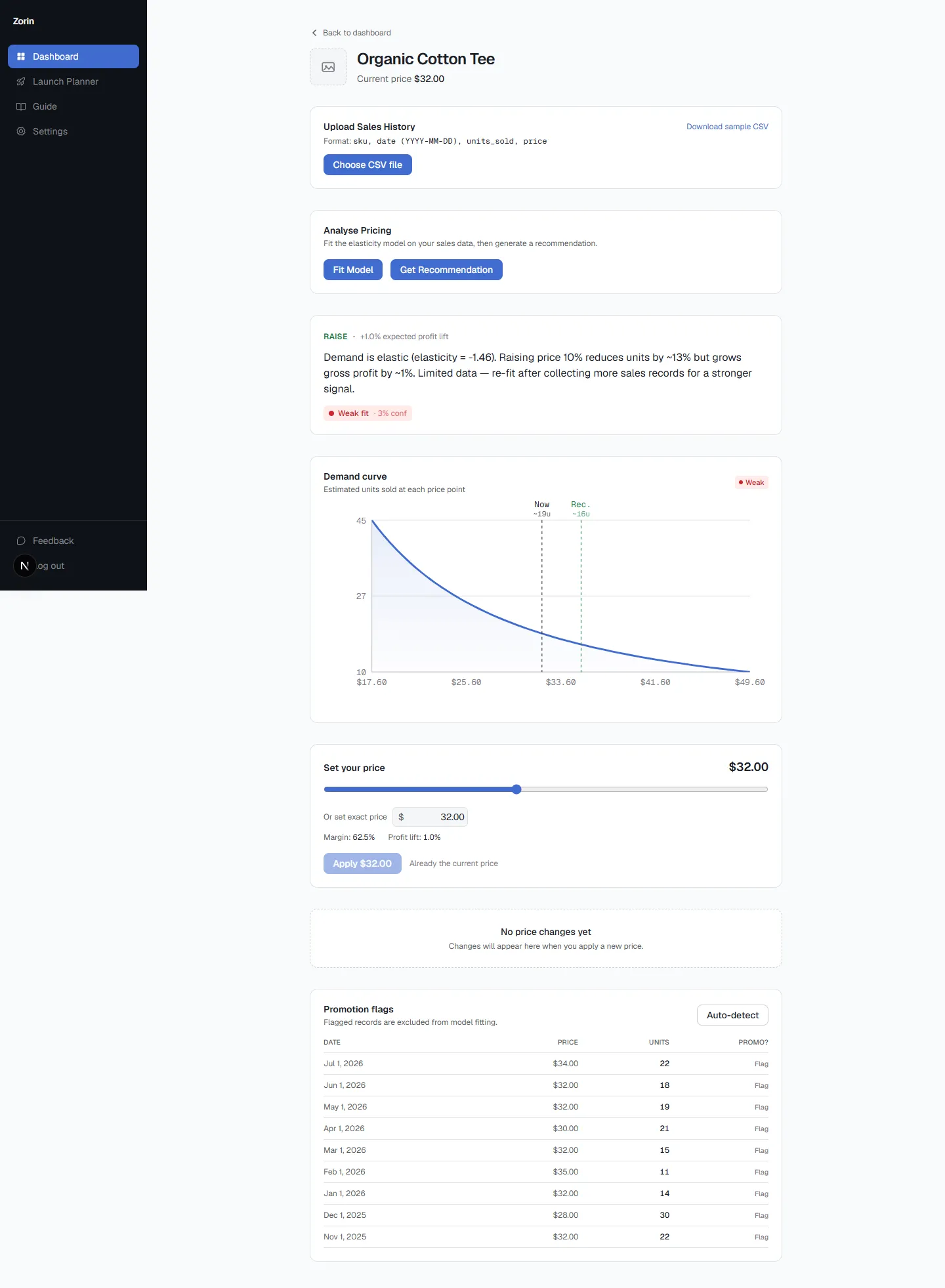
Zorin is the first type in the table above. It reads your own Shopify or WooCommerce sales history, fits a log-log elasticity regression for each product, and recommends raise, lower or hold with an estimated profit impact and an R-squared based confidence score. It lets you flag promotions so they don't distort the read, it doesn't use other merchants' data to set your prices, and nothing changes until you approve it. Its limits are the ones any honest demand model has: a product needs some past price variation before the recommendation is strong, and it isn't a real-time repricer.
Key Takeaways
- AI pricing software ranges from true demand models to competitor-matching rules with an AI label; ask which one you're buying.
- AI price optimization estimates each product's price elasticity and recommends the most profitable price within your limits.
- Good tools show confidence and recommend "hold" when data is thin, as with Product B in the example.
- Research in the American Economic Review found learning algorithms can drift to above-competitive prices, and the DOJ's 2025 RealPage settlement targets pooled competitor data.
- Prefer tools that learn from your own data, explain their recommendations and keep a person in charge of changes.
Frequently Asked Questions
What is AI pricing software?
AI pricing software uses machine learning to recommend or set prices from data such as your sales history, costs and competitor prices. The most useful kind estimates how demand for each product responds to price and suggests the price that maximizes profit.
How does AI price optimization work?
It collects your price and sales data, removes distortions like promotions and stockouts, fits a demand model for each product, then recommends a price that meets your goal, usually profit, within limits such as a cost floor and a maximum change.
Is AI pricing software worth it for a small store?
It can be if you have sales history and products where price isn't fixed by a brand or marketplace. In the worked example, a 6% raise on one well-understood product added about 8% to its monthly profit. Stores with very little history should expect low-confidence results at first.
Is AI pricing legal?
Using AI to set your own prices from your own data is legal. The risk comes from tools that pool nonpublic data from competing businesses or align their prices, which is what the DOJ's 2025 RealPage settlement addressed. New York also requires a disclosure when prices are set by algorithm from a consumer's personal data. This is general information, not legal advice.
What is the difference between AI pricing and dynamic pricing?
Dynamic pricing describes prices that change frequently in response to conditions. AI pricing describes how the price is chosen. A tool can use AI to recommend occasional price changes without being dynamic, and a dynamic pricing tool can run on simple rules with no AI at all.
Can AI pricing software set prices automatically?
Many tools can, but automatic changes should only run with floors, ceilings and step limits you control. Starting with recommendations you approve is safer until you've seen how the model behaves on your catalog.
AI pricing software is only as good as the data it learns from and the guardrails around it. Look for a demand model built on your own sales, honest confidence levels and a person in charge of every change. To see what that looks like on your own catalog, start a free Zorin trial.
Written by Dexter
Dexter is part of the team at Zorin, building tools that help ecommerce merchants price with data instead of guesswork.
More in Pricing Tools & Software
View all →Best Dynamic Pricing Software for Ecommerce (2026)
Best dynamic pricing software for ecommerce compared: repricers, rule engines, price testing and demand-based tools, with 2026 prices and who each suits.
Pricing Intelligence vs Pricing Analytics Software
Pricing intelligence tracks competitors; pricing analytics reads your own sales. Which type of pricing software to buy first, and where Zorin fits.
Are G2 & Capterra Reviews Reliable? How to Check
G2, Capterra and TrustRadius verify reviews differently. How each works, what gets filtered out, and what to check before trusting a pricing tool's score.