Best Dynamic Pricing Software for Ecommerce (2026)
The best dynamic pricing software for ecommerce depends on what should drive your prices. If you sell on Amazon or Walmart, a repricer like Informed Repricer reacts to the Buy Box in real time. If you track competitors across marketplaces, Prisync or Omnia Retail adjust prices by rule. If you want to test prices on your own Shopify store, Intelligems runs price experiments. If you want prices based on how your own customers respond, Zorin recommends changes from a per-product demand model. Large retailers usually end up with an enterprise platform like Competera.
The Quick Comparison
| Tool | What drives the price | Best for | Published starting price |
|---|---|---|---|
| Informed Repricer | Amazon Buy Box and competing offers | Amazon and Walmart marketplace sellers | $99/month (Launch), $199/month (Pro) |
| Prisync | Competitor prices plus your rules | SMB stores selling products competitors also stock | $199/month for the dynamic pricing engine (URL-based Premium) |
| Omnia Retail | Market data plus a rule tree | Multi-marketplace retailers and DTC brands | €399/month (SMB, single shop) |
| Intelligems | Live price tests on your storefront | Shopify brands with enough traffic to test | $1,199/month Smart Pricing module plus the $599 base module |
| Zorin | Your own sales history (price elasticity) | Shopify and WooCommerce stores that set their own prices | $39 to $249/month |
| Competera | Demand and competitive factors at scale | Enterprise retailers with pricing teams | Quote only |
Prices were checked on each vendor's pricing page in September 2026 and are list prices before any annual or bundle discounts.
First, Decide What Should Move Your Prices
Dynamic pricing software isn't one category. The biggest difference between tools is the signal they react to:
- Competitor-driven: prices follow the market. Right when you sell identical products against many sellers.
- Experiment-driven: the tool tests prices on real visitors and keeps the winner. Right when you have steady traffic and can accept showing different prices during a test.
- Demand-model-driven: the tool learns how your customers have responded to past prices and recommends the most profitable one. Right when you set your own prices and have sales history.
If you aren't sure whether your store is ready for any of them, start with dynamic pricing software: is your store ready?
1. Informed Repricer: Best for Amazon and Walmart Sellers
Informed Repricer is built for marketplace sellers competing for the Buy Box. Its Pro plan is $199 a month with unlimited listings and users, instant repricing and profit protection, and a $99 Launch plan applies until your business reaches $5,000 in monthly revenue. It connects to more than 20 international Amazon marketplaces and Walmart Marketplace, and offers a 14-day free trial with no credit card. Add-ons such as faster "Overdrive" updates cost extra.
Choose it if most of your revenue comes through marketplace listings shared with other sellers. Skip it if you sell mainly on your own store, where there's no Buy Box to win.
2. Prisync: Best Rule-Based Option for SMB Stores
Prisync tracks competitor prices and, from its $199-a-month Premium plan (up to 1,000 products on the URL-based model), adds a dynamic pricing engine that adjusts your prices by rules you set against competitor prices. Its $99 plan is monitoring only. There's a 14-day free trial.
Choose it if competitors sell the same products and you want transparent, rule-based adjustments. Skip it if your products are own-brand, since there's nothing direct to price against. See Zorin vs Prisync.
3. Omnia Retail: Best for Multi-Marketplace Retailers
Omnia Retail's SMB plan starts at €399 a month for a single shop with up to five users. It combines price monitoring with automated dynamic pricing built in a visual rule tree, approval limits, strategy rollback and an AI assistant that explains price moves. It integrates with Shopify and several European ecommerce platforms, and supports EU Omnibus lowest-price tracking.
Choose it if you sell across several marketplaces, especially in Europe, and want monitoring and repricing in one tool. Skip it if you need a low-cost starting point. See Zorin vs Omnia Retail.
Ready to see your own numbers?
Start your free trial4. Intelligems: Best for Price Testing on Shopify
Intelligems is a testing platform for Shopify brands. Its Smart Pricing module, which runs price and discount tests, lists at $1,199 a month on top of the $599 Smart Content module every plan includes, for stores up to 10,000 orders a month before bundle and annual discounts. It reports more than 5,000 stores and 4.8 stars on the Shopify App Store.
Choose it if you have enough traffic to reach clear test results and the budget for a premium tool. Skip it if you're a smaller store: the monthly cost needs a large profit lift to pay back. Running a fair test is covered in how to run a price A/B test the right way.
5. Zorin: Best for Demand-Based Pricing on Shopify and WooCommerce
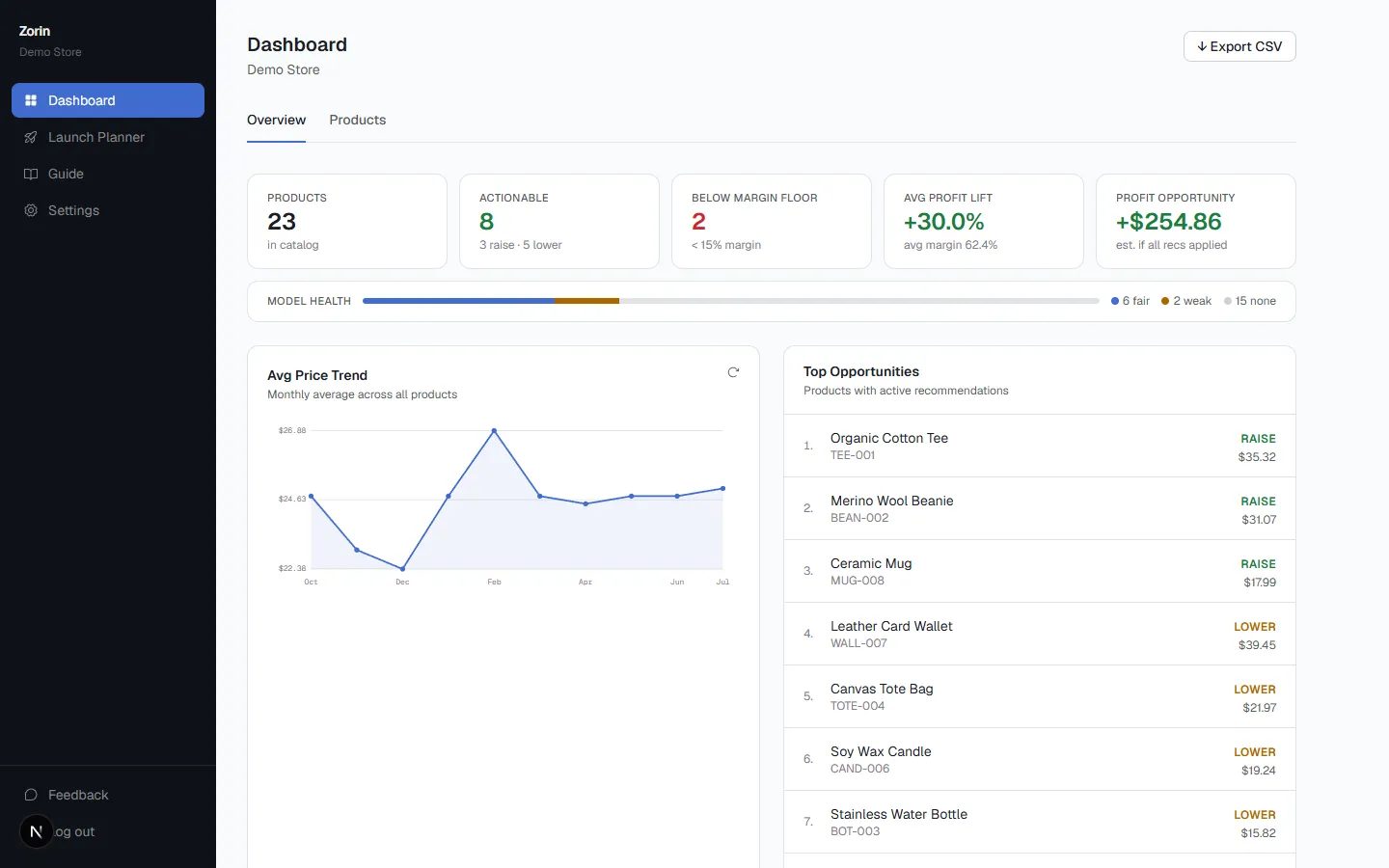
Zorin reads your Shopify or WooCommerce sales history, fits a price elasticity model for each product and recommends raise, lower or hold with an estimated profit impact and a confidence score. You approve changes, one at a time or in bulk, and they're pushed to your store. Pricing is published at $39 to $249 a month depending on catalog size.
Choose it if you set your own prices, have some sales history and want to know how your own customers respond rather than follow competitors. Skip it if you need second-by-second automatic repricing: Zorin recommends and you apply; it isn't a real-time repricer, and it doesn't scrape competitor prices.
6. Competera: Best for Enterprise Retailers
Competera doesn't publish plans; pricing is by request and scoped to catalog size and markets. It models demand alongside competitive and other factors and is designed for retailers with dedicated pricing teams and ERP integrations. For smaller stores, see Competera alternatives.
Worked Example: What a Tool Has to Earn
A Shopify store does $100,000 a month in revenue at a 40% gross margin, so $40,000 of gross profit. Here's the profit lift each tool needs just to pay for itself:
| Monthly cost | Lift in gross profit needed to break even |
|---|---|
| $99 | 0.25% |
| $199 | 0.5% |
| $249 | 0.6% |
| €399 (roughly $430 to $470) | 1.1% to 1.2% |
| $1,798 ($1,199 + $599) | 4.5% |
A 4.5% profit lift is achievable for a store with the right catalog and traffic, but it's a meaningful bar; a 0.5% lift is a much lower one. Match the tool to the size of the prize. The full ROI method is in is pricing software worth the monthly cost?
Guardrails Any Dynamic Pricing Tool Needs
- A floor per product based on landed cost plus a minimum margin.
- A ceiling and a maximum step, so no single change moves a price too far.
- Human approval for large changes, at least until you trust the tool.
- A clear customer story. Price changes customers can explain are tolerated; ones that look like exploiting demand trigger backlash, as covered in what dynamic pricing is.
Key Takeaways
- Pick dynamic pricing software by the signal it reacts to: competitors, live tests or your own demand data.
- Informed Repricer ($99 to $199) suits Amazon and Walmart sellers; Prisync ($199 for its pricing engine) suits rule-based SMB stores.
- Omnia Retail (from €399) fits multi-marketplace retailers; Competera is quote-only enterprise software.
- Intelligems' Smart Pricing costs $1,199 a month plus a $599 base module, so it needs about a 4.5% profit lift on a $100k-a-month store.
- Zorin ($39 to $249) recommends prices from your own sales history rather than repricing in real time.
Frequently Asked Questions
What is the best dynamic pricing software for ecommerce?
It depends on your channel and data. Marketplace sellers usually do best with a repricer like Informed Repricer, stores competing on identical products with Prisync or Omnia Retail, high-traffic Shopify brands with Intelligems, and stores that set their own prices with a demand-based tool like Zorin.
What is the best dynamic pricing software for Shopify?
For price testing, Intelligems is built for Shopify but priced for larger brands. For rule-based competitor pricing, Prisync integrates with Shopify. For recommendations from your own sales history, Zorin connects to Shopify and pushes approved prices back to your store.
How much does dynamic pricing software cost?
Published prices range from about $39 to $249 a month for SMB demand-based tools, $99 to $199 for marketplace repricers, $199 and up for competitor-based rule engines, and $1,800 a month or more for premium testing platforms. Enterprise platforms are usually quote-only.
Is dynamic pricing software worth it for small stores?
It can be if the tool's cost is a small share of your gross profit and your products have room to move. A $199 tool needs a 0.5% profit lift on a store making $40,000 of gross profit a month; a $1,798 tool needs 4.5%.
What is the difference between a repricer and dynamic pricing software?
A repricer is a type of dynamic pricing software that changes prices in response to competitor offers, usually on marketplaces. Dynamic pricing software also includes tools that price from demand models or live experiments.
Can dynamic pricing software change prices automatically?
Most can. Repricers and rule engines change prices automatically within limits you set, while demand-based tools like Zorin recommend changes for you to approve. Automatic changes should always run with floors, ceilings and step limits.
The best dynamic pricing software is the one whose signal matches your business: the Buy Box, your competitors, live tests or your own customers' behavior. If your store sets its own prices and you want to know how each product responds, start a free Zorin trial and see recommendations from your own sales history.
Written by Dexter
Dexter is part of the team at Zorin, building tools that help ecommerce merchants price with data instead of guesswork.
More in Pricing Tools & Software
View all →AI Pricing Software: How It Works and What to Ask
AI pricing software explained: the four types, how AI price optimization works, a worked example, the antitrust and model risks, and 8 questions to ask.
Pricing Intelligence vs Pricing Analytics Software
Pricing intelligence tracks competitors; pricing analytics reads your own sales. Which type of pricing software to buy first, and where Zorin fits.
Are G2 & Capterra Reviews Reliable? How to Check
G2, Capterra and TrustRadius verify reviews differently. How each works, what gets filtered out, and what to check before trusting a pricing tool's score.