Best Competitor Price Tracking Software (2026)
The best competitor price tracking software depends on what you sell and where. For a Shopify or WooCommerce store tracking up to a few thousand products, Prisync is the most straightforward self-serve option with published pricing. Price2Spy suits brands that also need MAP monitoring and screenshots. Omnia Retail fits multi-marketplace sellers who want automated repricing, and Competera is the enterprise choice. If you sell products with GTINs through Google Shopping, check Merchant Center's free price benchmarks before paying for anything.
The Quick Comparison
| Tool | Best for | Published starting price | Repricing | MAP monitoring |
|---|---|---|---|---|
| Google Merchant Center price benchmarks | Stores already on Google Shopping with GTINs | Included in Merchant Center | No (suggestions only) | No |
| Prisync | Self-serve SMB stores, up to 5,000 products | $99/month (URL-based, 100 products) | Premium tier and up | Platinum tier |
| Price2Spy | Brands and retailers needing MAP evidence | Starter and Basic tiers; Premium on request | Paid add-on module | Basic tier and up |
| Omnia Retail | Multi-marketplace retailers and DTC brands, especially in Europe | €399/month (SMB, single shop) | Yes, core feature | Via monitoring |
| Competera | Enterprise retailers with large catalogs | Quote only | Yes | Enterprise scope |
Prices and features were checked on each vendor's pricing page in October 2026. Always confirm current terms before buying.
1. Google Merchant Center Price Benchmarks: Start Here If You Can
If your products have GTINs and you already list them on Google Shopping, you may already have competitor price data. Google's Merchant Center pricing analytics show a benchmark price for each product, defined as the average price that typically leads to more successful auctions, impressions, clicks or conversions, calculated from all retailers selling the same GTIN in Shopping ads and organic listings. You also see how far above or below the benchmark you sit.
Limits: it only covers products with a valid GTIN sold by other retailers on Google, it doesn't name competitors, and it doesn't change prices. For many small stores selling branded products, it's still enough to answer "am I out of line?" without a subscription.
2. Prisync: The Self-Serve Default for SMB Stores
Prisync's pricing is published and split into three models. The URL-based model, where you give it the competitor product pages to watch, runs $99 a month for up to 100 products with price updates three times a day, $199 for up to 1,000 products with its dynamic pricing engine, and $399 for up to 5,000 products with instant notifications, price history and MAP monitoring for suppliers. Channel-based plans, which track marketplaces, start at $199 a month with additional channels at $100 to $200 each, and API access costs 20% extra. There's a 14-day free trial with no credit card.
Best for: Shopify and WooCommerce stores that sell products competitors also stock and want a clear, predictable monthly price. Watch for: costs climb quickly with channels and API access, and like any scraper it depends on competitor pages staying readable. Our Zorin vs Prisync comparison covers where it fits against a demand-based tool.
3. Price2Spy: Monitoring With MAP Evidence
Price2Spy's pricing page lists a self-service Starter tier (up to 10 competitors, daily price change alerts), a Basic tier that adds marketplace monitoring, MAP monitoring, historical reports, platform integrations and instant alerts, and a Premium tier priced on request with API access and up to 8 price checks a day. Repricing, automatic product matching and screenshot capture are separate paid modules; screenshots are the feature brands use to document MAP violations. It offers a 14-day free trial without payment details.
Best for: brands and distributors policing resellers, and retailers who want more frequent checks. Watch for: the full workflow needs add-on modules, so compare the total monthly cost, not the base tier. For the MAP side specifically, see MAP pricing software.
4. Omnia Retail: Monitoring Plus Automated Repricing
Omnia Retail's SMB plan starts at €399 a month for a single shop with up to five users, combining price monitoring from any competitor, reseller or domain with automated dynamic pricing and an AI assistant, Omnia Agent, that explains pricing moves. Enterprise plans for multiple shops are custom. It integrates with Shopify and several European platforms and markets features such as approval limits, rollback and EU Omnibus compliance.
Best for: retailers selling across several marketplaces who want monitoring and repricing in one system. Watch for: it's a bigger commitment than a monitoring-only tool, and its automation reacts to the market rather than modeling your own customers' demand. See Zorin vs Omnia Retail.
Ready to see your own numbers?
Start your free trial5. Competera: Enterprise Pricing Platform
Competera doesn't publish plans; pricing is by request and scoped to catalog size and markets. It combines competitive data with demand modeling across many factors and is built for large retailers with pricing teams. For most small and mid-sized stores it's more platform than they need, as covered in Competera alternatives for smaller stores.
How to Choose: Five Questions
- Do competitors sell the exact same products? Price tracking only works when there's a matching listing to compare. Stores selling their own brand often have nothing to track.
- How many products and channels? Per-product costs fall sharply at higher tiers, but channel add-ons can double the bill.
- How often do prices change in your market? Three checks a day is plenty for most categories; fast-moving marketplaces may need more.
- Do you need to change prices automatically? If yes, insist on floors, ceilings and approval limits. If no, a monitoring-only plan is cheaper.
- Are you a brand enforcing MAP? Then screenshot evidence and seller identification matter more than repricing.
Worked Example: Is a Tracker Worth It?
A store sells 80 products that also appear on three competitor sites. Prisync's $99 plan covers them, at about $1.24 per product per month.
- Where it pays: tracking shows a competitor has been out of stock on your bestseller for a week. You were about to match their earlier 10% cut on a $40 product selling 100 units a month; not matching keeps $400 of margin that month alone.
- Where it doesn't: if 60 of your 80 products are own-brand with no direct equivalent, most of the subscription tracks noise. Manual checks on the 20 overlapping products would do.
The deciding factor is overlap. If you're unsure whether you need a tracker at all, read competitor price tracking: do you need an app? first.
Where Zorin Fits Alongside a Tracker
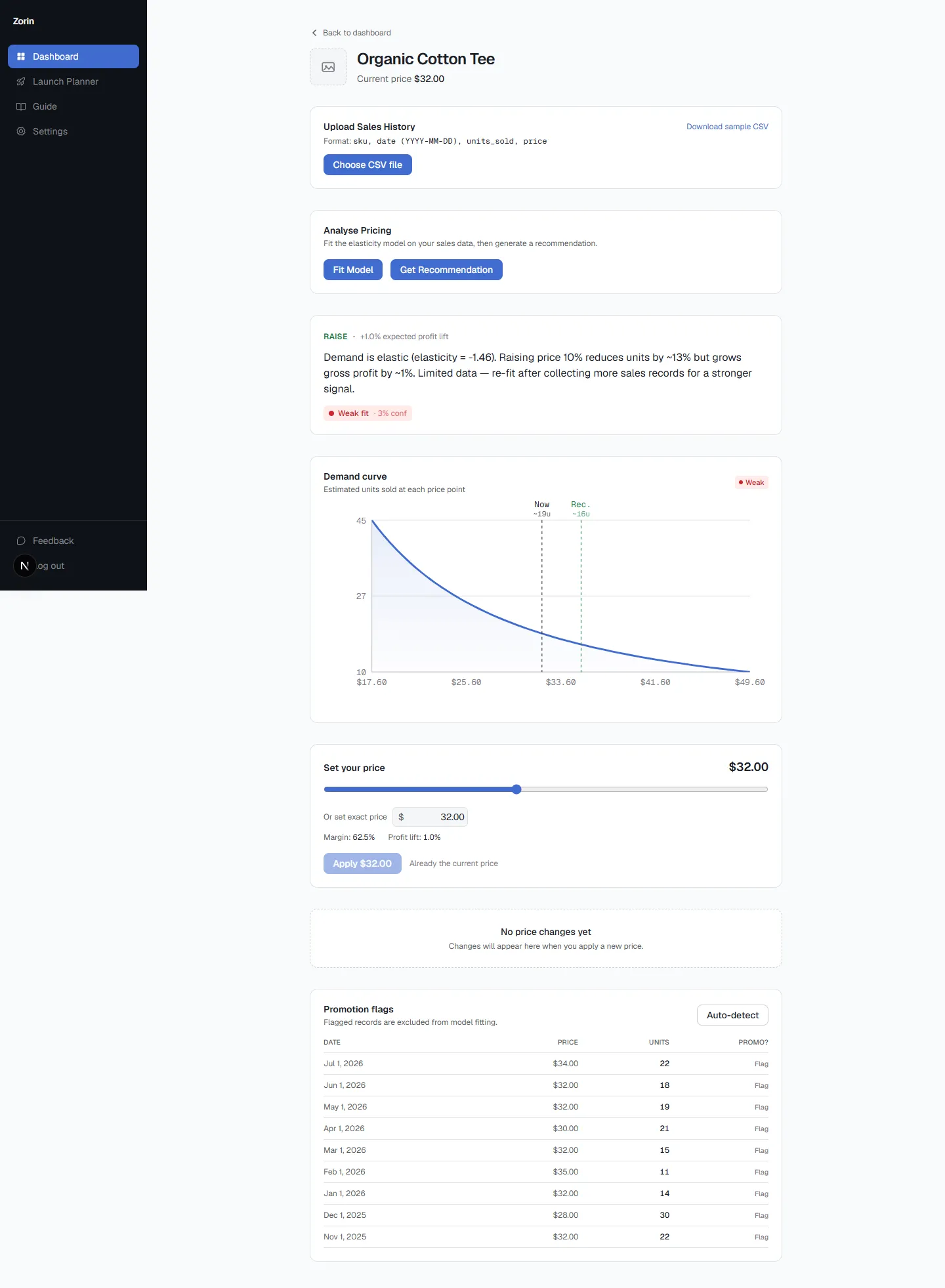
Zorin isn't a competitor price tracker, and it doesn't scrape competitor sites. It answers the other half of the question: how your own customers respond to your prices. It fits a price elasticity model for each product from your Shopify or WooCommerce sales history and recommends raise, lower or hold with an estimated profit impact and a confidence score. You can log the competitor prices you know about for each product and see their minimum, median and maximum next to the recommendation. Many stores use a tracker to see the market and a demand model to decide whether a competitor's move actually matters. Pricing is published, from $39 to $249 a month depending on catalog size.
Key Takeaways
- Check Google Merchant Center's price benchmarks first if your products have GTINs; they cost nothing extra.
- Prisync is the simplest self-serve tracker for SMB stores, from $99 a month for 100 products.
- Price2Spy suits brands that need MAP monitoring and screenshot evidence; repricing and matching are add-ons.
- Omnia Retail (from €399 a month) and Competera (quote only) combine tracking with automated or enterprise-level pricing.
- A tracker only pays when competitors sell the same products; pair it with a demand model to decide when to react.
Frequently Asked Questions
What is the best competitor price tracking software for small businesses?
For most small Shopify or WooCommerce stores, Prisync is the easiest starting point, with published plans from $99 a month for 100 products and a 14-day free trial. If your products have GTINs and appear on Google Shopping, Merchant Center's price benchmarks may be enough on their own.
Is there free competitor price tracking software?
Google Merchant Center shows benchmark prices for products with valid GTINs that other retailers also sell on Google, as part of its analytics. Most dedicated tools offer free trials rather than free plans.
What is the difference between price tracking and repricing software?
Price tracking software monitors competitor prices and alerts you to changes. Repricing software goes further and changes your prices automatically based on rules. Many tools offer both, often with repricing on higher tiers or as an add-on.
How often should competitor prices be checked?
For most ecommerce categories, one to three checks a day is enough. Fast-moving marketplaces with many sellers on the same listing may justify more frequent checks, which usually cost more.
Do I need competitor price tracking if I sell my own brand?
Often not. If competitors don't sell the same product, there's no direct price to track. Your own sales data and customer research usually tell you more about the right price than a competitor's similar-but-different product.
Does Zorin track competitor prices?
Not automatically. Zorin models how your own customers respond to price from your sales history. You can record competitor prices manually for each product and see their range next to Zorin's recommendation.
The best competitor price tracking software is the one that matches how much real overlap you have with competitors, and how often you need to react. Whatever tracker you choose, the decision to match or hold is easier when you know how your own customers respond. Try Zorin free to see that for every product in your catalog.
Written by Dexter
Dexter is part of the team at Zorin, building tools that help ecommerce merchants price with data instead of guesswork.
More in Pricing Tools & Software
View all →Pricefx Alternatives & Competitors: 5 Options
Pricefx alternatives by business type: Zilliant and Vendavo for B2B, Competera and Omnia Retail for retail, and Zorin for Shopify and WooCommerce stores.
MAP Pricing Software: Monitoring & Compliance Guide
What MAP pricing software does, the legal frame, when manual MAP monitoring stops working, a 7-step compliance process and questions to ask vendors.
Price Management Software: A Buyer's Guide
What price management software does, how it differs from price optimization, when a store needs one, a worked cost example and the guardrails to insist on.