MAP Pricing Software: Monitoring & Compliance Guide
MAP pricing software monitors the prices your resellers advertise online, flags anything below your minimum advertised price (MAP), captures evidence and helps you enforce your policy consistently. Brands need it once they have more listings than anyone can check by hand, which happens quickly with a few dozen resellers and marketplaces. The software handles detection; MAP pricing compliance still depends on a clear written policy and enforcing it the same way every time.
What MAP Pricing Software Does
A minimum advertised price is the lowest price a brand allows resellers to advertise for a product. (The basics, including how MAP differs from MSRP, are in our guide to minimum advertised price.) MAP pricing software, also called MAP monitoring software, automates the policing:
| Feature | What it does | Why it matters |
|---|---|---|
| Listing coverage | Scans reseller websites, marketplaces like Amazon, eBay and Walmart, and shopping feeds like Google Shopping | Violations happen wherever prices are shown |
| Product matching | Matches each listing to your SKU, including variants and bundles | A wrong match creates false violations |
| Seller identification | Names the seller behind each listing, including unauthorized ones | You can't enforce against a seller you can't identify |
| Evidence capture | Saves timestamped screenshots of each violation | Proof when you send a notice or suspend a reseller |
| Alerts and frequency | Checks prices daily or more often and alerts you to new violations | A violation left for a week spreads to other sellers |
| Enforcement workflow | Tracks notices sent, repeat offenders and resolution | Consistent enforcement is what makes a policy stick |
| Reporting | Shows compliance rates by reseller, channel and product over time | Tells you whether the policy is working |
The Legal Frame You're Working Within
MAP software is a monitoring tool; the policy it monitors has to be built correctly. In the U.S., two Supreme Court decisions shape it. United States v. Colgate & Co. (1919) is the basis for a manufacturer's right to announce a pricing policy on its own and choose not to deal with resellers who don't follow it. Leegin Creative Leather Products v. PSKS (2007) held that vertical price restraints are judged under the rule of reason rather than being automatically illegal.
The FTC's guidance on manufacturer-imposed requirements adds a caution: it has challenged MAP policies that banned discounted prices even in ads retailers paid for themselves. Some states also treat minimum pricing agreements more strictly than federal law. The practical takeaway is to keep MAP a unilateral policy about advertised prices, not a negotiated agreement about selling prices, and to get legal advice when you write it. This is general information, not legal advice.
Worked Example: When Manual Monitoring Stops Working
A kitchenware brand sells 120 SKUs through 40 authorized online resellers, plus whoever lists its products on Amazon and eBay.
- Listings to check: 120 SKUs × 40 resellers = 4,800 potential listings, before marketplaces.
- Manual effort: at 30 seconds a listing, one full check takes 40 hours. Weekly checks would be a full-time job; daily checks are impossible.
- Cost of a missed violation: a $120 blender has a $120 MAP and a $66 wholesale price, so resellers earn $54 a unit. One reseller advertises it at $99. Within a week, three others match. Those four sell 150 units a month between them, and the brand's other retailers, now making $33 instead of $54 on every sale they match, start cutting their reorders.
The direct loss here falls on the resellers, $21 a unit, or $3,150 a month across 150 units. The real loss to the brand is the damage to its retail network and its price position, which is why speed of detection matters. A tool that checks daily and flags the first violation lets you act before it spreads.
See what Zorin's elasticity model says about your own catalog.
Start free trialMAP Pricing Compliance: A Step-by-Step Process
- Write a clear unilateral policy. Define which products are covered, what counts as an advertised price (product pages, ads, emails, marketplace listings), what doesn't (the price in a shopping cart, in many policies), and the consequences.
- Keep an up-to-date MAP list by SKU. Monitoring tools need the exact MAP for each product and variant.
- Monitor every channel your products appear on. Include marketplaces and shopping feeds, not just reseller sites.
- Capture evidence automatically. Timestamped screenshots make enforcement straightforward.
- Enforce the same way every time. A standard sequence, such as notice, then a short suspension, then termination, applied to every reseller regardless of size.
- Deal with unauthorized sellers separately. Sellers without an account aren't bound by your policy, so tracing their supply and using marketplace brand tools is a different process.
- Review compliance monthly. Look for repeat offenders, channels that drift and products where MAP may be set unrealistically high.
How to Choose MAP Pricing Software
Dedicated MAP monitoring tools and broader price-tracking tools both offer MAP features. Price tracking tools often include it only on higher plans; for example, Prisync's published pricing lists MAP monitoring for suppliers in its Platinum tier. Questions to ask any vendor:
- Which marketplaces, sites and shopping feeds does it cover, and how often does it check?
- How accurate is product matching for variants, bundles and multipacks?
- Can it identify the seller behind each marketplace listing?
- Does it capture timestamped screenshots automatically?
- Does it include an enforcement workflow, or just a list of violations?
- How is it priced: by SKU, by seller, by channel or by check frequency?
For a broader look at competitor and price monitoring tools, see Prisync alternatives and whether you need a competitor price tracking app.
For Resellers: Pricing Inside a MAP Policy
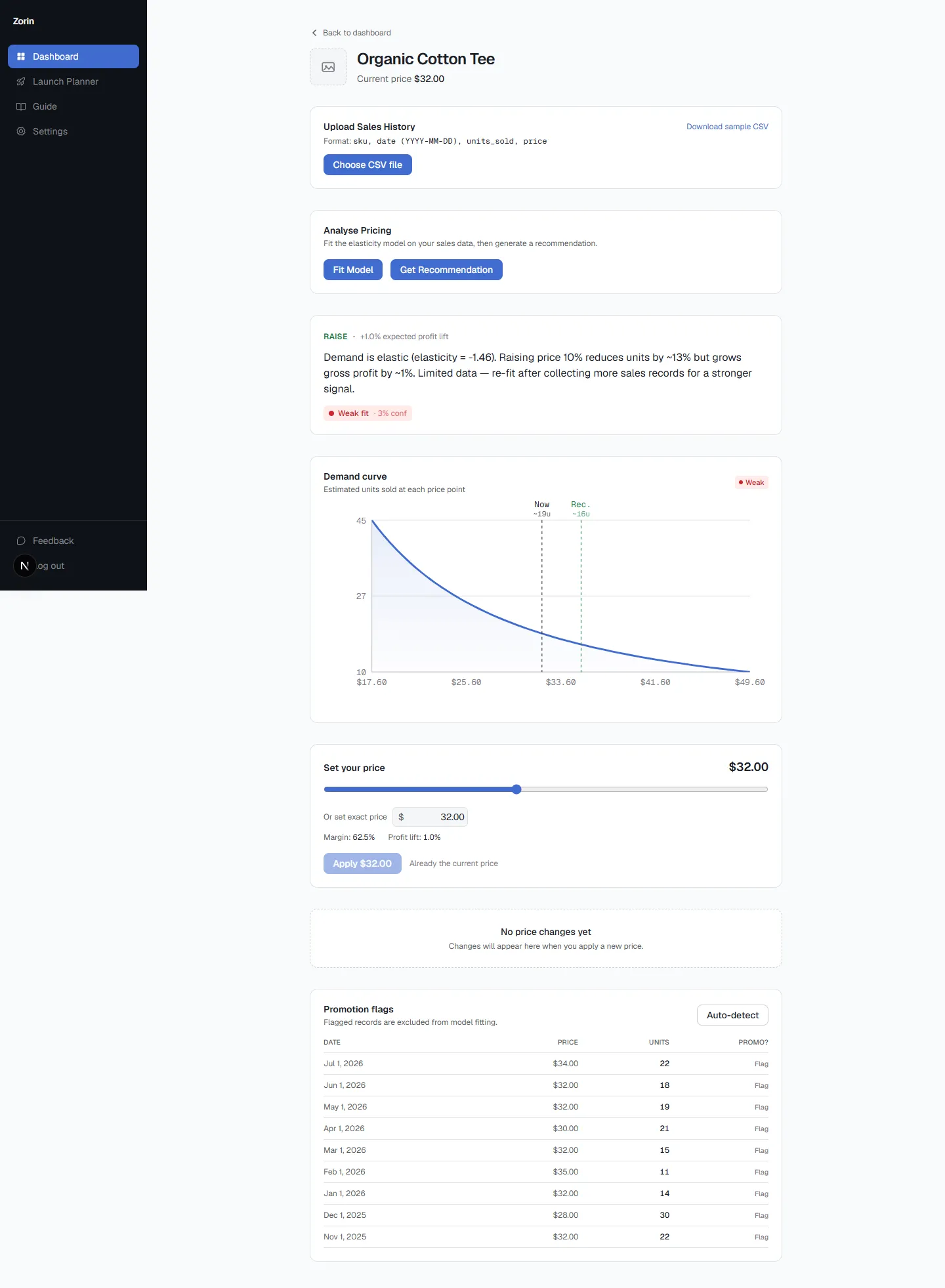
If you're a reseller rather than a brand, MAP limits how low you can advertise, but not whether you should sit at MAP or above it. Some products sell just as well a little above MAP; others need to sit right at it to compete. That's a demand question. Zorin reads your Shopify or WooCommerce sales history, fits a price elasticity model for each product and recommends raise, lower or hold with an estimated profit impact. It isn't a MAP monitoring tool and doesn't scan reseller sites; it helps you choose the most profitable price within the rules you have to follow.
Key Takeaways
- MAP pricing software scans reseller sites, marketplaces and shopping feeds for prices advertised below your minimum advertised price.
- Key features are coverage, accurate product matching, seller identification, screenshot evidence, alerts and an enforcement workflow.
- Colgate (1919) supports unilateral pricing policies, and Leegin (2007) put vertical price restraints under the rule of reason.
- With 120 SKUs and 40 resellers, one manual check takes about 40 hours, which is why brands automate monitoring.
- Software detects violations; compliance comes from a clear written policy enforced the same way every time.
Frequently Asked Questions
What is MAP pricing software?
It's software that monitors the prices resellers advertise online, compares them with your minimum advertised price for each product, flags violations with evidence and helps you track enforcement.
What is MAP pricing compliance?
MAP compliance means resellers advertise your products at or above the minimum advertised price set in your policy. Brands maintain it by monitoring listings, documenting violations and applying the same consequences to every reseller who breaks the policy.
Is MAP pricing legal?
In the U.S., a unilateral MAP policy covering advertised prices is generally lawful under the Colgate doctrine, and vertical price restraints are judged under the rule of reason since Leegin. The FTC has challenged overly broad MAP programs, and some states are stricter, so have the policy reviewed by a lawyer. This is general information, not legal advice.
How do brands monitor MAP violations?
Most use MAP monitoring software that checks reseller sites, marketplaces and shopping feeds daily, matches listings to SKUs, identifies the seller and saves screenshots. Small brands with few resellers sometimes check manually, but that stops scaling quickly.
Does MAP apply to the price in the shopping cart?
Many MAP policies cover only advertised prices, so a lower price shown in the cart or at checkout may be allowed. It depends on how your policy defines an advertised price, so spell it out clearly.
Can MAP software stop unauthorized sellers?
It can identify them, but unauthorized sellers haven't agreed to your policy, so MAP enforcement doesn't apply to them directly. Brands usually trace where the stock came from and use marketplace brand protection programs instead.
MAP pricing software turns an impossible manual check into a daily report you can act on, but it only protects your price if your policy is clear and your enforcement is consistent. If you sell within a MAP policy and want to know where each product should sit above the minimum, try Zorin free with your own sales data.
Written by Dexter
Dexter is part of the team at Zorin, building tools that help ecommerce merchants price with data instead of guesswork.
More in Pricing Tools & Software
View all →Price Management Software: A Buyer's Guide
What price management software does, how it differs from price optimization, when a store needs one, a worked cost example and the guardrails to insist on.
Best Dynamic Pricing Software for Ecommerce (2026)
Best dynamic pricing software for ecommerce compared: repricers, rule engines, price testing and demand-based tools, with 2026 prices and who each suits.
AI Pricing Software: How It Works and What to Ask
AI pricing software explained: the four types, how AI price optimization works, a worked example, the antitrust and model risks, and 8 questions to ask.