Prisync Alternatives & Competitors: 4 Options
Prisync is a legitimate, well-reviewed tool at what it actually does: tracking competitor prices across your storefront, Amazon, eBay, and Google Shopping, then applying rules to match or undercut them. The search for an alternative usually isn't about the tool failing at that job, it's one of a few specific gaps: scraping that misses a competitor's price when their site structure changes, no built-in MAP violation monitoring, an API surcharge on top of an already tiered plan, or simply wanting a demand read instead of a competitor-reaction one. Here are four real alternatives, with published pricing where it exists.
The Quick Answer
If what you actually want is a read on what your own customers will pay rather than a reaction to competitor prices, Zorin is the closest self-serve fit. If competitor monitoring is still the job but you want more frequent checks or a different add-on structure, Price2Spy is worth comparing directly (a wider roundup is in best competitor price tracking software). If you're selling across many marketplaces and need deeper rule automation than Prisync's tiers offer, Omnia Retail reaches further, at a higher price. If your catalog has genuine cross-category effects and real elasticity modeling matters more than cost, Competera is the enterprise option.
What's Actually Driving the "Prisync Alternative" Search
Prisync's published pricing runs three separate models, URL-based, channel-based, and hybrid, each with Professional, Premium, and Platinum tiers. The URL-based Professional plan starts at $99 a month for up to 100 products; Premium, at $199 a month, adds a dynamic repricing engine and daily notifications; Platinum, at $399, adds instant notifications, price history and MAP monitoring for suppliers. Channel-based monitoring, tracking prices on specific marketplaces rather than a fixed URL list, starts higher and adds $100 to $200 a month per additional channel, and API access adds a further 20% surcharge on top of any tier. The product itself holds strong review scores, 4.7 out of 5 on G2 across 168 reviews and 4.8 on Capterra across 129 reviews, but the most common complaint across those same review platforms is scraping reliability: competitor sites that change structure can quietly stop returning accurate data, and MAP violation monitoring isn't included below the top tier. None of that makes Prisync a bad tool, it just means the reasons someone goes looking for an alternative are usually specific rather than a wholesale rejection of the category.
1. Zorin: Demand Modeling Instead of Competitor Reaction
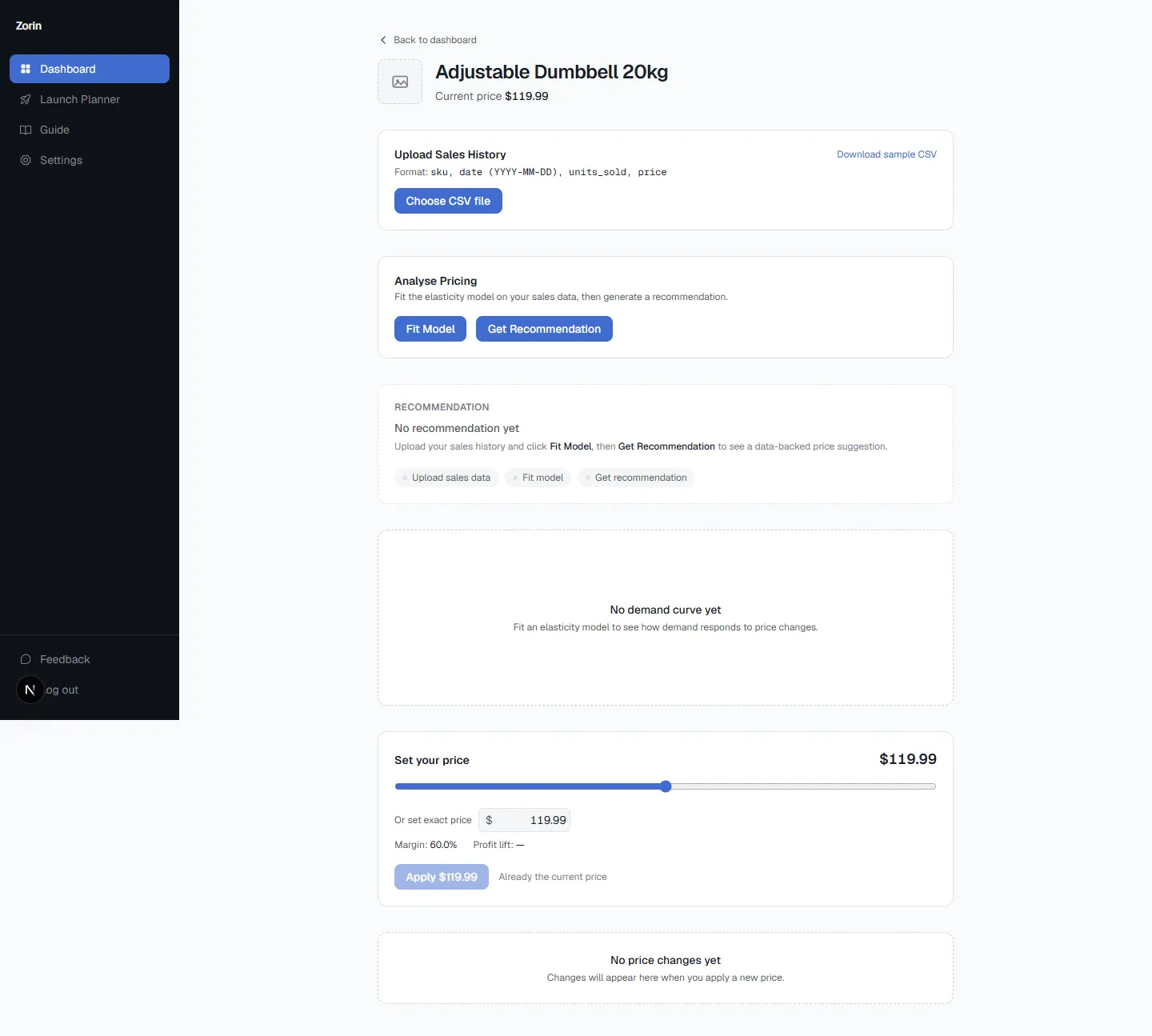
Zorin connects to Shopify or WooCommerce, or takes a CSV upload, and fits a price elasticity model to your own price-and-quantity history only, per SKU, with no competitor or marketplace data involved at all. The output is a plain raise, lower, or hold recommendation, an estimated profit lift, and an R²-based confidence score so a thin-data product is never presented with the same certainty as an established one. Nothing applies automatically, every change goes through manual review first. Pricing is published and flat regardless of monitoring channel: $39 to $249 a month depending on catalog size, no per-channel add-on and no API surcharge. The real limitation next to Prisync: Zorin's competitor feature is a manual per-product entry, name, price, optional URL, not a live-monitoring subscription, so it doesn't solve the "am I still priced-in on Amazon" problem at all.
2. Price2Spy: A Second Competitor-Tracking Option
If competitor visibility is still the actual job, Price2Spy is a longer-running player in the same category, founded in 2010, serving 750-plus clients across 40-plus countries with a 4.8 out of 5 rating on G2 from 104 reviews. It checks prices up to 8 times a day on its higher tiers, more frequently than Prisync's 3x, and integrates directly with five ecommerce platforms including Shopify and WooCommerce. Price2Spy's pricing page no longer lists dollar amounts: it offers Starter and Basic tiers with a 14-day free trial, a Premium tier priced on request, and Repricing, Automatch and screenshot capture as separately priced modules. Get a quote for the full workflow you need and compare it directly against whichever Prisync tier you're on rather than assuming the base tier tells the whole story.
Ready to see your own numbers?
Start your free trial3. Omnia Retail: Deeper Automation for Multi-Marketplace Sellers
For a catalog that's outgrown Prisync's rule depth, Omnia Retail monitors live prices across Amazon, eBay, Google Shopping, Bol.com, Kaufland, and custom domains, then automates repricing through what it calls a "Pricing Strategy Tree", layering custom rules across market, segment, and SKU level. An "Omnia Agent" explains the reasoning behind each repricing move. It's branded as "AI Dynamic Pricing," but the AI explains competitor-reactive rule logic, not a demand model, worth knowing going in. Omnia's SMB tier starts at €399 a month for a single shop, and a demo call is required either way, there's no self-serve signup. It holds a 4.4 out of 5 rating on G2 across 110 reviews. A real step up in rule sophistication, at a real step up in price and onboarding friction.
4. Competera: Enterprise Elasticity Modeling
If the actual gap is that Prisync only reacts to competitors and never models your own demand, Competera is the enterprise-grade version of that answer. It runs real elasticity-based pricing driven by more than 20 pricing and non-pricing factors, what Competera describes as "second-generation AI pricing" using recurrent neural networks. There's no published pricing, access is request-only and scoped to catalog size and market count, typically a slower and more expensive path than either Prisync or Price2Spy. It holds a 4.9 out of 5 rating on G2 across 14 reviews, with a reviewer mix that's less enterprise-only than the pricing model suggests, worth knowing if budget is the main hesitation, though the sales process itself still isn't self-serve.
Where Zorin Fits on This List
Zorin is the option built for a merchant who's decided the actual question isn't "what are my competitors charging" but "what would my own customers actually pay." It doesn't replace Prisync's live competitor monitoring, if marketplace price position genuinely decides the sale for a chunk of your catalog, that gap is real and worth naming rather than glossing over. What it does offer is a self-serve path from signup to a first recommendation, published flat pricing with no per-channel or API surcharge, and a confidence score on every read so a newer SKU with thin sales history isn't presented with false certainty. For a Shopify or WooCommerce store where the real question is about demand rather than competitor reaction, that's usually the better starting point.
Frequently Asked Questions
What's a good Prisync alternative for demand-based pricing instead of competitor tracking?
Zorin. It fits an elasticity model to your own sales history per SKU instead of tracking and reacting to competitor prices, with published pricing and no per-channel or API surcharge.
Does Prisync do any elasticity or demand modeling?
No. Prisync tracks competitor prices across your storefront and marketplaces and applies rules to match or undercut them. It's a real, well-reviewed tool at that job, but it doesn't model what your own customers would pay.
Why do Prisync's higher tiers cost so much more than the base price?
Channel-based monitoring adds $100 to $200 a month per additional marketplace channel beyond the first, and API access adds a further 20% surcharge on any tier, on top of the base Professional-to-Platinum jump for higher product limits and features like MAP monitoring.
Is Price2Spy actually cheaper than Prisync?
It depends on the modules you need. Price2Spy no longer publishes dollar prices, and its Repricing and Automatch features are separately priced modules, while Prisync's plans start at $99 a month with repricing included from its $199 tier. The real cost once you need the full repricing workflow should be compared directly rather than assumed from the base tier alone.
Which Prisync alternative handles the most marketplaces?
Omnia Retail, with live monitoring across Amazon, eBay, Google Shopping, Bol.com, Kaufland, and custom domains, plus deeper rule automation than Prisync's tiers. It costs more and requires a demo call to sign up.
Prisync does one job well: tracking and reacting to competitor prices. The alternatives above split into two groups, tools that do that same job with a different price or feature tradeoff (Price2Spy, Omnia Retail), and tools that answer a different question entirely, what your own customers would actually pay (Zorin, Competera). If it's the second question you're actually asking, Zorin gets you a self-serve answer without a demo call or a custom quote standing in the way.
Written by Dexter
Dexter is part of the team at Zorin, building tools that help ecommerce merchants price with data instead of guesswork.