How AI Pricing Software Handles Promotions
Good AI pricing software treats promotional prices and regular prices as different kinds of data. A sale week is not just "a lower price"; it also carries ad spend, urgency, stockpiling and a dip in sales afterwards, none of which tells you how customers respond to your everyday price. If the software learns from those weeks as if they were normal, it overestimates how price-sensitive a product is and recommends prices that are too low. The tools worth trusting detect or let you flag promotions, keep them out of the demand model, and show you what they excluded.
Why Promotions Confuse a Pricing Model
Most AI pricing tools learn a product's price elasticity, how much sales move when the price moves, from your own sales history. That only works if each week's sales reflect the price that week. A promotion breaks that assumption in three ways:
- The spike is bigger than the price cut explains. A 20% off sale comes with an email blast, a banner and a deadline. Some of the extra sales come from the attention, not the price.
- Some of the spike is borrowed from later weeks. Shoppers stock up during the sale and buy less afterwards. Research by Harald van Heerde, Peter Leeflang and Dick Wittink in the Journal of Marketing Research showed these pre- and post-promotion dips are real but hard to see in store-level data without models built specifically to capture them.
- Not all of the spike is new demand. In a follow-up study, van Heerde, Gupta and Wittink found that only about a third of the unit sales bump from a promotion came from shoppers switching brands; the rest came from people buying sooner or buying more. A model that reads the whole bump as "customers love a lower price" is crediting price with effects that belong to timing and stockpiling.
Worked Example: Same Product, Opposite Recommendations
A product normally sells for $30 and costs $12. Over ten weeks it sold around 100 units a week at $30, around 111 a week during a few weeks at $27, then 260 units in a 20% off promotion week at $24, followed by a slow week of 60 units back at $30 as stocked-up customers stayed away.
| Model trained on every week | Model with the promo week and the dip flagged | |
|---|---|---|
| Estimated elasticity | -3.77 (very price-sensitive) | -0.94 (not very price-sensitive) |
| Fit (R-squared) | 0.67 | 0.88 |
| Predicted weekly profit at $27 | $1,970 | $1,665 |
| Predicted weekly profit at $30 | $1,589 | $1,810 |
| Predicted weekly profit at $33 | $1,294 | $1,932 |
| Recommendation | Cut the price to $27 | Raise the price to $33 |
Two weeks out of ten flipped the answer. Trained on everything, the model sees a huge sales jump at $24 and concludes customers are extremely price-sensitive, so it recommends a permanent cut. With those weeks set aside, the regular-price weeks tell a different story: sales barely move between $27 and $30, so there is room to go up. Removing only the sale week but keeping the post-sale dip is not enough either; in this data it still produces an elasticity of -1.75 with a fit of just 0.23, a weak read that a good tool should label as low confidence.
The cost of getting this wrong is ongoing. Acting on the first model means pricing the product 10% below its regular price every week, giving up margin to chase a price sensitivity that only existed during the sale.
How Good AI Pricing Software Handles Promotions
| Approach | How it works | Strength | Watch out for |
|---|---|---|---|
| Automatic outlier detection | Flags weeks where sales sit far above what the model predicts for that price | Catches promotions you forgot to record | Misses dips after a sale and quiet promotions |
| Manual promotion flags | You mark sale weeks, launches or stockouts yourself | Uses knowledge only you have | Only as good as your records |
| Promotion as a separate input | The model includes "was this week promoted?" alongside price | Estimates the promotion lift separately from the price effect | Needs many promotions to learn from, usually enterprise tools |
| Ignoring promotions | Every week treated as a normal price point | Simple | Overstates price sensitivity and pushes prices down |
Whichever approach a tool uses, the result should be visible. You should be able to see which weeks were excluded and why, and change the decision if the software got it wrong.
See what Zorin's elasticity model says about your own catalog.
Start free trialQuestions to Ask a Vendor About Promotions
- Does the model separate promotional weeks from regular-price weeks? If the answer is "it learns from all your data", ask what stops a sale from dragging the recommendation down.
- How are promotions detected? Automatically, by your flags, by discount codes from your store, or not at all?
- What happens to the weeks after a sale? Ask whether post-promotion dips are recognized, or whether a slow week after a sale is read as customers rejecting the regular price.
- Can I see and override what was excluded? A list of flagged weeks you can toggle is the minimum.
- Does the confidence score change when promotions are removed? Removing weeks leaves less data, and an honest tool says so.
- Will it recommend running promotions, or only regular prices? Most demand-based tools optimize the everyday price; promotion planning is a separate job.
For the wider checklist, see AI pricing software: how it works and what to ask.
What This Looks Like in a Real Tool
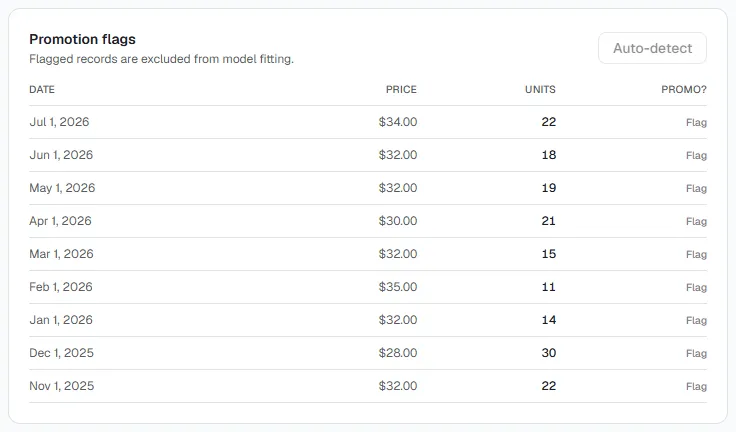
In Zorin, each product's demand model is fitted only on sales weeks that aren't flagged as promotions. An Auto-detect button compares every week against the fitted model and flags weeks whose sales sit more than two standard deviations above what the price alone would predict, which catches most sale spikes. Because automatic detection looks for spikes, it won't catch a slow week after a sale, so you can also flag or unflag any week yourself. When the model is refitted, the confidence score is calculated from the weeks that remain, so a product that loses a lot of data to promotions is shown as less certain rather than presented with false precision.
Running promotions well is its own discipline. If you're planning one, see how to run a sale without wrecking your margin and which products actually deserve a discount.
Key Takeaways
- Promotional weeks carry ad spend, urgency and stockpiling, so they don't show how customers respond to your regular price.
- Research found only about a third of a promotion's unit bump comes from brand switching; the rest is shoppers buying sooner or buying more.
- In the worked example, including one sale week and its dip turned an elasticity of -0.94 into -3.77 and flipped the recommendation from a raise to a cut.
- Good AI pricing software detects or lets you flag promotions, excludes them from the demand model and shows what it excluded.
- Ask vendors how they handle post-sale dips and whether confidence drops when promotional weeks are removed.
Frequently Asked Questions
How does AI pricing software handle promotional vs regular pricing?
Good tools separate them. They detect or let you flag promotional weeks, leave those weeks out of the model that estimates price sensitivity, and base recommendations on how sales respond to regular prices. Some enterprise tools also model the promotion lift separately so it can be planned.
Why should promotions be excluded from a pricing model?
Because a promotion's sales spike includes effects that have nothing to do with the everyday price, such as advertising, deadlines and stockpiling. Left in, those weeks make a product look much more price-sensitive than it is and push recommendations too low.
What is a post-promotion dip?
It's the drop in sales in the weeks after a sale, when customers who stocked up during the promotion buy less. If a pricing model doesn't recognize it, it can wrongly read the slow week as customers rejecting the regular price.
Can AI pricing software detect promotions automatically?
Many tools can flag weeks where sales sit far above what the price alone predicts. Automatic detection usually catches sale spikes but can miss quiet promotions and post-sale dips, so a manual way to flag and unflag weeks is important.
Does excluding promotions make a pricing recommendation less reliable?
It leaves fewer weeks of data, so confidence can fall, but the estimate is usually more accurate because it reflects regular-price behavior. An honest tool shows the lower confidence instead of hiding it.
Will AI pricing software tell me when to run a sale?
Most demand-based tools optimize your everyday price rather than plan promotions. They can tell you which products are price-sensitive enough that a discount is likely to pay off, but timing and depth of promotions are usually a separate decision.
Promotions are where most pricing models quietly go wrong, because a sale week looks like proof that customers want a lower price. Software that separates sale weeks from regular weeks gives you a truer read and a better price. To see how your own products respond once promotions are set aside, start a free Zorin trial.
Written by Dexter
Dexter is part of the team at Zorin, building tools that help ecommerce merchants price with data instead of guesswork.
More in Pricing Tools & Software
View all →Pricing Simulation Tools: Test a Price First
A pricing simulation tool predicts units, revenue and profit at a new price. The types, a worked 4-price simulation, and how to tell if one is trustworthy.
Best Competitor Price Tracking Software (2026)
The best competitor price tracking software compared: Google's free benchmarks, Prisync, Price2Spy, Omnia Retail and Competera, with prices and fit.
Pricefx Alternatives & Competitors: 5 Options
Pricefx alternatives by business type: Zilliant and Vendavo for B2B, Competera and Omnia Retail for retail, and Zorin for Shopify and WooCommerce stores.