Competera Alternatives for Smaller Stores (2026)
Competera shows up in a lot of "enterprise pricing platform" searches, and for good reason, its elasticity modeling is real and genuinely sophisticated. The reason people go looking for an alternative almost always comes down to one of two things: pricing that's request-only and typically runs into six figures annually, or an onboarding process built around weeks of ERP integration that assumes a dedicated pricing team is already in place. If either of those doesn't match your store, here are four real alternatives, with published pricing where it exists.
The Quick Answer
If you're a self-serve Shopify or WooCommerce merchant who wants per-SKU elasticity modeling without a sales call, Zorin is the closest fit. If your catalog has genuine cross-category effects and you're prepared to shop a custom quote anyway, Symson does elasticity too and is worth a look. If your actual problem is competitor visibility rather than demand modeling, Prisync and Price2Spy both do that on published, self-serve pricing.
What's Actually Driving the "Competera Alternative" Search
Competera's own pricing page doesn't list plans or a starting price, access is request-only, scoped to catalog size, number of markets, and the level of AI optimization required. The platform itself is real: elasticity-based pricing driven by demand patterns and more than 20 pricing and non-pricing factors, what Competera describes as "second-generation AI pricing" using recurrent neural networks rather than simple elasticity correlation. It holds a 4.9 out of 5 rating on G2 across 14 reviews, and worth noting honestly since it cuts against the pure-enterprise assumption: G2's own reviewer breakdown shows 41.7% of reviewers come from small businesses (50 employees or fewer), another 41.7% from mid-market, and only 16.7% from enterprise accounts. So Competera isn't strictly closed off to smaller teams, but the quote-only pricing and integration-heavy onboarding still make it a slower, less predictable starting point than a self-serve tool for a lean team that wants a first answer quickly.
1. Zorin: Self-Serve Elasticity for SMB Catalogs
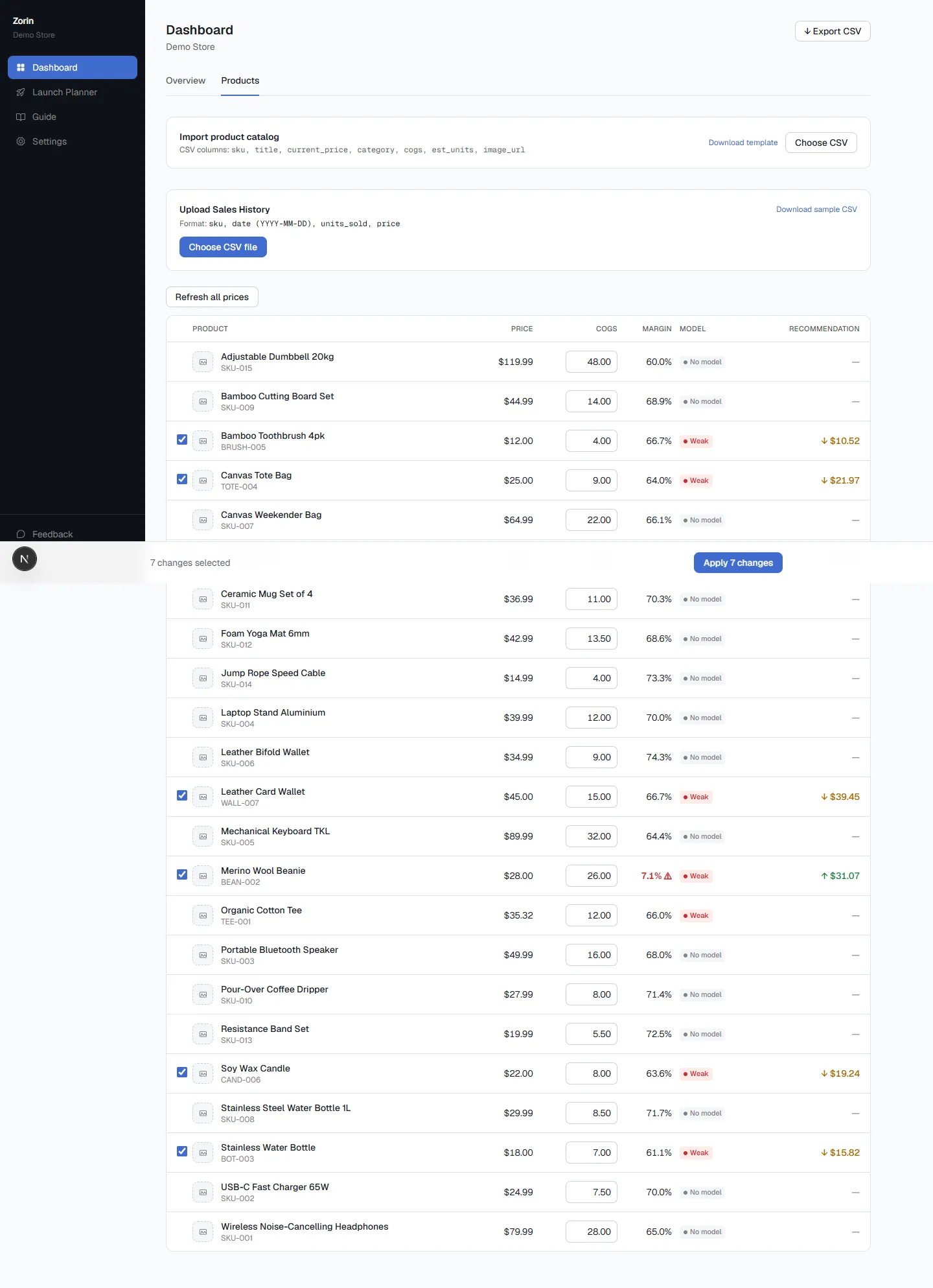
Zorin connects to Shopify or WooCommerce, or takes a CSV upload, and fits a price elasticity model to your own sales history per SKU, no ERP integration or model-training period. The output is a raise, lower, or hold recommendation with an estimated profit lift and an R²-based confidence score, and nothing applies automatically, every change goes through manual review first. Pricing is published: $39 to $249 a month depending on catalog size. The real limitation next to Competera: no cross-category effects modeling and no automated competitor tracking, Zorin's competitor feature is a manual per-product entry, not a live monitoring subscription.
2. Symson: Elasticity With Cross-Category Modeling
Symson is the closer mechanism match to Competera on this list: real elasticity modeling from a merchant's own sales data, blended with scraped competitor prices and seasonality, with cross-elasticity modeling across category "Key Value Items" for commodity assortments where discounting one product visibly shifts demand for another. Like Competera, there's no published pricing, access starts with a demo request. It's a genuine alternative if the cross-category depth is what you need and you're prepared to go through a sales process either way, just a different vendor to shop that quote against.
Ready to see your own numbers?
Start your free trial3. Prisync: Competitor Tracking and Repricing on Published Pricing
If the actual problem is staying visible against competitor listings rather than modeling your own demand, Prisync tracks competitor prices across your storefront, Amazon, eBay, and Google Shopping, with automatic repricing rules on its higher tiers. Published pricing runs $99 a month for up to 100 products, up to $399 a month for 5,000 products, self-serve, no demo required. No elasticity or demand modeling, this solves a different problem than Competera does, but it's a real, cheaper, faster-to-start option for the SKUs where marketplace price position is genuinely what decides the sale.
4. Price2Spy: A Second Repricing Option, Broader Platform Coverage
Price2Spy is a longer-running player in the same category as Prisync, founded in 2010, serving 750-plus clients across 40-plus countries, with a 4.8 out of 5 rating on G2 from 104 reviews. It covers competitor price tracking, custom repricing formulas that can run in hierarchical order, and integrates directly with five ecommerce platforms including Shopify and WooCommerce. Its pricing page lists Starter and Basic tiers with a 14-day free trial and a Premium tier on request, with Repricing and Automatch sold as separately priced modules that raise the real monthly cost once you need the full repricing workflow. Worth comparing directly against Prisync rather than assuming they're interchangeable, the add-on structure changes the real price at scale.
Where Zorin Fits on This List
Zorin is the option built specifically for a merchant who wants Competera's core idea, elasticity modeling from real data, without the enterprise sales process or the six-figure budget. It's not a smaller Competera in every dimension: no cross-category modeling, no built-in competitor scraping, no what-if scenario simulator. What it does offer is a direct path from signup to a first recommendation, published pricing, and a confidence score on every read so a newer SKU with thin data isn't presented with false certainty. For an independent or SMB Shopify or WooCommerce store, that tradeoff is usually the right one.
Frequently Asked Questions
What's a good Competera alternative for a small Shopify or WooCommerce store?
Zorin is the closest self-serve match: per-SKU elasticity modeling from your own sales history, published pricing, no ERP integration or sales call required to get started.
Does Competera publish its pricing anywhere?
No. Competera's pricing is request-only, scoped to catalog size, number of markets, and the level of AI optimization needed. There's no published starting price or free trial.
Is Competera only for large enterprise retailers?
Mostly, but not exclusively. G2's own reviewer data shows a meaningful share of small-business reviewers, so it's not a strict enterprise-only product, but the quote-only pricing and integration-heavy onboarding still favor a team with dedicated pricing resources.
What's the difference between Prisync and Price2Spy as Competera alternatives?
Neither does elasticity modeling the way Competera does, both are competitor price tracking and repricing tools instead. Price2Spy integrates with five ecommerce platforms and has add-on pricing for Automatch and Repricing features; Prisync's tiers bundle more of that by default at a higher base price.
Does Symson actually replace what Competera does?
It's the closest mechanism match on this list, real elasticity modeling with cross-category effects, but it shares Competera's quote-only pricing and demo-based onboarding, so it solves the modeling-depth problem without solving the accessibility problem.
Competera's modeling is real, the alternative search usually isn't about doubting the mechanism, it's about pricing and onboarding that don't fit a smaller team. Zorin, Symson, Prisync, and Price2Spy each solve a different piece of what Competera does, at a different price point and level of self-serve access. If the fit you're looking for is elasticity modeling without an enterprise sales process, Zorin is built for exactly that gap. For a direct, feature-by-feature look, see Zorin vs Competera.
Written by Dexter
Dexter is part of the team at Zorin, building tools that help ecommerce merchants price with data instead of guesswork.