How to Run a Price A/B Test the Right Way
A price test you can actually trust needs three things working together: a price change large enough to produce a real signal, a duration long enough to smooth out normal day-to-day noise, and enough traffic to reach genuine statistical significance rather than a result that looks meaningful but isn't. Most small stores get one or two of these right and skip the third without realizing it. This guide covers how long to run a price test, how much to actually change the price, what statistical significance means in plain terms, the real difference between a true A/B test and a simple before/after price change, and whether you need a developer to do any of this. For the trust, fairness, and legal considerations around showing different prices to different customers, price survey vs price testing covers that ground in depth; this post focuses on getting the test itself right.
How Long Should You Run a Price Test
Two weeks is the most commonly cited minimum, and it's a reasonable floor for most stores with meaningful traffic. Guidance varies past that point: some sources recommend running through at least one full business cycle, generally 2 to 4 weeks, to smooth out the normal difference between weekday and weekend shopping behavior, while lower-traffic stores are often advised to run 4 to 8 weeks simply because they need more calendar time to accumulate enough orders to say anything with confidence. There's no single universal number here, the real constraint isn't the calendar, it's whether you've accumulated enough orders to reach significance, which is a volume question as much as a duration one.
Is Your Result Significant Enough to Trust
Statistical significance is really just a measure of how likely your result is to be a real effect rather than random noise. A 95% confidence level, the usual standard, means that if the price change truly had no effect, you'd see a difference this large less than 5% of the time by chance alone. One common way to break that guarantee is checking results every day and stopping the moment they look good; Evan Miller's widely read explainer on A/B test mistakes shows how much that "peeking" inflates false positives. For a high-stakes decision like a permanent price change, some practitioners recommend tightening that to 99% confidence before acting, since the cost of being wrong is higher than it is for a smaller UI test.
Here's where a lot of guidance aimed at large ecommerce brands stops being useful for a small store: some sources cite sample-size thresholds like 30,000 visitors per variant with at least 3,000 conversions before a result counts as valid. That number describes a high-traffic enterprise store, not a typical independent Shopify or WooCommerce seller, and treating it as a universal requirement would mean most small stores could never run a valid price test at all. The more practical bar for a smaller store: at minimum, aim for 100 or more conversions per price variant before drawing a conclusion, and treat anything below that as directional rather than a settled result, similar to how a low-response survey should be read as a rough signal, not a precise number.
How Much to Change the Price
Test a meaningful move, not a token one. The bigger the price change, the fewer orders you need to detect its effect, so a move of roughly 10% or more is usually the practical minimum for a small store; smaller moves risk getting lost in normal day-to-day noise regardless of how long you run the test. A $50 product tested at $52 is unlikely to tell you much of anything useful. The same product tested at $55 to $60 gives you a real chance at reading an actual response.
Volume matters as much as the size of the move. A meaningful price change on your highest-volume product will reach a trustworthy sample size faster than the same percentage move on a slow-selling SKU, simply because more orders accumulate in the same calendar window. If you can only run one test at a time, run it on a product with real, steady sales volume rather than a thin one, even if the thin one is the product you're most curious about.
See what Zorin's elasticity model says about your own catalog.
Start free trialTrue A/B Test vs Before/After Price Change
These get talked about interchangeably, but they're methodologically different, and it's worth being precise about which one you're actually running. A true A/B test shows two different prices to comparable slices of traffic at the same time, randomly assigning visitors to one price or the other so both groups experience identical market conditions (season, promotions, traffic source) simultaneously. A before/after price change, more common in practice for a small store, moves the price once and compares sales in the period after against a prior period at the old price.
The before/after method is operationally far simpler, no traffic-splitting infrastructure required, but it's inherently noisier: anything else that changed between the two periods (seasonality, a competitor's move, a marketing push) gets mixed into the result along with the price effect, and there's no clean way to separate them after the fact. A true split test controls for that by running both prices at once. For most independent stores without the traffic volume or technical setup a true split test requires, the before/after method, run carefully and for long enough to average out short-term noise, is the realistic option, just one that calls for more caution in how confidently you read the result.
Running This Without a Developer or Data Scientist
No-code price-testing apps exist for Shopify specifically if you want to run a true simultaneous split test without engineering help. For most small stores, though, the more practical path is the before/after method applied to sales history you already have, no new app, no traffic-splitting setup, just clean before-and-after data around a real price change. The tradeoff covered above still applies: it's simpler to run, but noisier to interpret, which is exactly why the significance and duration guidance earlier in this post matters more for this method than for a true split test.
When You Don't Have the Traffic to Test
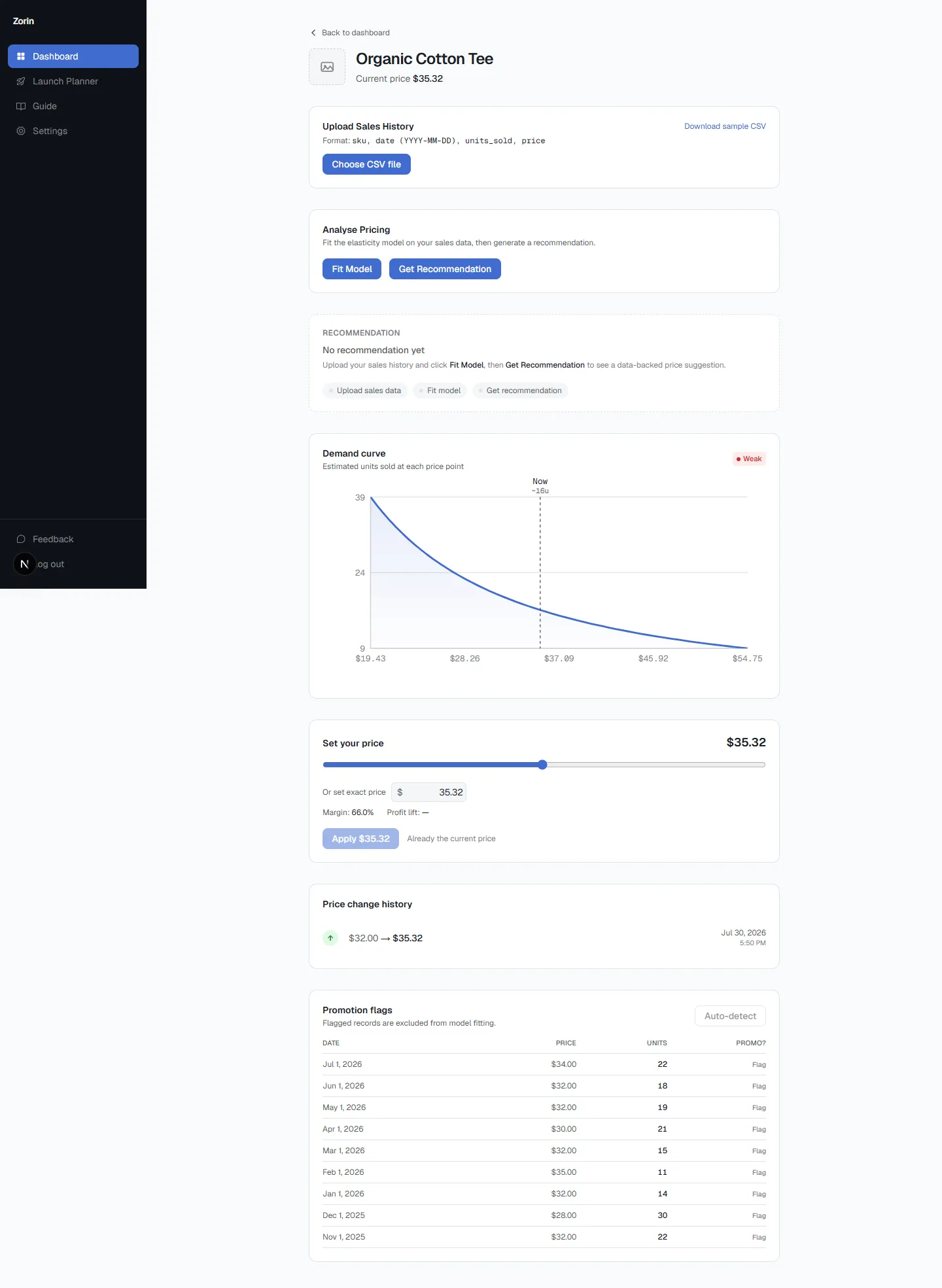
Zorin's elasticity model runs the before/after method automatically and at scale: it fits a regression across every real price point in your Shopify or WooCommerce sales history, not just one before/after comparison, and attaches a confidence label (Strong, Fair, or Weak) that does the same job statistical significance does in a manual test, telling you honestly whether the underlying data supports acting on the result. If you're already thinking in terms of a price test's duration and significance, that's the same question Zorin is answering for every SKU in your catalog automatically.
Key Takeaways
- Run a price test for at least 2 weeks, longer (4-8 weeks) for lower-traffic stores, and treat the duration as a volume question as much as a calendar one.
- Test a meaningful price change, roughly 10% or more, on a high-volume product rather than a token move on a thin one.
- Enterprise-scale sample-size guidance (30,000+ visitors per variant) doesn't apply to most independent stores. Aim for at least 100 conversions per variant as a practical bar, and treat anything below that as directional.
- A true A/B test splits traffic simultaneously; a before/after price change compares periods and is noisier but far more practical for most small stores.
- Zorin runs the before/after method automatically across your full sales history with a confidence label standing in for statistical significance. Start a free trial to see it for your own catalog.
A price test is only as trustworthy as its weakest link, a change too small, a duration too short, or a sample too thin can each quietly undermine an otherwise well-run test. Get all three right, or let Zorin handle the calculation automatically from data you already have. Start a free trial to see your own results.
Frequently Asked Questions
How long should I run a price test before trusting the result?
Two weeks is a common minimum, with 4 to 8 weeks recommended for lower-traffic stores. The real constraint is whether you've accumulated enough orders to reach statistical significance, which is a volume question as much as a duration one, not a fixed number of days that works for every store.
How much should I actually change the price when testing?
Big enough to detect with the orders you have. For most small stores that means a change of roughly 10% or more, because smaller effects need far more orders to separate from noise. Smaller moves risk getting lost in normal day-to-day sales noise, regardless of how long the test runs. Test on a high-volume product where possible, since more orders accumulate faster.
Can I A/B test prices without a developer or data scientist?
Yes. No-code price-testing apps exist for a true simultaneous split test, but for most small stores the more practical path is the before/after method applied to sales history you already have, no new tooling required, just clean data around a real price change.
What's the difference between a true A/B price test and a before/after price change?
A true A/B test shows two prices to comparable traffic at the same time, controlling for anything else that changes. A before/after price change moves the price once and compares periods, which is simpler to run but mixes in any other factor (seasonality, a competitor move) that changed between the two periods along with the price effect.
How do I know if my price test result is statistically significant enough to act on?
A 95% confidence level is standard for most ecommerce tests, tightened to 99% for a high-stakes permanent price change. For a small store, aim for at least 100 conversions per price variant as a practical minimum before drawing a conclusion; enterprise-scale sample-size guidance (30,000+ visitors per variant) describes a different kind of store entirely.
Is a before/after price test as reliable as a true A/B test?
No, it's noisier, since anything else that changed between the two periods gets mixed into the result along with the price effect. It's also far more practical for most small stores without the traffic volume or technical setup a true simultaneous split test requires, which is why running it carefully, with the duration and significance guidance above, matters more for this method than for a true split test.
Getting a price test right comes down to three things working together: a meaningful price change, enough time, and enough volume to trust the result. Skip any one of those and the test tells you less than it looks like it does. A price test is one of several ways to run a controlled discount, see how to run a sale without wrecking your margin for the broader playbook on protecting margin and data quality during any promotional period. Start a free trial and let Zorin run this calculation automatically from your own sales history.
Written by Dexter
Dexter is part of the team at Zorin, building tools that help ecommerce merchants price with data instead of guesswork.
More in Discounts & Promotions
View all →Dynamic vs Variable Pricing: What's the Difference?
Dynamic pricing changes prices continuously from live data; variable pricing sets prices in advance for known conditions. Examples and which to use.
Which Products Should You Discount? Use Your Data
Discount the products whose demand actually responds to price, not whatever is overstocked. How to pick sale candidates from your own sales history.
Should You Raise Prices Before Black Friday?
Raising prices before Black Friday to fake a discount backfires with shoppers and regulators. How deep to actually discount for BFCM and keep margin.