Price Survey vs Price Testing: Which to Trust?
A price survey asks customers what they'd pay. A price test shows real customers a real price and measures what they actually do. These sound like two versions of the same question, but they measure fundamentally different things, and mixing them up leads to either over-trusting a survey result or taking on more risk with a live test than the situation calls for. This guide covers the real distinction between the two, the specific risks that come with testing live prices on real customers, and how the two methods work best together rather than as a choice between them.
The Core Distinction: Stated Preference vs Revealed Preference
A survey measures stated preference: what a respondent says they'd pay when asked directly, with no real money changing hands and no real consequence to their answer. A price test measures revealed preference: what a real customer actually does when a real price is sitting in front of them at checkout, backed by an actual purchase decision.
The distinction matters because these two things don't always match. A classic illustration from pricing research: someone might say they exclusively listen to public radio, that's their stated preference, but if you pull up next to them in traffic and hear them singing along to a pop song on a commercial station, that's their revealed preference, and it's a more reliable signal precisely because it wasn't something they had time to curate or misremember. The same gap shows up in pricing. People tend to say they'd pay more in a hypothetical survey question than they actually do when real money is involved: a 2020 meta-analysis by Schmidt and Bijmolt covering 77 studies found hypothetical willingness to pay was 21% above real willingness to pay on average. That gap is worth knowing about, and it's why a survey number is an upper guide rather than a guarantee (more on reading one in how to interpret Van Westendorp results).
Neither method is simply better than the other in every situation. A survey is available before you have any real purchase data to work from. A price test requires an actual product, an actual price, and actual customers willing to transact, which means it's only available once those things exist, and it comes with risks a survey doesn't carry.
| Price Survey | Price Test | |
|---|---|---|
| Measures | Stated preference (what people say) | Revealed preference (what people do) |
| Available from | Day one, no sales history needed | Only once you have a real product and real customers |
| Risk to customers | None, no real transaction occurs | Real, especially the trust and fairness risk covered below |
| Reliability | Directionally useful, but tends to run high: stated willingness to pay averages about 21% above real | The most reliable signal available, since it's actual behavior |
What a Price Survey Gets You (and What It Doesn't)
A survey, the Van Westendorp method being the standard approach, asks respondents directly about price perception across four questions and produces an acceptable price range along with specific price points inside it. The core advantage is availability: it works from day one, before a product has sold a single unit, which makes it the only option for setting a defensible launch price when no sales history exists yet. It also carries zero risk to real customers or real revenue, since no actual transaction happens during the survey itself.
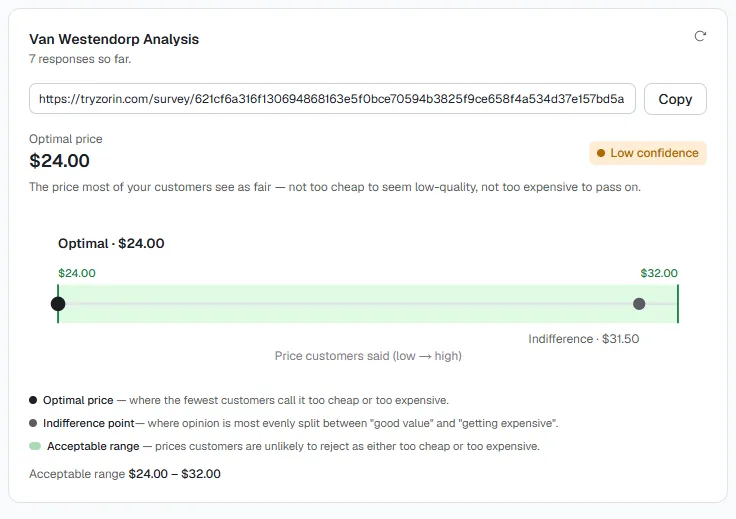
What it doesn't give you is certainty. A stated answer, however thoughtfully given, can diverge from what the same person would actually do at checkout with a real price and a real credit card in hand. Treat survey results as a strong, genuinely useful starting signal rather than a guaranteed final number. For the mechanics of running a Van Westendorp survey and reading its results in depth, How to Run a Price Sensitivity Survey and How to Interpret Van Westendorp Results cover that ground directly; this post focuses on how the method compares to and combines with live testing.
What a Price Test Gets You (and the Real Risks That Come With It)
A live price test, showing a real price to real customers and measuring what they actually do, gives you the most reliable signal available: actual behavior rather than a stated intention. That reliability comes with genuine risk that a survey simply doesn't carry, and it's worth understanding both risks precisely before running one.
One of the clearest cautionary examples in ecommerce history is Amazon's price testing experiment in September 2000, when the company randomly varied discounts between 20% and 40% across 68 DVD titles over a five-day test, meaning two customers buying the identical title at the same time could pay meaningfully different prices, in one documented case, the same X-Files box set at anywhere from $89.99 to $104.99 against a $149 list price. Shoppers compared notes, discovered the discrepancy, and the backlash was immediate and public, forcing Amazon to refund the difference to the roughly 6,900 affected customers and publicly commit to never testing prices based on customer identity again. Over two decades later, companies still make some version of this same mistake: two customers, sometimes at the same company or in the same social circle, discover they were shown different prices for the identical product at the same time, and the resulting trust damage tends to spread faster and further than the test itself ever did.
The trust and fairness risk
This is the larger practical risk, and it doesn't take many customers noticing to become a real problem. Shoppers generally expect price consistency. Discovering that someone else paid less for the exact same item at the exact same time reads as unfair, even when the difference was small and the test was well-intentioned. Once that trust is damaged, it's expensive and slow to rebuild, often costing far more in long-term loyalty than whatever the test was designed to optimize.
The legal risk, stated precisely
Live price testing is generally legal in most jurisdictions, and it's been used widely and openly for decades in categories like airlines, hotels, and ride-sharing. The specific legal concern most often raised in the US is the Robinson-Patman Act, which does technically extend to consumer sales of commodities, not only business-to-business transactions, a distinction worth being precise about rather than assuming it doesn't apply at all. In practice, though, a Robinson-Patman claim requires showing the price difference caused real competitive injury between the two purchasers, and that element is difficult to establish when the buyers are individual consumers rather than competing resellers, which is a large part of why enforcement against consumer-facing price tests has historically been rare. This isn't legal advice, and the specific facts of a given pricing program matter, but for most ecommerce sellers the bigger practical risk isn't legal exposure, it's the reputational and trust damage described above, which carries no clean legal remedy once it happens.
See what Zorin's elasticity model says about your own catalog.
Start free trialThe Safer Alternative: Test the Framing, Not the Raw Price
Several practitioners in this space converge on the same workaround, and it's worth taking seriously: instead of showing two customers two different prices for the identical product at the same moment, test how the price is presented rather than the number itself. Does a bold price anchor at the top of the page outperform revealing price after building context for the product? Does a three-tier pricing table convert better than a single clean offer? Does "save $120 a year" outperform "just $10 a month" for the same underlying price?
This approach yields genuinely useful behavioral data, insight into perception, framing, and how customers process a price, without introducing the core fairness problem of literally charging two people different amounts for the same thing at the same time. For many ecommerce sellers, testing presentation rather than the raw price delivers most of the insight a full price experiment was hoping to provide, with meaningfully less risk attached.
How to Combine a Survey and a Price Test (Rather Than Choosing One)
The most reliable path to a price isn't picking a survey or a live test as the single method to trust. It's triangulating across a few inputs, each of which covers a gap the others leave open.
Start with the acceptable price range from a survey, which narrows the field before you've risked anything with a real customer. Apply your margin floor next, ruling out any candidate price that wouldn't be profitable regardless of how customers perceive it. What's left is a small set of realistic candidates, often just one or two, worth testing further rather than an unbounded range of possible prices.
From there, if a live test is warranted, keep it narrow and, where possible, favor testing framing and presentation on the surviving candidates rather than direct price discrimination between customers, for the trust reasons covered above. And once a product has accumulated real sales history at a given price, per-SKU elasticity data becomes available as an additional, ongoing signal. Elasticity is itself a form of revealed preference, gathered passively from how customers actually behaved at the price you've already set, rather than requiring a deliberate experiment to produce it. In practice, this gives a merchant four inputs building on each other over a product's life: a survey's acceptable range before launch, a margin floor throughout, an optional narrow test of presentation on top candidates, and ongoing elasticity data once enough real sales history has accumulated to make that signal reliable.
No single one of these methods should be setting your final price in isolation. Each one covers a blind spot the others have.
Run a Van Westendorp survey on your own catalog, then let elasticity data confirm it once you have sales history. Start a free trial to see both signals side by side.
Key Takeaways
- A survey measures stated preference; a price test measures revealed preference. What customers say they'd pay and what they actually do at checkout aren't always the same thing.
- A survey works before you have sales data and carries no risk to real customers. A live price test requires a real product and real customers, and carries genuine trust and reputational risk.
- The trust risk from live testing is real and well-documented. Customers discovering they paid different prices for the same product at the same time is the core problem, and it can spread and damage trust faster than the test itself.
- Testing price framing and presentation is a safer alternative to testing the raw number. It yields useful behavioral insight without the direct fairness problem of charging different customers differently for the identical item.
- The most reliable price comes from triangulating multiple signals, not choosing one method. A survey's acceptable range, a margin floor, an optional presentation test, and eventually elasticity data from real sales history all cover different blind spots.
Frequently Asked Questions
What's the difference between a price survey and price testing?
A price survey, like the Van Westendorp method, asks customers directly what they'd pay and measures stated preference, an intention with no real transaction attached. Price testing shows real customers a real price and measures revealed preference, what they actually do when the decision has real consequences. Revealed preference is generally the more reliable signal, but it requires exposing real customers to real prices, which a survey doesn't.
Is A/B testing prices legal?
Generally yes, in most jurisdictions, and it's been used openly for decades in categories like airlines and hotels. In the US, the main legal reference is the Robinson-Patman Act, which does technically extend to consumer commodity sales, not just B2B, though a claim also requires showing real competitive injury between the purchasers, an element that's difficult to establish for individual consumers rather than competing resellers. This isn't legal advice. The bigger practical risk for most sellers is reputational and trust-related, not legal.
What happened when Amazon tested different prices in 2000?
Amazon randomly varied discounts between 20% and 40% across 68 DVD titles over a five-day test in September 2000. Customers compared notes, discovered the discrepancy, and the resulting backlash forced Amazon to refund the difference to roughly 6,900 affected customers and publicly commit to never testing prices based on customer identity again. It remains one of the most cited cautionary examples of live price testing damaging customer trust.
How do I test pricing without the customer trust risk?
Test how the price is presented rather than the raw number itself. Comparing a bold price anchor against a context-first reveal, or a tiered pricing table against a single offer, gives you useful behavioral insight into how customers respond to framing, without charging two customers different amounts for the same product at the same time.
Should I use a price survey or run a live price test?
Ideally both, in sequence, rather than choosing one. Use a survey's acceptable price range to narrow your options before you've risked anything with real customers, apply your margin floor to rule out unprofitable candidates, and then, if warranted, test framing or presentation on the one or two candidates that survive both filters.
Can I skip the survey and just run a price test if I already have some sales data?
If you have real sales history with genuine price variation, elasticity data derived from that history is itself a form of revealed preference and can be more directly useful than a new survey. A survey earns its place specifically when that sales history doesn't exist yet, most commonly for a new product launch, or when you want a second, independent signal before a high-stakes price change.
Why does Zorin only offer the survey and not live price testing?
A Van Westendorp survey gathers stated preference safely, with no risk to real customers or real transactions, and works from day one before any sales history exists. Live price testing carries genuine trust and fairness risk, as covered above, and Zorin's elasticity model already provides a revealed-preference signal once a product has real sales history, without requiring a deliberate live experiment that exposes different customers to different prices.
A survey and a live test aren't competing methods fighting for the same job. They answer different questions at different points in a product's life, one works before you have any sales data, the other requires it and carries real risk if handled carelessly. The most reliable price comes from combining what a survey tells you customers say, what your margin actually allows, and, once available, what your real sales history shows customers do. Zorin keeps the survey and the elasticity model on the same platform so both signals are there when you're ready to decide. Already have sales data and wondering if a survey still adds anything? here's when it's still worth running one.
Written by Dexter
Dexter is part of the team at Zorin, building tools that help ecommerce merchants price with data instead of guesswork.
More in Price Sensitivity Surveys
View all →Do You Need a Survey If You Have Sales Data?
A pricing survey and your sales history measure different things. See when a Van Westendorp survey beats elasticity data, and when it doesn't.
How to Run a Van Westendorp Price Survey
The 4 Van Westendorp questions, who to ask, how many responses you need, and how to turn the answers into an acceptable price range before you launch.
How to Interpret Van Westendorp (PSM) Results
Learn what the four Van Westendorp price points actually mean, how to read a narrow vs wide range, and why the optimal price point isn't your final price.