Should You Raise Prices Before Black Friday?
No, raising a price right before Black Friday just to cross it out and show a bigger discount is a real risk, not a harmless marketing trick, and it's worth understanding exactly why before BFCM planning starts. This guide covers how much to actually discount for Black Friday and Cyber Monday, the specific legal and trust risk behind fake discount anchoring, which products in your catalog should go on sale versus stay at full price, how to check whether a discount actually protected your margin, and how to get back to normal pricing once the event ends.
How Much to Discount for BFCM
A flat 25% off across the board is common enough to be treated as a default in a lot of BFCM guides, but the more useful framing is sizing the discount against your own margin rather than matching what everyone else runs. A product with a 65% gross margin can absorb a deeper discount than one running at 25%, and running the same flat percentage across a whole catalog with mixed margins guarantees some products lose money on every sale during the event.
Timing matters as much as depth. Several BFCM retrospectives from the 2025 season found that starting the sale window earlier, sometimes a full week before Black Friday with early access for existing customers, captured more revenue than discounting more deeply over a shorter window. Depth and duration are two separate levers, and going deeper isn't the only way, or even the most effective way, to compete for BFCM spend.
The Short Answer on Raising Prices First
Don't. Inflating a price for a day or two specifically so a subsequent "sale" price looks like a bigger discount than it actually is isn't a gray-area marketing tactic. It's a specific, named practice that consumer protection law and multiple real lawsuits have already addressed directly, covered in detail below.
The Real Risk: Fake Discount Anchoring
The FTC's Guides Against Deceptive Pricing, codified at 16 CFR Part 233, set out a specific standard for when a "was" price is legitimate to advertise: the former price has to be a bona fide price the item was actually, openly offered at for a reasonably substantial period in the regular course of business, not a price set for a day or two purely to manufacture a bigger-looking markdown. A price that only ever existed to be crossed out doesn't meet that bar, and the guidance is explicit that doing so misrepresents the bargain a shopper thinks they're getting.
This isn't a theoretical risk. Kohl's settled a class action for $6.15 million (Russell et al. v. Kohl's Department Stores) over allegations that it advertised a 30% discount off a false "regular" or "original" price that didn't reflect what the product had actually sold for. The FTC itself hasn't actively enforced these guides in recent years, but that gap has been filled by state attorneys general and class action litigation instead, several major retailers have faced similar suits over the same underlying practice, fictitious reference pricing used to inflate the appearance of a BFCM-style discount.
The practical takeaway for a smaller store: use your actual regular price as the "before" number, always. If a product has genuinely been selling at $40 for the past two months, a BFCM price of $30 is a real, defensible 25% discount. If you quietly moved that same product to $50 the week before the sale specifically to advertise it as 40% off, you're doing exactly what got larger retailers sued, just without their legal budget to absorb the consequences.
Which Products to Discount, and Which to Hold at Full Price
Treat this as a per-product decision, not a storewide one. A blanket 25%-off-everything sale discounts products that would have sold at full price anyway, giving away margin you didn't need to give away, and it can under-discount the specific products that actually needed a push to move. The products worth discounting hardest are the ones with real elastic demand, where a lower price meaningfully changes how many units move. The products worth protecting at full price, or discounting only lightly, are the ones with inelastic demand and strong existing sell-through, since a discount there mostly just gives away margin on sales that would have happened regardless.
Zorin's per-SKU elasticity model answers this directly: a product flagged as elastic with strong confidence is a genuine candidate for a deeper BFCM discount, while an inelastic, steady-selling product is usually better held at or near full price, or given a smaller, margin-protective discount instead of matching the storewide number.
See what Zorin's elasticity model says about your own catalog.
Start free trialDid the Discount Actually Protect Your Margin?
After the event, the check is the same margin math that applies to any discount, run against your actual BFCM numbers rather than a projection. Compare total gross profit during the sale window against what those same products would have generated at full price over a comparable prior period, not just total revenue, which can look strong even when margin quietly collapsed. A discount that moved a lot of units but generated less total profit than a smaller, better-targeted discount would have isn't a win just because the top-line revenue number looked good on the day.
Getting Back to Normal Pricing After BFCM
Rolling prices back cleanly matters for two separate reasons. The obvious one is margin, staying at BFCM pricing longer than planned quietly erodes profit on every sale after the event's actual justification (urgency, event timing) has expired. The less obvious one is data quality: BFCM sales volume, driven by a temporary discount and a burst of promotional traffic, doesn't reflect normal price sensitivity, and if that period gets fed into a future elasticity calculation without being flagged as promotional, it will distort the read on how your customers actually respond to price outside of a sale event.
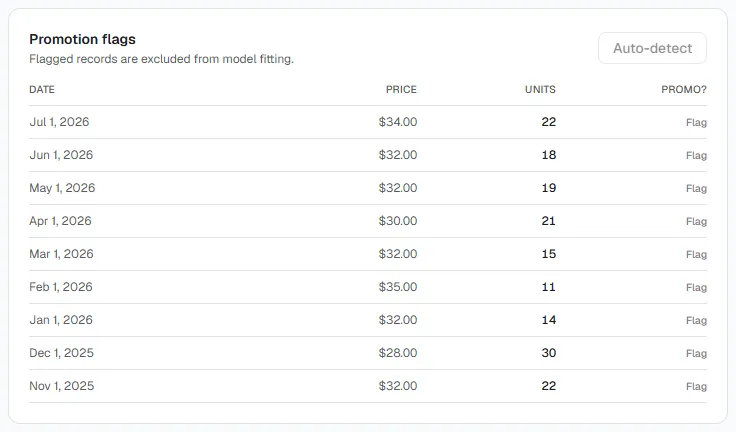
Zorin's promotion detection flags exactly this kind of period automatically, so a BFCM sales spike gets excluded from the baseline elasticity fit rather than silently treated as evidence that your regular-price customers are more price-sensitive than they actually are. For the underlying margin math behind any discount, seasonal or otherwise, how much you should discount without killing your margin covers that ground in full.
Checking Which Products Can Take a Deeper Discount
BFCM decisions come down to the same two questions covered above: which products can actually absorb a discount without giving away margin you didn't need to, and how do you keep the event from distorting your pricing data afterward. Zorin answers both from your connected Shopify or WooCommerce sales history, a per-SKU elasticity read to guide the discount decision, and automatic promotion detection to keep the resulting sales spike from corrupting your model once the event is over.
Key Takeaways
- Don't raise a price before BFCM just to advertise a bigger-looking discount. The FTC's own Guides Against Deceptive Pricing (16 CFR Part 233) require a "was" price to be genuine, and Kohl's paid $6.15 million to settle a class action over exactly this practice.
- A flat storewide discount percentage isn't the most profitable approach. Size the discount against each product's own margin and elasticity, not a round number everyone else is using.
- Discount your elastic, price-sensitive products hardest. Hold inelastic, steady-selling products at or near full price, since a discount there mostly just gives away margin.
- Check profit, not just revenue, after the event. A discount that moved more units but generated less total profit than a smaller, targeted one isn't actually a win.
- Flag the BFCM sales spike as promotional before it feeds into any future elasticity calculation, or it will distort how price-sensitive your regular customers look. Start a free trial to see per-SKU BFCM recommendations for your own catalog.
The safest BFCM pricing strategy is also the most defensible one: real regular prices, discounts sized to each product's actual margin and elasticity, and a clean flag on the sales spike once the event ends. Start a free trial and see what that looks like for your own store.
Frequently Asked Questions
How much should I discount for Black Friday and Cyber Monday?
There's no single right number. A flat 25% off is common, but sizing the discount against each product's own margin and elasticity produces a more profitable result than matching a storewide default. Products with elastic demand can typically support deeper discounts; products with inelastic, steady demand are usually better protected at or near full price.
Should I raise my prices before Black Friday to make the discount look bigger?
No. The FTC's Guides Against Deceptive Pricing require a "was" price to be genuine, actually offered for a substantial period, not inflated for a day or two purely to manufacture a bigger discount. Kohl's paid $6.15 million to settle a class action over this exact practice. Use your real, actual regular price as the baseline.
Which products should go on sale for BFCM, and which should stay full price?
Discount products with elastic demand, where a lower price meaningfully increases units sold, and hold inelastic, steady-selling products at or near full price, since discounting them mostly gives away margin on sales that would have happened anyway. A per-SKU elasticity read is a more reliable guide here than a storewide flat discount.
How do I know if a BFCM discount actually hurt my margin?
Compare total gross profit during the sale, not just revenue, against what the same products would have generated at full price over a comparable prior period. Strong revenue during a sale can still represent a net loss in profit if the discount was deeper than the elasticity of that product actually justified.
Should I go back to normal prices right after BFCM, or ease into it?
Roll back cleanly and promptly once the event's actual justification (urgency, a limited-time event) has passed. Staying at BFCM pricing longer than planned quietly erodes margin, and it's worth flagging the BFCM sales window as promotional in your records so the temporary spike doesn't distort future price-sensitivity calculations.
Is it illegal to advertise a fake "was" price?
It runs against the FTC's Guides Against Deceptive Pricing (16 CFR Part 233), and while the FTC itself hasn't actively enforced these guides in recent years, state attorneys general and class action lawsuits have filled that gap. Several major retailers have paid real settlements over fictitious reference pricing, so "the FTC doesn't enforce this anymore" isn't the same as "there's no real risk."
The safest, most profitable BFCM strategy is also the most honest one: real prices as the baseline, discounts sized to what each product can actually absorb, and a clean flag on the promotional period once it's over. The same discipline applies to running any sale without wrecking your margin, BFCM just raises the stakes and the legal scrutiny. Start a free trial to see which of your products are the strongest BFCM candidates.
Written by Dexter
Dexter is part of the team at Zorin, building tools that help ecommerce merchants price with data instead of guesswork.
More in Discounts & Promotions
View all →Dynamic vs Variable Pricing: What's the Difference?
Dynamic pricing changes prices continuously from live data; variable pricing sets prices in advance for known conditions. Examples and which to use.
Which Products Should You Discount? Use Your Data
Discount the products whose demand actually responds to price, not whatever is overstocked. How to pick sale candidates from your own sales history.
How to Run a Price A/B Test the Right Way
Sample size, test duration, and how much to change the price. The mechanics of a real price test, no data scientist required.