How Much to Discount Without Losing Your Margin
If you're deciding how deep to discount, the answer starts with one number: your gross margin, not your competitor's sale price. Most sustainable discounts land between 10% and 30%, with the right depth set by how much margin room your category actually has. Get that number wrong and a discount that looks generous on the surface quietly eats your entire profit on every unit sold.
I've made this mistake myself, running a "just take 20% off, it's not that much" sale on a product with a 35% margin, and watching the math afterward tell a very different story than the one I'd assumed while setting the price. That gap between what a discount feels like and what it actually costs is the entire subject of this guide. Whether you're clearing dead stock, weighing a BOGO offer, or deciding between a flash sale and an extended one, it all comes back to the same formula. This is closely related to running a sale without wrecking your margin more broadly, this guide goes deeper on the specific tactics: discount depth, dead stock, flash vs. extended, and BOGO.
The Only Formula You Need Before Any Discount
Every discount decision in this guide traces back to one relationship: cutting your price shrinks your margin faster than the discount percentage suggests, because your costs stay fixed while your revenue drops. Once you have this formula, you can sanity check any promotion in under a minute instead of discovering the damage after the sale ends.
Here's the math. If you sell a product for $100 with a 40% margin ($60 cost, $40 profit), a 10% discount drops your price to $90. Your cost stays at $60, so your new profit is $30, a margin of 33%. That's not a 10% hit to your margin, it's closer to a 17% hit, because the discount comes straight out of your profit dollar, not out of a proportional slice of everything.
The general relationship: new margin = (old margin minus discount) divided by (1 minus discount). At deeper discounts the effect compounds. A 20% discount on that same 40% margin product requires you to sell roughly double the units just to hold the same total profit. At 30% off, you'd need close to four times the volume.
I check this formula before I approve any promotion now, and I'd recommend building it into a simple spreadsheet if you haven't already. It takes five minutes and it's the difference between a sale that grows your business and one that quietly funds it away.
The takeaway: run the break-even formula before setting any discount number, because the margin hit is always proportionally larger than the discount percentage itself.
Square's own breakdown of discounting strategy walks through a worked example: a product selling at $100 with a $60 cost (a 40% margin) discounted by 20% drops to an $80 selling price. The unit cost hasn't changed, so profit per unit falls from $40 to $20, half of what it was. To generate the same total profit as before, that store needs to sell 100 additional units, doubling total volume. The same source notes that at a thinner 20% margin, a 15% discount requires a 300% increase in sales just to hold the same margin.
How Deep Should My Discount Actually Be
Discount depth should follow your category's gross margin, not a round number that feels generous or a competitor's sale price. Products with thick margins can absorb a real cut. Products with thin margins usually can't, no matter how good the sale looks on a banner.
A rough guide that holds up consistently across categories:
| Margin band | Sustainable discount depth | Why |
|---|---|---|
| High margin (50%+ gross margin) | Often 20 to 30% | Enough room to absorb a real cut without falling below a reasonable profit line |
| Medium margin (30 to 50%) | Needs caution past 20% | A flat 20 to 30% cut can get uncomfortably close to break-even; tiered offers or free shipping often protect margin better |
| Low margin (under 30%) | Rarely discount directly | A 30% discount on a 35% margin product can leave roughly 5% margin left, barely enough to cover overhead |
There's also a perception ceiling worth knowing. Research on discount perception puts 10% as roughly the minimum threshold customers register as "worth acting on," while discounts past about 30% start to trigger a "something's wrong with this product" reaction rather than reading as a good deal. That 10 to 30% band isn't arbitrary. It's roughly where perceived value and margin protection both hold up at once.
I'd add one thing from actually running these numbers over time: your best customers, the ones who'd buy at full price anyway, are usually the ones you should discount least. Blanket sitewide discounts hand margin to people who never needed the incentive in the first place. This is the same logic behind why bestsellers and slow sellers need different pricing strategies, a proven seller rarely needs the same discount as something that isn't moving.
The takeaway: set discount depth from your category's margin band, generally 10 to 30%, with high-margin products absorbing the deeper end and thin-margin products avoiding direct discounts almost entirely.
How Do I Clear Dead Stock Without Destroying My Margin
Dead stock feels like it demands a deep, immediate markdown, but that instinct is usually the most expensive way to solve the problem. Bundling and targeted offers on the right pairing frequently clear inventory at a better realized margin than a flat, sitewide price cut.
Before reaching for a markdown, I run through this order of preference:
- Bundle the dead stock with a high-margin bestseller. The customer sees a complete, appealing offer. You move the slow item without directly cutting its visible price, and the bundle's blended margin often looks much better than a standalone discount would.
- Run a BOGO on a specific high-margin pairing. This works especially well when the dead stock item has decent margin on its own; giving it away or discounting it as the "second item" in a BOGO can clear inventory while the paid item still carries most of the profit.
- Use a tiered discount tied to order value, something like 10% off $50, 20% off $100, rather than a flat percentage off the dead item alone. This nudges customers toward a bigger basket instead of just a cheaper single purchase.
- Reserve a flat, deep markdown for stock that genuinely has to move, seasonal inventory before it's fully out of season, or anything taking up warehouse space you need back. Even here, run the break-even math first so you know the actual floor.
One pattern worth watching: deep discounts during clearance can also increase returns and shrink average order value during the promotion itself, so factor that into your expected recovery, not just the headline discount percentage.
The takeaway: try bundling or a targeted BOGO on high-margin pairings before a flat markdown, and reserve deep across-the-board discounts for stock you genuinely need gone regardless of margin impact.
Should I Run a Flash Sale or an Extended Sale
Flash sales concentrate your margin risk into a short, controllable window. Extended sales spread that exposure over more time, and they're harder to walk back once customers start expecting the lower price as the norm.
Here's how I think through the choice:
Flash sale fits when:
- You need a burst of urgency around a specific event or inventory push.
- You want the discount contained to 24 to 72 hours so the margin hit is easy to forecast and doesn't bleed into your regular pricing perception.
- You're testing a discount depth or format before committing to it more broadly.
Extended sale fits when:
- You're addressing a genuinely slow season and need sustained demand, not just a spike.
- Your margin can absorb a longer exposure window without threatening your break-even for the quarter.
- You're comfortable that customers won't simply learn to wait for the extended window every time.
The risk with extended and frequent sales is cumulative: when a store is "always on sale," nothing feels like a real discount anymore, and customers start waiting rather than buying at your normal price. Flash sales sidestep that risk mostly because their scarcity is the point. A tight window signals urgency instead of desperation.
I'd lean flash by default unless you have a specific, margin-checked reason to extend it. It's easier to run a second flash sale next month than to walk back a six-week sale that's trained your customers to expect a lower price permanently.
The takeaway: choose a flash sale for contained, forecastable margin risk and urgency, and reserve extended sales for genuine seasonal slowdowns where the margin can sustain a longer window.
How Do I Price a BOGO Offer Without Losing Money
BOGO's real discount is almost always smaller than it feels to the customer, and it only works financially on products with enough margin to absorb giving away or cutting a second unit. Getting this wrong is one of the most common ways well-meaning promotions quietly lose money on every single order.
Start with the math most merchants get wrong. "Buy One, Get One 50% Off" is not a 50% discount. On two $20 items, the customer pays $20 plus $10, or $30 total for $40 of product. That's 25% off the order, not 50%. If your marketing copy or your own mental math treats it as a 50% discount, you're underestimating your actual revenue by a meaningful margin.
The margin threshold matters even more. BOGO Free (buy one, get one fully free) generally needs a gross margin above 50% to stay profitable once you account for the free item's cost. Below roughly 40% margin, giving away a full second unit can mean losing money on every qualifying transaction. Softer variants scale down from there: half-off BOGO generally needs gross margin above 25%, and buy-two-get-one needs above 33%. If your margin doesn't clear the bar for a full free item, a percentage-off second item protects your profit far better than a straight free offer.
A quick way to check before you launch:
- Confirm your product's gross margin first. Below 40%, avoid BOGO Free entirely.
- Calculate the combined-transaction margin, revenue from one item minus the cost of two, not just the margin on the paid item alone.
- Restrict eligibility to specific SKUs with enough margin to absorb the hit, rather than running BOGO sitewide.
- State the real discount plainly in your marketing, both for compliance and so your own team doesn't overestimate the deal's cost.
BOGO tends to work well as a clearance tool on high-margin items with a low cost of goods, and to lose money quietly on products with a 30% margin where nobody ran the numbers first. The format itself isn't the risk. Skipping the math is.
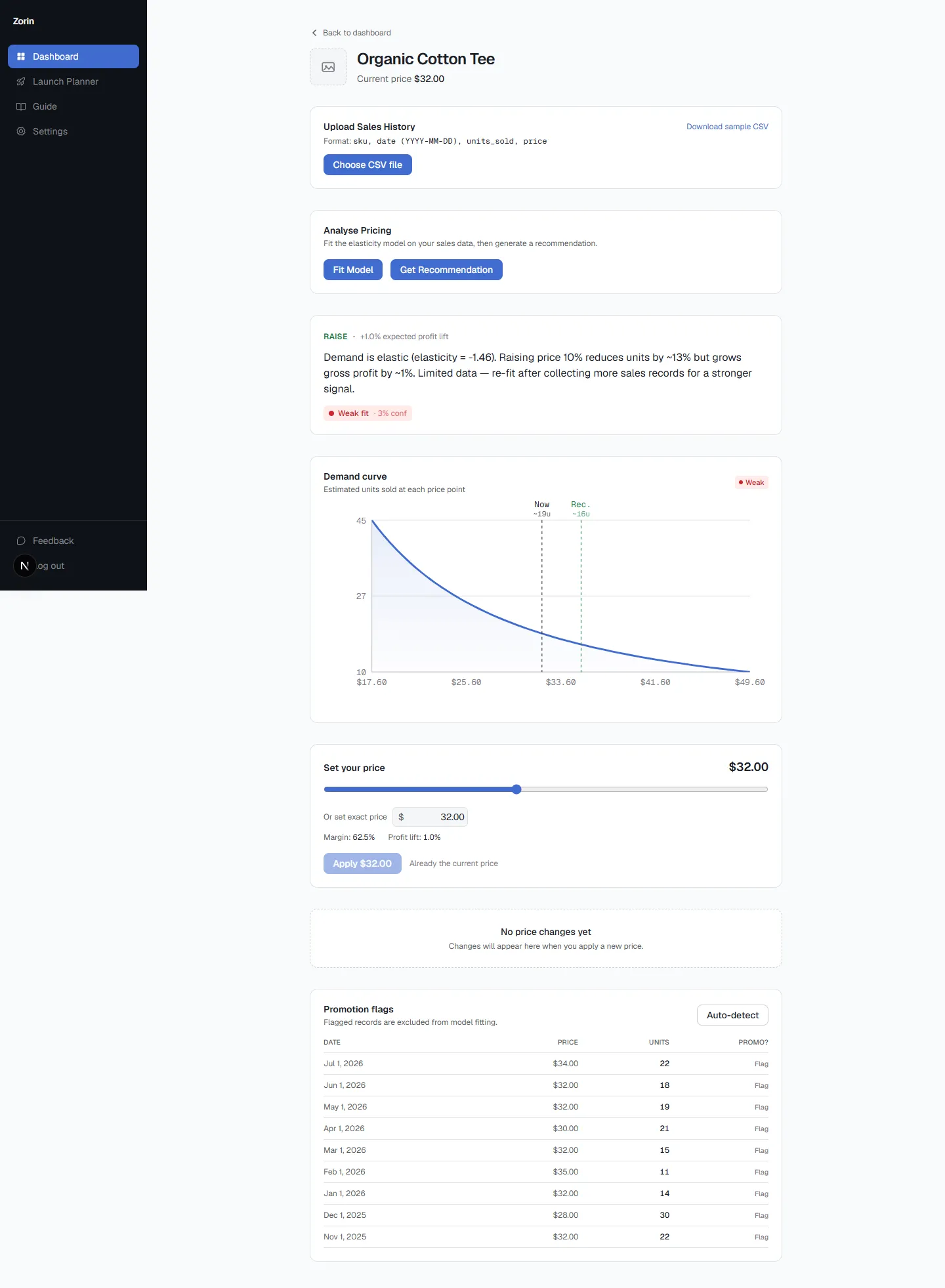
This is the same discipline Zorin applies to everyday pricing, just aimed at a different question. Zorin doesn't run BOGO or bundle math directly, its engine reads your own sales history to calculate each product's price elasticity and recommends a raise, lower, or hold with an estimated profit lift, not a competitor's price or a fixed rule. But the underlying habit is identical: know the real number behind a price change before you commit to it, whether that change is a repriced product or a BOGO offer on the same SKU.
The takeaway: confirm your product clears roughly a 40 to 50% margin threshold before running BOGO Free, and remember that "50% off the second item" is closer to a 25% discount on the full order.
A comparison of BOGO and percentage-off structures puts it plainly: at margins under 40%, both discount types can destroy profitability, and the guidance below that threshold is to be very careful with BOGO specifically, since giving away a full free unit is harder for a thin margin to absorb than a smaller percentage cut.
See what Zorin's elasticity model says about your own catalog.
Start free trialWhen Should I Discount vs. Bundle Instead
Discounting and bundling solve different problems, and picking the wrong one for your actual goal is a common way to give away margin without getting the result you wanted. The decision should follow from what you're actually trying to accomplish, not from which tactic is easier to set up in your store admin.
Discount when:
- You need urgency on a specific, identifiable product, dead stock, a seasonal item, something you need moving this week.
- The goal is a clear, fast signal: this price is temporarily lower, act now.
- You're comfortable with customers seeing the item's price drop directly, since that visible cut is the whole point.
Bundle when:
- You want to raise average order value without touching the perceived price of any single product.
- You have a complementary high-margin item that pairs naturally with a slower mover, letting the bundle's blended margin do the work a standalone discount can't.
- You're wary of training customers to wait for discounts on your bestsellers, since a bundle protects the individual item's price integrity while still offering real value.
A simple example: a camera bundled with a discounted case and memory card gives the customer a complete, appealing package at a better combined price, without ever putting the camera itself on sale. The camera's price stays intact. The bundle does the persuading.
I'd default to bundling whenever the underlying question is "how do I get people to buy more," and reach for a direct discount only when the question is genuinely "how do I move this specific thing, now." Conflating the two is how a lot of promotions end up costing more margin than the result was worth.
None of the tactics in this guide, discount depth, BOGO, bundling, replace the need to know your actual margin on a product before you touch its price. That's the same starting point Zorin is built around for everyday pricing: it reads your own sales history, calculates each product's price elasticity, and recommends a raise, lower, or hold with an estimated profit lift, grounded in your real cost and demand data, not a competitor's price or a guess. Zorin doesn't calculate discount or bundle math directly, but the habit of knowing your real numbers before changing a price is the same one this guide has been asking you to build for every promotion. If you haven't checked your baseline elasticity yet, connect your sales history before your next sale.
The takeaway: discount to create urgency on a specific product, bundle to raise order value while protecting a product's perceived price, and choose based on the actual goal rather than convenience.
Stopping Discount Codes From Stacking on Sale Items
This is one of the most common ways a promotion goes unprofitable without anyone deciding that on purpose. A customer applies a sitewide discount code on top of a product that's already marked down for clearance, and the resulting price falls well below what anyone intended, sometimes below cost.
Most platforms don't make this easy to prevent by default. The practical fixes: exclude sale-tagged collections from discount code eligibility at the code level, or, if that's not directly supported, maintain a separate collection for already-discounted items and configure codes to explicitly exclude it. Whichever fix you use, a discount code and a clearance markdown are two separate pricing decisions, and neither should silently combine without you choosing that outcome.
How Much of Your Revenue Should Come From Discounts
This is a number worth tracking over time, not just per-sale. Guidance on avoiding an ecommerce discount dependency problem flags that if discounted orders are consistently driving 30-40% or more of total revenue, that cadence is already too high regardless of how few individual "sale events" it feels like you're running.
The risk here isn't any single promotion, it's what happens gradually: customers learn to wait for the next discount instead of buying at full price, and your effective average margin quietly erodes month over month even though no single decision looks reckless in isolation. Checking this ratio on a regular cadence, not just reacting to how any one sale performed, catches the drift before it shows up as a surprise in a profit review.
What a Sale Does to Your Pricing Data After It Ends
The part most discount guides skip entirely: what happens to your pricing decisions after the sale is over.
A spike in sales during a discount period doesn't reflect how customers behave at your normal price. If that spike gets folded into your regular sales history untouched, it distorts your read on how price-sensitive your customers actually are, and future pricing decisions end up built on a skewed picture. Zorin automatically detects likely promotional spikes in your sales history and flags them for exclusion, so a discount week doesn't get baked into your baseline elasticity estimate. You can also confirm or override a flag manually if you know a spike had a different cause.
This matters most exactly when you're deciding whether a past discount actually worked. Zorin reads your own sales history, product by product, and returns a raise, lower, or hold recommendation with the elasticity behind it and a confidence label reflecting how much real data supports the estimate, so you're working from your own customers' demonstrated behavior rather than a generic rule of thumb applied across every SKU the same way. If you're running a sale on a specific product, testing the discount against that product's demand curve first beats picking a percentage because it feels generous.
Key Takeaways
- A discount's margin hit is always proportionally larger than the discount percentage itself, because your costs stay fixed while revenue drops.
- Discount depth should follow your category's gross margin, generally 10 to 30%, not a round number that feels generous.
- Bundling or a targeted BOGO on a high-margin pairing usually clears dead stock at a better realized margin than a flat markdown.
- "Buy One, Get One 50% Off" is roughly a 25% discount on the full order, not 50%, and BOGO Free generally needs 50%+ gross margin to stay profitable.
- Discounting and bundling solve different problems: discount for urgency on one product, bundle to raise order value without touching a bestseller's visible price.
Frequently Asked Questions
How deep should my discount actually be?
Typically 10% to 30% of price, with the right depth set by your category's gross margin rather than a competitor's sale. Categories under 30% margin should generally avoid discounts much past 10 to 15%.
How do I clear dead stock without destroying my margin?
Try bundling the item with a high-margin bestseller, or run a targeted BOGO on a strong pairing, before reaching for a flat markdown. Reserve deep across-the-board cuts for stock that genuinely has to move regardless of margin.
Should I run a flash sale or an extended sale?
Flash sales concentrate margin risk into a short, controllable window and suit urgency-driven clearance. Extended sales spread that exposure over time and only make sense when your margin can sustain a longer window without training customers to always wait.
How do I price a BOGO offer without losing money?
Confirm your product's gross margin clears roughly 40 to 50% before running BOGO Free. Below that threshold, a percentage-off second item protects your margin far better than giving a full unit away.
When should I discount vs. bundle instead?
Discount when you need urgency on one specific product. Bundle when you want to raise order value while protecting the perceived price of any single item in your catalog.
Is "Buy One, Get One 50% Off" actually a 50% discount?
No. It's roughly 25% off the total order, since the 50% reduction only applies to the second item, not the full purchase.
Why does a small discount hurt margin more than it seems?
Because your costs stay fixed while revenue drops, the margin percentage falls faster than the discount percentage. A 10% discount on a 40% margin product can cut margin by closer to 17%, not 10%.
How many times a year should I run major discounts?
Most guidance points to roughly 4 to 6 major sale events a year outside your regular pricing, so discounts still feel occasional rather than an expected, permanent state.
Every question in this guide comes back to the same habit: know your margin floor before you touch a price, whether that's a seasonal discount, a BOGO offer, or a bundle built to move dead stock. The math takes minutes to run and it's the difference between a sale that grows your business and one that quietly funds it away. Building that check into your everyday pricing, not just your big promotions, is exactly what elasticity, calculated from your own sales history, is for.
Written by Dexter
Dexter is part of the team at Zorin, building tools that help ecommerce merchants price with data instead of guesswork.
More in Discounts & Promotions
View all →Which Products Should You Discount? Use Your Data
Discount the products whose demand actually responds to price, not whatever is overstocked. How to pick sale candidates from your own sales history.
Should You Raise Prices Before Black Friday?
Raising prices before Black Friday to fake a discount backfires with shoppers and regulators. How deep to actually discount for BFCM and keep margin.
How to Run a Price A/B Test the Right Way
Sample size, test duration, and how much to change the price. The mechanics of a real price test, no data scientist required.