Pricing Bestsellers vs Slow Sellers Differently
Bestsellers and slow sellers need different pricing strategies because they're solving different problems: a bestseller's question is how much more profit you can extract from demand that's already proven, while a slow seller's question is whether the price itself, not the product, is the reason it isn't moving. Applying one blanket pricing rule across a catalog treats both as if they were the same problem, and that's usually where margin gets left on the table or dead stock quietly piles up.
Two Different Questions Wearing the Same Label
"What should I price this at" sounds like one question, but it means something different depending on the product. For a bestseller, demand at the current price is already proven, so the real question is whether that price is leaving profit on the table, whether a modest increase would barely dent volume while meaningfully raising margin. For a slow seller, demand hasn't been proven at all, and the question is whether price is even the actual obstacle, or whether the product simply isn't reaching the right customers.
Why Bestsellers Can Often Take a Higher Price Than You'd Guess
A product selling consistently at its current price doesn't automatically mean the current price is optimal, it means the price is acceptable to enough customers to generate steady volume. If the elasticity estimate for that product is low (customers not very price-sensitive), there's often real room to raise price without losing much volume, and the resulting margin gain applies to every unit you're already selling, assuming you know what counts as a healthy margin for your store in the first place. This is easy to miss precisely because nothing about steady sales signals a problem.
Why a Slow Seller's Problem Might Not Be Price at All
It's tempting to assume a slow-moving product just needs a discount to move. Sometimes that's true. Often, the real issue is visibility, positioning, or simply weaker product-market fit, none of which a lower price actually fixes. Elasticity can help here too: if a product's estimated elasticity is high (very price-sensitive) and it's still not moving even at a reasonable price, that's a signal worth investigating beyond pricing. If elasticity is low and it's still not moving, a discount is unlikely to be the fix, since customers weren't especially price-sensitive to begin with.
| Segment | Typical question | What elasticity often shows | Likely lever |
|---|---|---|---|
| Bestseller | Am I leaving margin on the table? | Often lower elasticity; demand already proven | Test a modest price increase |
| Steady mid-performer | Is this priced about right? | Moderate elasticity, reasonable confidence | Standard review cadence, minor adjustments |
| Slow seller | Is price actually the obstacle? | Varies; low elasticity suggests price isn't the fix | Investigate visibility/fit before discounting |
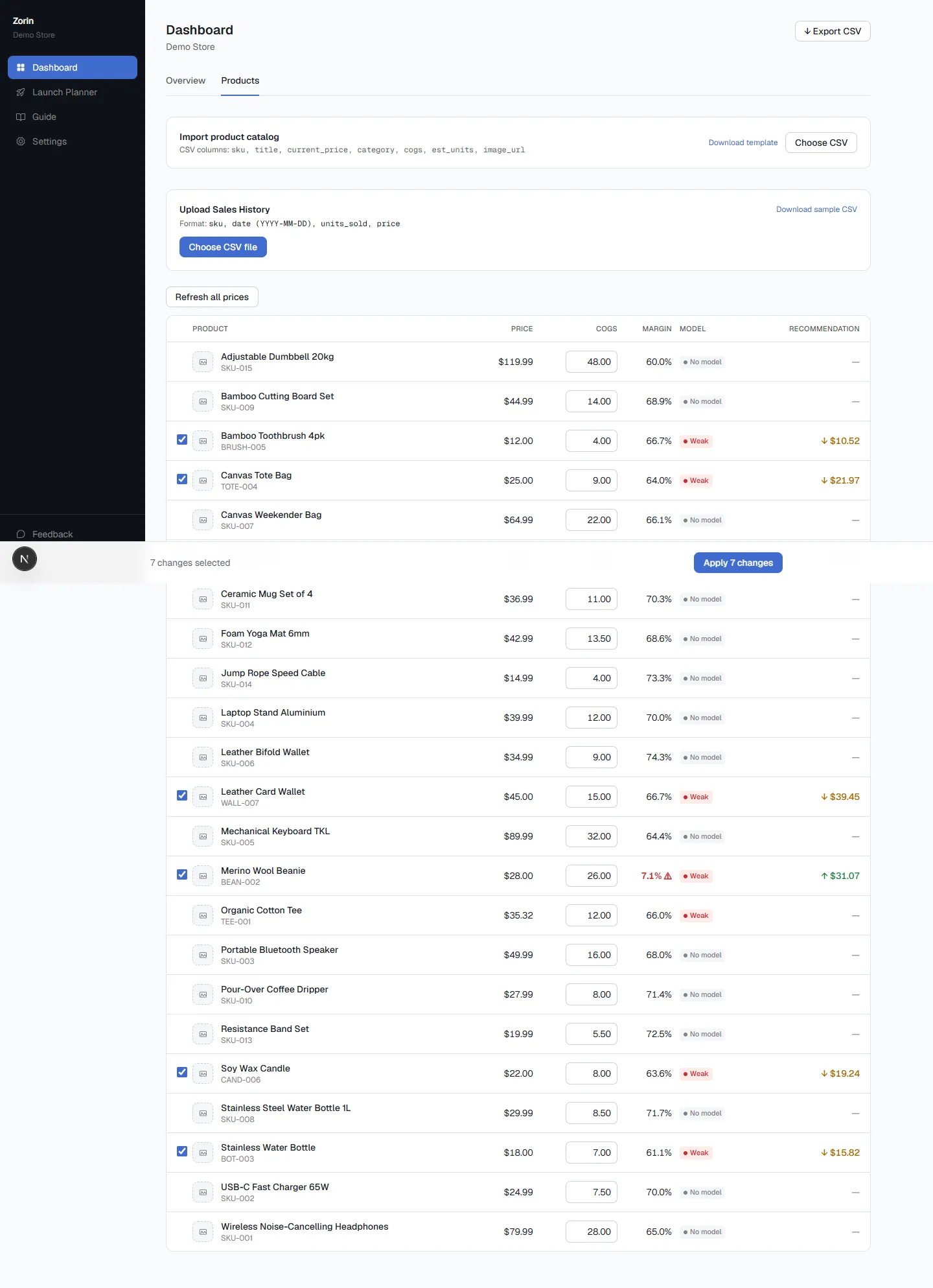
Why One Blanket Rule Overcorrects Both Groups
A catalog-wide discount treats a bestseller and a slow seller identically, giving away margin on the bestseller that didn't need to be given up, while possibly still not being enough to move the slow seller if price wasn't the real obstacle. A catalog-wide price increase has the mirror problem: it might work fine on inelastic bestsellers but push an already-struggling slow seller further from moving at all. Segmenting the catalog before applying any blanket rule avoids both mistakes at once.
See what Zorin's elasticity model says about your own catalog.
Start free trialHow Much Products Differ Inside One Catalog
If every product in a store responded to price the same way, one rule would be fine. They don't. Published research compiled in our price elasticity by category reference puts basic t-shirts at about -1.17 and casual or athletic wear at about -2.86. Those can sit side by side in one clothing store, and the second is more than twice as price-sensitive as the first.
Here's what that means in practice. Raise both by 10%. The t-shirt loses roughly 12% of its unit sales, which a 10% higher price mostly makes up for. The athletic top loses roughly 29%, which it doesn't. Same rule, same percentage, opposite outcomes. Bestseller or slow seller is a useful first split, but how price-sensitive each product actually is decides what to do with it.
How to Actually Segment Your Catalog
Rather than manually deciding which products count as "bestsellers" and which count as "slow," let each product's own sales history and calculated elasticity do that sorting for you. A product with strong, consistent volume and low price sensitivity behaves like a bestseller regardless of what category you'd have put it in by instinct. A product with thin data or weak demand at any price tested behaves like a genuine slow seller, and deserves a different conversation than a pricing tweak.
A Practical Way to Review a Mixed Catalog
- Sort by confidence and elasticity rather than by gut-feel category labels.
- Test a modest price increase on low-elasticity, high-confidence bestsellers first, where the upside is clearest.
- Investigate slow sellers beyond price before assuming a discount is the fix, especially if elasticity is already low.
- Avoid one blanket rule across the whole catalog for either a sale or a general price adjustment.
If you want to see this split for your own catalog rather than guessing which products fall into which group, upload your sales history and review each product's own elasticity and confidence score.
Key Takeaways
- A bestseller has proven demand, so the pricing question is usually whether you can raise price without meaningfully denting that demand.
- A slow seller's pricing question is different: is a lower price the thing that would actually move it, or is the problem elsewhere (visibility, positioning, fit)?
- Elasticity, calculated separately per product, naturally reflects this difference rather than requiring you to guess which category a product falls into.
- A single catalog-wide discount or markup ignores this split and usually overcorrects one group while undercorrecting the other.
- Reviewing your catalog by segment (proven sellers vs. thin performers) is more useful than reviewing it as one undifferentiated list.
Frequently Asked Questions
Why do bestsellers and slow sellers need different pricing strategies?
A bestseller's question is whether you can raise price without losing much proven demand. A slow seller's question is whether price is even the actual obstacle, which a discount doesn't necessarily fix.
Should I ever raise the price of my bestselling product?
If its elasticity is low, meaning customers aren't very price-sensitive, a modest increase can often raise margin without meaningfully denting volume.
Will discounting a slow-moving product always help it sell?
Not necessarily. If the product's elasticity is low, price isn't the main driver of its performance, and a discount may not fix an underlying visibility or fit problem.
How do I know which category a product falls into?
Its own elasticity and confidence score, calculated from its actual sales history, naturally reflect this rather than requiring you to guess based on instinct.
Is a catalog-wide discount ever a good idea?
It can work for a genuine, time-limited event, but it typically overcorrects bestsellers (giving away unneeded margin) while possibly undercorrecting slow sellers if price wasn't their real problem.
What should I check before discounting a slow seller?
Whether its elasticity is actually high enough that price is a meaningful lever, versus a visibility or positioning issue a lower price wouldn't solve.
Do I need to manually categorize my products?
No. Elasticity and confidence, calculated per product, naturally sort your catalog by how it should be treated without requiring manual labeling.
A catalog isn't one pricing problem, it's many small ones that happen to share a dashboard. Let each product's own data tell you whether it's a bestseller with room to raise, or a slow seller whose real problem might not be its price at all.
Written by Dexter
Dexter is part of the team at Zorin, building tools that help ecommerce merchants price with data instead of guesswork.
More in Margin & Profit Fundamentals
View all →Margin vs Markup: Formulas, Chart & Examples
Markup is profit over cost; margin is profit over price. Formulas, a margin to markup chart, Costco and e.l.f. examples, and the mistake that costs you.
WooCommerce vs Shopify Fees: Real Margin Compared
No platform fee doesn't mean better margin. WooCommerce vs Shopify transaction, hosting and plugin costs compared, and how to find your real net profit.
Ecommerce Profit Margins: Benchmarks & Tracking
Healthy ecommerce profit margins by category, gross vs net, margin vs markup, and how to track the gap on Shopify before it quietly eats your profit.