Margin vs Markup: Formulas, Chart & Examples
Markup is profit as a percentage of cost; margin is profit as a percentage of the selling price. A product that costs $30 and sells for $60 has a 100% markup but a 50% margin. The two numbers describe the same profit from different directions, so a 50% markup is only a 33% margin. Mixing them up is one of the most common and expensive pricing mistakes in ecommerce, because it leaves you with less profit per sale than you planned.
Margin vs Markup: The Short Definitions
Markup answers the question "how much did I add on top of what this cost me?" It starts from cost and is the number most people use when setting a price for the first time.
Margin (gross margin, to be precise) answers "how much of every dollar I take in do I keep?" It starts from the selling price and is the number used in financial statements, benchmarks and almost every "what's a good margin" conversation.
Both use the same profit figure, selling price minus cost. The only difference is what you divide it by. Because price is always bigger than cost for a profitable product, margin is always the smaller of the two percentages.
Markup vs Margin Formulas
| What you want | Formula | Example: cost $30, price $60 |
|---|---|---|
| Gross profit | Price − Cost | $60 − $30 = $30 |
| Markup % | (Price − Cost) ÷ Cost × 100 | $30 ÷ $30 = 100% |
| Margin % | (Price − Cost) ÷ Price × 100 | $30 ÷ $60 = 50% |
| Price from a target markup | Cost × (1 + Markup) | $30 × 2.00 = $60 |
| Price from a target margin | Cost ÷ (1 − Margin) | $30 ÷ 0.50 = $60 |
| Convert markup to margin | Markup ÷ (1 + Markup) | 1.00 ÷ 2.00 = 50% |
| Convert margin to markup | Margin ÷ (1 − Margin) | 0.50 ÷ 0.50 = 100% |
The last two rows are the ones worth memorizing. If a supplier, a benchmark or a colleague gives you one number, you can turn it into the other in a few seconds.
Margin to Markup Conversion Chart
Here is how common margin targets translate into the markup you need to apply to cost. Notice how quickly markup climbs as margin rises: every step toward a very high margin needs a much bigger jump in markup.
| Gross margin | Markup on cost | Price multiple of cost |
|---|---|---|
| 10% | 11.1% | 1.11x |
| 20% | 25% | 1.25x |
| 25% | 33.3% | 1.33x |
| 30% | 42.9% | 1.43x |
| 33.3% | 50% | 1.5x |
| 40% | 66.7% | 1.67x |
| 50% | 100% | 2x (keystone) |
| 60% | 150% | 2.5x |
| 66.7% | 200% | 3x |
| 70% | 233% | 3.33x |
| 75% | 300% | 4x |
| 80% | 400% | 5x |
Margin can never reach 100%, because that would mean the product cost nothing. Markup has no ceiling at all. That asymmetry is why a "300% markup" sounds enormous while the matching 75% margin sounds ordinary for a beauty or supplement brand.
Worked Example: What the Mix-Up Actually Costs
Say a product costs you $24 landed (unit cost plus inbound freight and duty), and you want a 40% margin, a common target for DTC brands before marketing costs.
- The right way: price = $24 ÷ (1 − 0.40) = $40.00. Profit per unit is $16, and $16 ÷ $40 = 40%. Target hit.
- The common mistake: you add 40% to cost instead: $24 × 1.40 = $33.60. Profit per unit is $9.60, and $9.60 ÷ $33.60 = 28.6%. You wanted 40% and got less than 29%.
- Over 1,000 units: the correct price earns $16,000 of gross profit; the mistaken one earns $9,600. The confusion costs $6,400, or 40% of the profit you planned for, on one product.
The mistake compounds when a discount lands on top. Run a 20% off sale on the $33.60 price and you sell at $26.88, leaving $2.88 of profit per unit, a 10.7% margin before shipping, payment fees or ad spend. The same sale on the correctly priced $40 product sells at $32 and still keeps $8 per unit. How deep you can safely discount from your real margin is covered in how much to discount without losing your margin.
See what Zorin's elasticity model says about your own catalog.
Start free trialReal-World Examples: Costco vs a Beauty Brand
Public company filings show how far apart margin and markup can sit depending on the business model.
Costco. In its fiscal 2025 annual report, Costco reported net sales of $269.9 billion, merchandise costs of $239.9 billion and a gross margin of $30.0 billion. That is a gross margin percentage of 11.12%. Expressed as a markup on what Costco paid for the goods, it is about 12.5% ($30.0 billion ÷ $239.9 billion). Costco makes the model work through volume and membership fees, which rose 10% to $5.3 billion in the same year, rather than through the price of each item.
e.l.f. Beauty. At the other end, e.l.f. Beauty reported a 70.7% gross margin in its most recent Form 10-K. Converted to markup, that is roughly 241% on cost, or a selling price about 3.4 times what the product costs to make. Cosmetics are cheap to produce relative to what shoppers will pay for a trusted brand, which is why beauty and supplements sit near the top of our profit margins by product category research.
The same word, "markup", covers 12.5% in one business and 241% in another. That is why benchmarks are almost always quoted as margins: margin tells you what share of revenue is left to pay for everything else, which makes businesses comparable.
When to Use Markup and When to Use Margin
| Situation | Use | Why |
|---|---|---|
| Setting a first price from a supplier quote | Markup, then check the margin | You know the cost first, so it's the natural starting point |
| Comparing yourself to benchmarks | Margin | Industry figures and financial statements report margin |
| Deciding how deep a discount can go | Margin | A discount comes off the selling price, which is margin's base |
| Budgeting ad spend or fees per order | Margin | Fees and ad costs are usually a share of revenue |
| Wholesale and keystone conversations | Markup (as a multiple) | Retail buyers talk in "2x" or "2.5x" multiples of cost |
A practical rule: use markup to start a conversation about price, and margin to decide whether the price is sustainable. The popular retail shortcut of doubling cost is covered in our guide to keystone pricing for clothing brands, and it is exactly a 100% markup, or a 50% margin.
Five Mistakes That Make Your Margin Smaller Than You Think
- Using unit cost instead of landed cost. Freight, duty, packaging and inbound shipping are part of cost. Leave them out and both your markup and your margin are overstated.
- Adding the target margin to cost. The worked example above: "cost plus 40%" gives a 28.6% margin, not 40%.
- Forgetting payment and platform fees. Card processing, marketplace commissions and app fees come off the selling price. On a thin margin they can take a third of it. Our Shopify profit margin calculator includes them.
- Quoting discounts against markup. "We have a 100% markup, so a 50% off sale is fine" is wrong: a 100% markup is a 50% margin, and a 50% discount takes it to zero.
- Applying one markup to the whole catalog. A uniform markup ignores that products respond to price differently. Some can carry a much higher price without losing sales; others lose volume the moment you move. Cost tells you the floor, not the right price.
Beyond Margin and Markup: Is the Price Actually Right?
Margin and markup tell you how much profit a price leaves you. They don't tell you whether a different price would earn more. A product with a healthy 60% margin can still be underpriced if customers would happily pay 10% more, and a product can hit your margin target while quietly losing sales to a price that is too high.
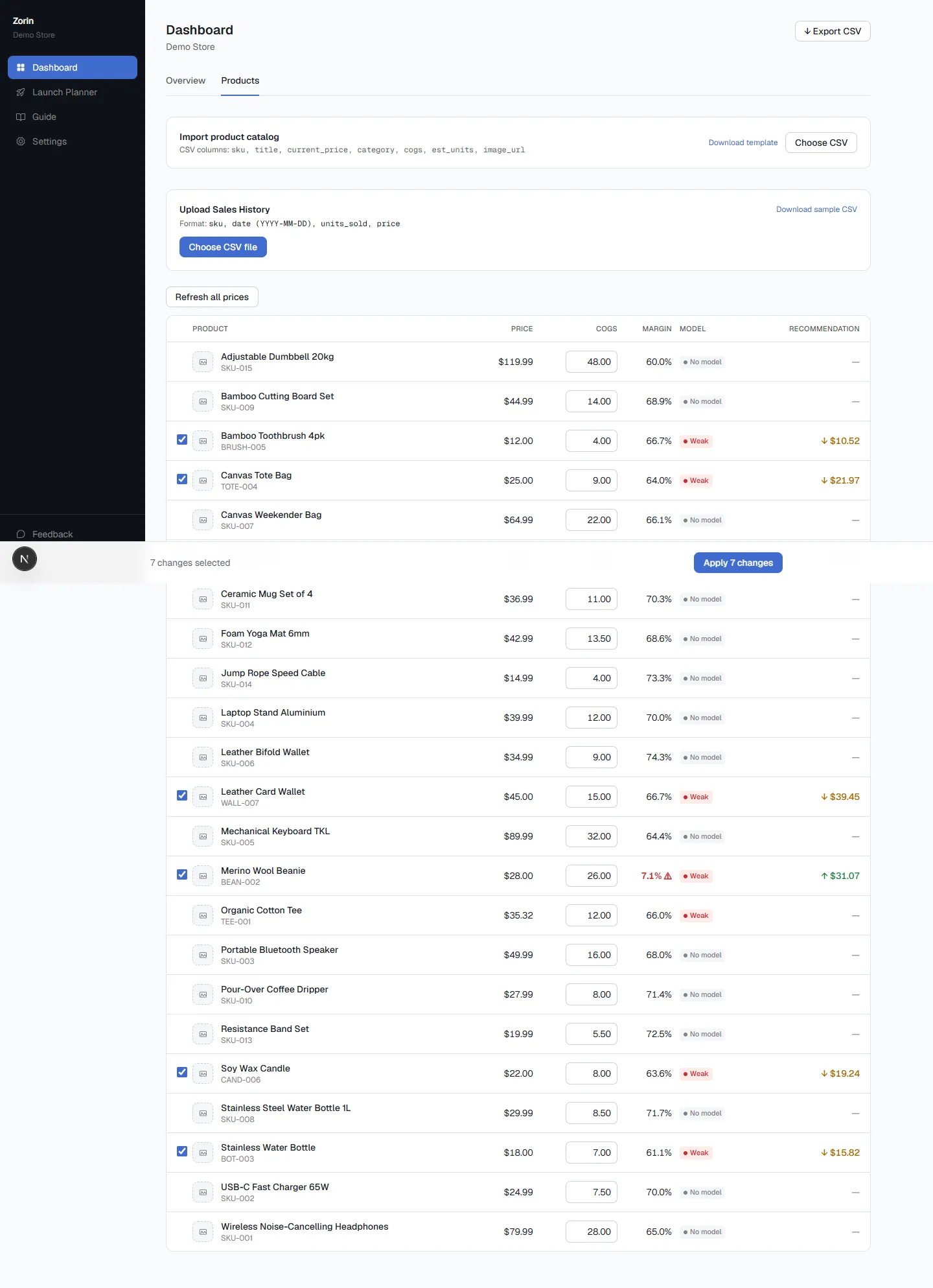
That second question is about demand, and it's what Zorin measures. It reads your Shopify or WooCommerce sales history, fits a price elasticity model for each product, and shows margin, model confidence and a raise, lower or hold recommendation side by side, with an estimated profit impact for each change. Your cost data sets the floor; your customers' response to past price changes sets the direction.
If you're still working out what margin to aim for in the first place, start with ecommerce profit margin benchmarks and how to track them.
Key Takeaways
- Markup is profit divided by cost; margin is profit divided by price. A $30 product sold at $60 has a 100% markup and a 50% margin.
- Convert with markup ÷ (1 + markup) and margin ÷ (1 − margin). A 50% markup is only a 33% margin.
- To hit a target margin, price = cost ÷ (1 − margin). Adding the margin percentage to cost undershoots it: "cost plus 40%" gives 28.6%.
- Costco's fiscal 2025 gross margin was 11.12%, about a 12.5% markup; e.l.f. Beauty's 70.7% margin is roughly a 241% markup.
- Use markup to set a starting price and margin to judge discounts, fees and benchmarks, then check demand to see if the price is actually right.
Frequently Asked Questions
What is the difference between margin and markup?
Markup is profit as a percentage of cost, and margin is profit as a percentage of the selling price. Both use the same profit figure, but because price is larger than cost, margin is always the smaller percentage. A product that costs $30 and sells for $60 has a 100% markup and a 50% margin.
Is a 50% markup the same as a 50% margin?
No. A 50% markup on a $30 cost gives a $45 price and $15 of profit, which is a 33.3% margin. To get a 50% margin you need a 100% markup, which means doubling the cost to $60.
How do I convert markup to margin?
Divide the markup by one plus the markup. A 100% markup is 1.00 ÷ 2.00 = 50% margin, and a 25% markup is 0.25 ÷ 1.25 = 20% margin. To go the other way, divide the margin by one minus the margin.
How do I calculate a selling price from a target margin?
Divide your cost by one minus the target margin. For a $24 cost and a 40% margin, the price is $24 ÷ 0.60 = $40. Multiplying cost by 1.40 instead gives $33.60, which is only a 28.6% margin.
Should I use margin or markup for pricing?
Use markup to set a starting price from a supplier cost, then check the margin before you commit. Margin is the right number for comparing against benchmarks, sizing discounts and budgeting fees and ad spend, because all of those are measured against revenue.
What is a good markup for ecommerce?
It depends heavily on the category. A warehouse retailer like Costco runs about a 12.5% markup, while beauty brands often run 200% or more. Work from the margin you need after fees, returns and marketing, then convert it to a markup, rather than copying a markup from another business.
Why is margin always lower than markup?
Because margin divides the same profit by the selling price, which is always larger than the cost for a profitable product. Dividing by a bigger number gives a smaller percentage. That's also why margin can never reach 100% while markup has no upper limit.
Margin and markup measure the same profit from two directions, and knowing which one you're looking at protects you from pricing below the margin you planned. Once your cost math is right, the next question is whether customers would pay more or buy more at a different price. Try Zorin free to see that product by product from your own sales history.
Written by Dexter
Dexter is part of the team at Zorin, building tools that help ecommerce merchants price with data instead of guesswork.
More in Margin & Profit Fundamentals
View all →WooCommerce vs Shopify Fees: Real Margin Compared
No platform fee doesn't mean better margin. WooCommerce vs Shopify transaction, hosting and plugin costs compared, and how to find your real net profit.
Ecommerce Profit Margins: Benchmarks & Tracking
Healthy ecommerce profit margins by category, gross vs net, margin vs markup, and how to track the gap on Shopify before it quietly eats your profit.
How to Know If Your Prices Are Too High or Too Low
Declining sales and high close rates are lagging signals. Price elasticity tells you before you change anything, not after the damage is done.