How to Price Clothing: Keystone, Returns, Tariffs
A healthy gross margin and a healthy business are not the same thing in apparel, and the gap between them is bigger here than in almost any other ecommerce category. TrueProfit's analysis of 600+ clothing stores puts healthy benchmarks at 60-70% gross margin but only 10-20% net margin, so roughly 50 points disappear between the two lines. This guide covers what markup and margin look like for clothing brands, where that gap comes from, how returns and tariffs drive it, and how to price consistently across wholesale, DTC and marketplace channels.
What's a Good Markup or Margin for a Clothing Brand?
Keystone pricing, doubling your cost to set your retail price, has been the default apparel formula for decades. It still works as a sanity check, but for most DTC brands it isn't enough on its own, because a 2x markup only produces a 50% gross margin before returns, acquisition and tariffs take their share.
How far above keystone you need to go depends on the channel. Wholesale carries fewer of your own costs, so brands can often live closer to 2x there. DTC carries customer acquisition, fulfillment and a much higher return rate, so a DTC price usually needs a noticeably larger multiple just to reach the same operating outcome.
On the margin side, TrueProfit's analysis of 600+ clothing stores puts healthy 2026 benchmarks at 60-70% gross margin, 20-30% operating margin and 10-20% net profit margin. For comparison, the biggest athletic brands report gross margins in the 40s and 50s: Nike posted 42.7% in fiscal 2025 and Lululemon has run 54-58%, according to their public filings. A garment costing $15 to produce landing at $30-40 wholesale or $60-80 DTC is a common example of what those multiples look like in practice.
These numbers are a useful starting reference, not a guarantee. As the next section covers, a gross margin that sits comfortably inside these ranges can still leave a brand with almost nothing at the operating line.
Here's how markup on cost translates into gross margin, which is the number the benchmarks above use (the formulas behind it are in markup vs margin explained):
| Markup on cost | $15 garment sells for | Gross margin |
|---|---|---|
| 2x (keystone) | $30 | 50% |
| 2.5x | $37.50 | 60% |
| 3x | $45 | 67% |
| 4x | $60 | 75% |
| 5x | $75 | 80% |
Why Is My Apparel Store's Margin Healthy but Profit So Thin?
This is one of the most common, and most confusing, experiences for apparel sellers: the gross margin looks fine, sometimes even good, and the business still isn't making real money.
The answer is in the order costs get paid. Gross margin only accounts for the cost of the product itself, materials, manufacturing, and direct labor. Everything else, returns, customer acquisition, marketing, fulfillment, and increasingly tariffs, gets paid out of what's left after that. In apparel specifically, what's left after that turns out to be a lot smaller than the gross margin number suggests.
Look at those benchmarks again: 60-70% gross, 10-20% net. That's not one underperforming brand, that's what a healthy clothing store looks like. A pricing approach that only protects gross margin is solving the wrong problem, because gross margin was never the number that decides whether the business is actually profitable.
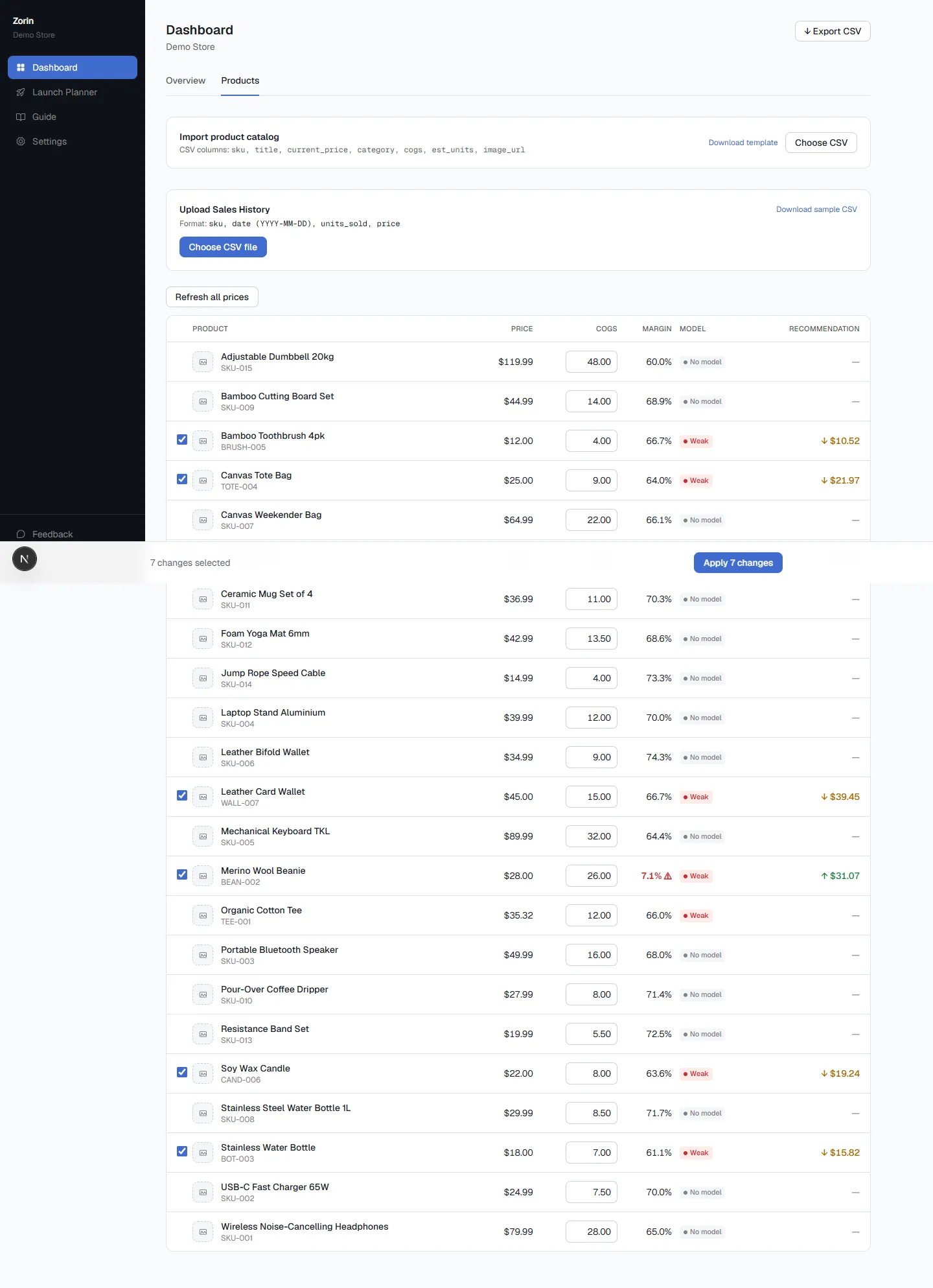
This is also why a fixed markup number, applied uniformly across a catalog, can be misleading. Two products can carry the identical 2.5x markup and land in very different places once returns and acquisition cost are factored in, because return rates and ad performance differ by product, not just by category. A per-SKU view of what's actually happening after gross margin, not just a blanket markup target, is what closes that gap between what the spreadsheet says and what the bank account shows.
How Returns Affect Pricing for Clothing and Apparel Brands
Fashion has the highest return rate of any ecommerce category. Coresight Research measured U.S. online apparel returns at 24.4%, published benchmarks range from 20% to 40%, and European fashion marketplace Zalando reports that around half of the items ordered come back; our return rate by category research has the sources. Fit-dependent items like shoes, fitted tops and pants run toward the high end, basics and accessories lower. Every return costs money: return shipping, inspection, restocking, and often a markdown on items that can't be resold at full price.
Run the math and the effect on margin is direct. If 30% of what you ship comes back and each return costs you $8 to process, a $60 jacket at a 50% gross margin earns about $18.60 per unit shipped, not the $30 on the sticker. A product priced to hit a target margin without accounting for its return rate is priced against a number it will never actually earn.
The practical implication for pricing: categories and styles with higher return rates (fit-dependent items like pants and fitted tops tend to run higher than accessories or basics) need either a higher markup to absorb the expected return cost, or a genuine investment in reducing returns through better sizing information and product photography. Sizing and fit issues alone are commonly cited as the majority driver of apparel returns, which is why better fit data moves the number more than return policy changes do. Pricing every product in a catalog identically, without accounting for the fact that a fitted blazer returns at a meaningfully different rate than a basic t-shirt, means some products are quietly subsidizing others.
See what Zorin's elasticity model says about your own catalog.
Start free trialHow Tariffs Affect What You Should Charge for Apparel
Tariffs have been the most volatile input cost in apparel pricing over the past two years, and the situation has genuinely moved more than once, which is exactly why a specific number quoted today is worth double-checking before you plan around it rather than treating it as settled.
The average U.S. tariff on apparel imports rose from 14.7% in January 2025 to 35.1% in December 2025, the highest in decades, according to data compiled by Sheng Lu at the University of Delaware, driven largely by the 2025 "reciprocal" tariffs layered on top of existing duties. That spike didn't hold: on February 20, 2026 the Supreme Court struck down the IEEPA-based tariffs, which covered the reciprocal tariffs. Other duties, including Section 301 tariffs on goods from China, weren't affected, and the overall picture has kept shifting since. The only safe approach is to check the current rate for your specific products and sourcing country before you set a price.
The pattern that matters more than any single number: this is an actively moving policy area, not a fixed cost you can plan against once and forget. If you're pricing against a specific tariff figure, verify the current rate for your specific sourcing country and product category before treating it as still accurate, since the rate that applied even six months ago may no longer hold.
The pass-through versus absorb decision that applies to any cost increase, not raise every price uniformly, but check which specific products can tolerate a price increase without losing meaningful volume, applies directly here. A tariff-driven cost increase is still a cost increase, and the products with more inelastic demand are the ones that can absorb more of it without the price change costing you more in lost sales than it saves in margin.
Should You Price the Same on Shopify DTC, Wholesale, and Marketplaces?
No, and the channel-conflict conversation that apparel brands often have internally is really a margin-architecture conversation in disguise. Once each channel is priced to its own operating line, rather than to a single blended number applied everywhere, most of the perceived conflict resolves itself, because nobody is using DTC discounts to quietly paper over a wholesale margin problem, or vice versa.
The working multiples reflect this directly: wholesale typically runs 1.9-2.2x production cost, while pure DTC runs 3-5x. That's not brands being inconsistent, it's brands pricing each channel for the costs specific to that channel. Wholesale carries lower acquisition cost (the retailer brings the customer) but a lower price ceiling, since the retailer needs their own margin on top. DTC carries the full acquisition and fulfillment cost but commands a higher price, since the brand is selling directly with no intermediary margin to protect.
If you're selling apparel on Shopify alongside Amazon or another marketplace, the multi-channel pricing framework covers the mechanics in more depth, including the Buy Box suppression risk that can result from pricing your DTC store meaningfully lower than a marketplace listing. The same underlying principle applies: price each channel to reflect its own fee structure and margin requirements, rather than defaulting to one number everywhere and hoping it works out evenly across all of them.
Run your own margin math instead of a category-wide benchmark. Start a free trial and see which of your products have room to move and which are already priced right. If skincare or another beauty category is also part of your catalog, the margin structure and launch-pricing approach look quite different, worth a separate read rather than assuming apparel benchmarks carry over.
Key Takeaways
- Keystone (2x markup) is a floor, not a target. DTC brands usually need a bigger multiple than wholesale because DTC carries acquisition, fulfillment and higher return costs.
- Gross margin and net margin are very different numbers in apparel. Healthy clothing stores run 60-70% gross margin but only 10-20% net, per TrueProfit's benchmarks.
- Returns alone can cut margin sharply. At a 30% return rate and $8 per return, a $60 jacket at 50% gross margin earns about $18.60 per unit shipped instead of $30.
- Tariffs are an actively moving policy area, not a fixed number. The effective rate spiked in 2025, was partly reversed by a Supreme Court ruling, and shifted again by mid-2026, varying by sourcing country. Verify current rates before pricing against a specific figure.
- Price each channel to its own operating line, not to one blended number. DTC, wholesale, and marketplace pricing all carry different cost structures, and matching them intentionally resolves most channel-conflict concerns.
Frequently Asked Questions
What's a good markup or margin for a clothing brand on Shopify?
Keystone (2x cost) gives a 50% gross margin and is best treated as a floor. TrueProfit's benchmarks for healthy clothing stores are 60-70% gross margin, which means roughly 2.5-3.3x cost, with 20-30% operating and 10-20% net margin. DTC brands generally need to sit higher than wholesale-heavy brands because they carry acquisition, fulfillment and return costs themselves.
Why does my apparel store have healthy gross margin but barely any profit?
Gross margin only accounts for product cost. Everything else, returns, customer acquisition, fulfillment and tariffs, gets paid out of what's left, and in apparel that leaves much less than the gross margin suggests. TrueProfit's benchmarks for healthy clothing stores are 60-70% gross margin but only 10-20% net, a gap driven mainly by returns and acquisition costs.
How do returns affect pricing for clothing and apparel brands?
Significantly. Fashion has the highest return rate of any ecommerce category, around 24% for U.S. online apparel by Coresight Research's measure and higher for fit-dependent items. Each return costs shipping, handling and often a markdown. Products with higher expected return rates need either a higher markup to absorb that cost or investment in reducing returns through better sizing and photography.
Should I price my clothing the same on my Shopify store as wholesale or Amazon?
No. Each channel carries a different cost structure, so pricing them identically usually means underpricing one channel or overpricing another. Wholesale typically runs 1.9-2.2x production cost since the retailer brings the customer and takes their own margin; DTC runs 3-5x since the brand absorbs full acquisition and fulfillment cost directly. Price each channel to its own operating line rather than a single number applied everywhere.
How do tariffs and import costs affect what I should charge for apparel?
Significantly, and unpredictably. The average U.S. apparel import tariff rose from 14.7% to 35.1% during 2025, then the Supreme Court struck down the IEEPA-based reciprocal tariffs in February 2026, while other duties such as Section 301 tariffs on China remained. Because this is an actively moving policy area, check current rates for your specific sourcing country before pricing rather than relying on any fixed figure, including the ones in this article.
Is keystone pricing (2x markup) still a viable strategy for apparel?
As a sanity check, yes, it's a reasonable floor to make sure you're not pricing too low. As a full strategy, no. A 2x markup produces roughly a 50% gross margin, and in apparel that typically converts to a low-single-digit operating margin once returns and acquisition costs are paid. Treat keystone as the minimum you need to beat, not the number you're aiming to land on.
Why do DTC apparel brands charge so much more than the same product wholesale?
Because DTC absorbs costs that wholesale doesn't. A wholesale buyer brings their own customer base, so the brand's acquisition cost on that sale is close to zero, and the retailer applies their own markup on top before it reaches the end customer. A DTC sale means the brand pays for the entire acquisition, fulfillment, and (often) return cost directly, and needs a meaningfully higher multiple to reach a comparable operating outcome per unit sold.
Markup and margin benchmarks are a useful floor, not a guarantee that a given price is actually working. Returns, tariffs, and channel mix all pull differently on different products in the same catalog, which means the products that can safely absorb a price increase and the ones that can't rarely line up neatly with a single category-wide target. Zorin reads your Shopify or WooCommerce sales history per SKU and shows you which specific products have room to move and which don't, so the pricing decision reflects how each product is actually performing rather than a markup number applied evenly across very different items.
Written by Dexter
Dexter is part of the team at Zorin, building tools that help ecommerce merchants price with data instead of guesswork.
More in Vertical-Specific Pricing
View all →What's a Good Profit Margin for a Supplement Brand?
DTC supplement brands typically run 60-80% gross margins. What a healthy margin looks like, how to price new SKUs, and how to set subscribe-and-save.
Skincare Pricing on Shopify: Charging Enough?
Most DTC skincare brands underprice. Learn what healthy margins look like, how to structure pricing tiers, and how to price SKUs with real demand data.