Skincare Pricing on Shopify: Charging Enough?
If your DTC skincare brand's gross margin is below 65%, you're almost certainly underpriced. Private DTC skincare benchmarks land at 65-72% median, with the strongest brands clearing 75%. Below that floor, there's rarely enough room to fund customer acquisition and still earn an operating profit. The fix usually isn't cutting costs. It's raising prices, and the conversion drop from a moderate increase is almost always smaller than skincare founders expect.
Most skincare pricing advice on the internet starts and ends with a cost-plus formula: calculate COGS, apply a 2-3x markup, check what competitors charge, done. That produces a defensible number. It rarely produces the right one. This post covers what healthy beauty margins actually look like, why most indie brands underprice, how to structure pricing across a product line, how to price a new SKU with no sales history, and how to know which products can handle a price increase using real demand data from tools like Zorin.
What "Good Margins" Actually Look Like for a DTC Beauty Brand
Beauty and skincare carry some of the highest gross margins in ecommerce, but "high" is relative, and the range within the category is wide. Here's what the benchmarks actually say.
Public pure-play beauty companies show what healthy skincare margins look like: e.l.f. Beauty carried a 70.7% gross margin in its most recent 10-K and Olaplex 69.4% in its fiscal 2025 10-K. A brand selling well below the high 60s is usually leaving margin on the table rather than facing a structural cost problem. These numbers represent cost of goods as a percentage of revenue, including ingredients, packaging, and direct production costs.
Below 65% gross margin, the economics of a DTC beauty brand start to break down. Here's why: customer acquisition in beauty is expensive. According to MHI Growth Engine's 2026 DTC benchmarks, the average CPA for a DTC skincare brand is roughly $42, with a median AOV of $68. At those numbers, first-order contribution margin after product costs is approximately 38%. That has to cover payment processing, shipping, packaging, returns, and ideally leave something for operating profit. With a gross margin of 55%, that math gets very tight very fast. With a gross margin of 70%, it works.
The benchmarks also vary meaningfully by product type within skincare. According to BootLeads' Shopify skincare store data, the average listed price for skincare products on Shopify is about $55, but the most common pricing band is under $25. That gap between the average and the mode tells you that a small number of brands are pricing at premium levels and pulling the average up, while the majority are clustering at entry-level price points. If most of your catalog is priced under $25, you're competing in the most crowded part of the market with the thinnest margins.
One number to keep in mind as a gut check: the beauty rule of thumb is an 8-10x markup on bare unit COGS (ingredients and packaging only, before labor, overhead, or shipping). If your serum costs $4 in ingredients and packaging and you're selling it for $24, that's a 6x markup, or an 83% gross margin (see how markup converts to margin). Technically profitable, but leaving significant room on the table compared to brands that sell a similar formulation for $38-48.
The Underpricing Problem in Beauty
Most DTC beauty brands are underpriced. That's not an opinion. It's a pattern visible across pricing data from agencies, platforms, and the brands themselves.
ATTN Agency documented a case study that illustrates this precisely. A skincare brand came to them spending $180,000 per month on Meta ads with a $52 AOV and a 3% contribution margin. The founders were terrified to raise prices because "the market is competitive." The agency ran a price test at three points: $52, $62, and $72. The $62 price point generated 6.5% more revenue per visitor and nearly tripled contribution margin from 3% to 8.5%. The conversion rate barely moved. Same product, same ads, same creative. Just a $10 price increase turned a money-losing brand into a profitable one.
This pattern repeats because of a structural dynamic specific to beauty. Skincare founders price from costs and competitors, both of which push prices down. COGS on a skincare product can be remarkably low ($3-8 for many formulations), so cost-plus at 2-3x gives you a $9-24 price point. Then you check what "similar" products cost on Amazon or the Shopify App Store, and you find a crowded range of $15-30 cleansers and $25-45 serums. You price within that range, and you move on.
What this misses is a dynamic that matters more in beauty than in most categories: price can function as a quality cue, not just a cost. Laura Thompson, co-founder of Three Ships Beauty, described the experience on Shopify's blog: her brand was initially priced too cheaply, and customers didn't associate the product with being high quality. Pricing up didn't just improve margins. It improved conversion because the product finally looked like it was worth what it actually delivered. That effect isn't universal, plenty of beauty shoppers are genuinely value-driven and skeptical of price-as-quality signaling, but for a brand telling a premium or clinical-grade story, pricing too low can actively undercut the story you're trying to tell.
This is the opposite of how pricing works in commodity markets. In commodities, lower price wins the sale because the product is identical. In beauty, lower price can lose the sale because it signals the product isn't as good. A $12 vitamin C serum and a $48 vitamin C serum may have similar ingredient lists, but the $48 one has permission to tell a story about clinical-grade formulation, third-party testing, and premium sourcing that the $12 one doesn't.
The takeaway is blunt: if you've never raised your prices since launching your skincare brand, and your margins are below 65%, you are almost certainly underpriced. The conversion penalty for a moderate increase (10-20%) in beauty is consistently smaller than founders expect, and the margin improvement is consistently larger.
How to Price Across Your Product Line (Entry, Core, Premium)
A skincare line needs a pricing ladder, not a single markup formula. Different products serve different jobs in your catalog, attract different customer mindsets, and carry different margin profiles. Applying the same 3x markup across your entire line means your cleanser and your clinical serum are priced using the same logic, which doesn't reflect how customers actually evaluate them.
A common good-better-best structure spaces three tiers at roughly 1x : 1.5x : 2-3x, with each tier doing a different job:
| Tier | Typical price range | Target gross margin | Job |
|---|---|---|---|
| Entry (good) | $14-24 | 60-70% | Acquire customers. Low-risk first purchase. Builds trial and trust. |
| Core (better) | $28-48 | 70-75% | Default revenue driver. Where most volume should land. The "sensible" choice. |
| Premium (best) | $60-120+ | 75-80%+ | High-margin anchor. Makes the core tier look reasonable by comparison. |
The most useful move in this framework is presenting the premium SKU first. A $98 clinical serum on the product page makes the $42 core serum read as the sensible, mainstream choice, which is exactly where you want most of your volume. This is the anchoring effect applied to your own catalog: the premium price reframes how customers evaluate the core price.
Within these tiers, product type matters. Daily-use products (cleansers, moisturizers, toners) are more price-sensitive because customers buy them every 6-10 weeks and have a strong sense of per-ounce cost. These naturally sit in the entry and lower-core range. Treatment products (serums, masks, peels, exfoliants) command higher margins because customers perceive them as transformative, buy them less frequently, and evaluate them by results rather than volume. These belong in the upper-core and premium range.
Pricing consistency across tiers also matters more than most founders realize. If your eye cream (0.5 oz) costs less than your face cream (1.5 oz) without a clear reason, customers notice the inconsistency. The formulation, ingredient quality, or concentration should justify any price point that breaks the per-ounce pattern. A $68 eye cream is defensible if it contains retinal at 0.1% in a specialized delivery system. It's confusing if it uses the same ingredients as your $32 moisturizer.
For a deeper look at whether your current prices are too high or too low independent of product category, see our post on how to know if your prices are too high or too low.
See what Zorin's elasticity model says about your own catalog.
Start free trialHow to Price a New Skincare Product When You Have No Sales Data
Launching a new SKU is the hardest pricing decision in beauty. You have COGS, you have competitor reference points, and you have instinct. None of these tell you what your specific customers would actually pay for this specific product.
Cost-plus gives you a floor. If your serum costs $6 to produce (ingredients, packaging, fill, label), a 10x markup puts you at $60. That's useful as a minimum viable price, but it doesn't tell you whether $60 is too low, too high, or exactly right for your audience and brand positioning.
Competitor benchmarking gives you noise, not signal. A "similar" serum at another brand was priced based on their costs, their brand equity, their audience, and their margin targets, none of which are the same as yours. Importing their number imports their entire pricing logic, which may not fit your store.
The more useful approach for a pre-launch SKU is stated-preference research: asking your own customers (or target customers) what they'd pay, using a structured methodology rather than a casual "would you buy this for $X?" question.
Zorin's Van Westendorp Price Sensitivity survey does this with four questions that calculate an acceptable price range, an optimal price point, and critically, a "too cheap" threshold. The too-cheap finding is especially valuable in beauty because it identifies the price below which customers start questioning product quality. For a clinical-grade serum, discovering that your target audience considers anything below $35 "too cheap to trust" is a pricing signal worth more than any cost-plus formula.
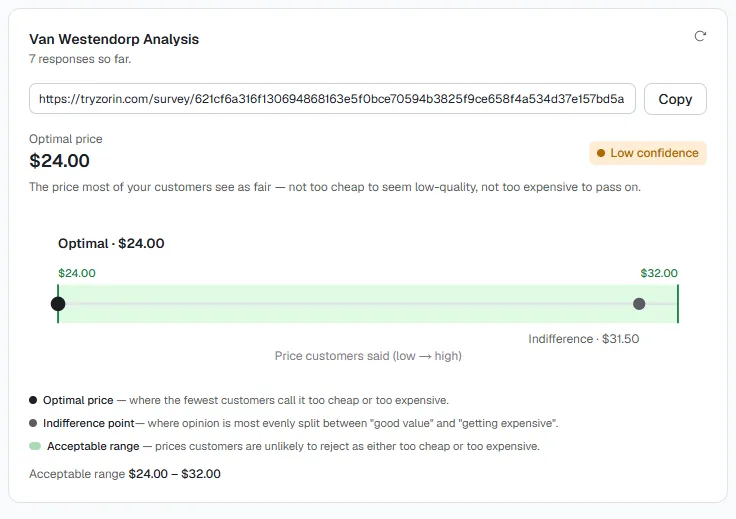
The survey requires no login from respondents and produces a stated-preference read you can use to set your launch price. Once the product has a few months of sales history, Zorin's elasticity model picks up from there with a revealed-preference signal, showing you how customers actually responded to the price through their purchasing behavior rather than their survey answers. You read the two signals side by side: what they said they'd pay, and what they actually did.
For more on pricing new products with no history, see our post on how to price a new product with no sales history.
When to Raise Your Prices (and How to Know Your Customers Can Handle It)
If your beauty products are selling steadily, your margins are below 65%, and you haven't changed prices since launch, the answer is almost certainly to raise them. But "raise prices" isn't one decision. For a 40-SKU skincare line, it's 40 separate decisions, and each product has a different tolerance for an increase.
This is where cost-plus thinking falls apart entirely. A cost-plus formula can tell you that your cleanser "should" be $22 based on a 3x markup. It can't tell you whether moving it from $18 to $22 will cost you 2% of unit volume or 15%. That answer depends on how price-sensitive your specific customers are for that specific product, and the only way to know is to read the data.
Zorin fits a demand model per SKU from your Shopify or WooCommerce sales history. For each product, you get a raise, lower, or hold recommendation with the elasticity coefficient that shows exactly how demand responds to price changes. A product with low elasticity (demand barely moves when price moves) is safe to increase because your customers aren't price-sensitive on that item. A product with high elasticity (demand drops sharply when price increases) needs more caution.
For a skincare brand, the elasticity pattern often maps intuitively to product type. Treatment products with strong ingredient stories and visible results tend to be more inelastic: customers keep buying because the product works for their skin, and a $5 increase doesn't change that calculus. Daily-use basics like cleansers tend to be more elastic because customers have more alternatives and a stronger per-ounce price awareness.
The confidence label adds a second layer of honesty. Many skincare SKUs have limited price variation history because the brand set a price at launch and never moved it. Zorin flags these as weak-confidence rather than presenting a false recommendation. A product with insufficient data to model gets a "we can't tell you yet" answer, not a guess dressed up as certainty.
A practical approach to raising prices across a skincare line:
Start by identifying the 5-10 products where Zorin shows a "raise" recommendation with strong confidence and low elasticity. These are the products where the data says your customers can absorb an increase without meaningful volume loss. Raise these first by 10-15%. Measure the impact over 4-6 weeks.
Then move to the medium-confidence products and test smaller increases (5-10%). Hold off on the high-elasticity and weak-confidence products until you have more data.
This sequenced approach is less risky than a blanket price increase across your entire catalog, and it lets you learn which product types and price bands your audience is most sensitive to. You can preview the margin impact of any price change using the Shopify profit margin calculator before committing.
For more on the mechanics and psychology of raising prices, see our post on whether you should raise prices to cover rising costs. Skincare isn't the only category with its own pricing quirks either. Apparel carries a different set of pressures entirely, from size-run economics to return rates, and supplements have their own margin structure and subscription economics, worth a look if you sell across categories.
Key Takeaways
- DTC skincare gross margins should be 65-75%, with the best brands above 75%. Below 65%, there's rarely enough room to fund acquisition and still earn an operating profit.
- Most indie beauty brands are underpriced. A skincare brand that raised its hero product from $52 to $62 saw conversion barely move while contribution margin nearly tripled, from 3% to 8.5%.
- Structure your pricing as a good-better-best ladder (entry $14-24, core $28-48, premium $60-120+) with each tier serving a different job and carrying a different margin band. Present the premium tier first to anchor the core tier as the sensible choice.
- For new product launches, a Van Westendorp survey identifies what your customers consider too cheap (a quality-perception risk unique to beauty) and too expensive, giving you a data-backed launch price before you have any sales history.
- Use per-SKU elasticity data to identify which products in your catalog can absorb a price increase and which can't. Start a free trial of Zorin to see raise, lower, and hold recommendations across your product line.
Frequently Asked Questions
How do I know if I'm charging enough for my skincare products on Shopify?
Check your blended gross margin across your catalog. If it's below 65%, you're almost certainly underpriced for a DTC beauty brand. The private DTC skincare benchmark is 65-72% median, with top performers above 75%. If your margins are in the 40-55% range, a moderate price increase (10-15%) on your least price-sensitive products will likely improve profitability without meaningfully affecting conversion.
What profit margin should a DTC beauty brand aim for, and how do I get there?
Target 65-75% gross margin, with the goal of eventually reaching the 70-75% range where the strongest DTC skincare brands operate. To get there, audit your pricing tier by tier: entry products should clear 60-70% gross, core products 70-75%, and premium products 75-80%+. If your product COGS are already low (as they typically are in skincare), the lever is raising prices, not cutting costs. A skincare brand's unit COGS are often $3-8, so even small price increases produce outsized margin improvements.
How do I price a new skincare product when I don't know what customers will pay?
Start with cost-plus to set your floor (8-10x bare unit COGS is the beauty rule of thumb), then validate with stated-preference data. Zorin's Van Westendorp survey identifies the acceptable price range and optimal price point using four structured questions. The "too cheap" threshold is especially useful in beauty, where pricing too low can signal low quality rather than a good deal. Once you have 2-3 months of sales data, elasticity modeling picks up with revealed-preference signals showing how customers actually responded to the launch price.
Why do some beauty brands charge $60 for a serum and still outsell cheaper alternatives?
Because price is a quality signal in beauty. A $60 serum has permission to tell a story about clinical-grade formulation, higher active concentrations, third-party testing, and premium packaging that a $18 serum doesn't. Customers buying a $60 serum aren't comparison-shopping on price. They're buying a perceived outcome: better skin. The higher price actually supports conversion because it reinforces the product's credibility. Brands that try to compete on price in the treatment skincare category often find that lower prices reduce trust rather than increase sales.
Should I raise my prices if my beauty products are selling well but my margins are thin?
Yes, almost certainly. If products are selling steadily, that's evidence of demand. Thin margins on a product with steady sales usually means the product is underpriced, not that you need to sell more volume. The key is knowing which specific products can absorb an increase. Zorin's per-SKU elasticity model identifies which SKUs have inelastic demand (safe to raise) and which are more price-sensitive (raise cautiously or hold). Start with the 5-10 least elastic products and test a 10-15% increase.
Is the 2-3x markup on COGS enough for a skincare brand?
It depends on your COGS, but for most skincare brands, a 2-3x markup is too low. Skincare COGS are typically very low ($3-8 per unit for many formulations), so a 2-3x markup gives you a $6-24 retail price. That's the most crowded and lowest-margin segment of the market. The beauty rule of thumb is 8-10x on bare unit COGS, which puts a product with $5 COGS at $40-50, firmly in the core tier where healthy margins live. Higher markups aren't greed, they're what's required to fund marketing, absorb returns, and still earn operating profit.
How should I handle pricing for subscription vs. one-time purchases?
A 10-15% subscription discount is standard in DTC skincare and is usually margin-positive because it increases customer lifetime value and reduces acquisition cost per order. Skincare's natural replenishment cycle (every 6-10 weeks for daily-use products) makes subscription a strong fit. Price the one-time purchase at your target margin, then offer the subscription discount as a loyalty incentive. The slight margin reduction per order is more than offset by the increased purchase frequency and reduced churn.
Should I price differently for daily-use products vs. treatment products?
Yes. Daily-use products (cleansers, moisturizers, toners) should sit in the entry-to-lower-core range ($14-32) because customers buy them frequently, have strong per-ounce price awareness, and compare them against more alternatives. Treatment products (serums, masks, peels, exfoliants) belong in the upper-core-to-premium range ($38-120+) because customers perceive them as transformative, evaluate them by results rather than volume, and buy them less often. Applying the same markup to both product types ignores how differently customers evaluate them.
How do I know if my prices are too low and it's hurting my brand perception?
Look for two signals. First, qualitative: if customers or reviewers describe your products as "great value" or "can't believe how cheap this is," that's a price-perception warning in beauty. In skincare, "cheap" is not a compliment. Second, quantitative: if your conversion rate is unusually low despite good traffic and strong product reviews, the price itself may be undermining perceived quality. A Van Westendorp survey can identify the threshold below which your target audience starts questioning quality, giving you a concrete number to price above.
Underpricing is the default state for most DTC skincare brands, not a mistake anyone made on purpose. Fix it in order: get your margin structure right tier by tier, price new launches with real customer data instead of a cost-plus guess, and use per-SKU elasticity to find out which existing products can absorb an increase without losing customers. Start a free trial to see raise, lower, and hold recommendations across your own catalog.
Written by Dexter
Dexter is part of the team at Zorin, building tools that help ecommerce merchants price with data instead of guesswork.
More in Vertical-Specific Pricing
View all →What's a Good Profit Margin for a Supplement Brand?
DTC supplement brands typically run 60-80% gross margins. What a healthy margin looks like, how to price new SKUs, and how to set subscribe-and-save.
How to Price Clothing: Keystone, Returns, Tariffs
A 55% gross margin can still mean 7% profit in apparel. Keystone markup benchmarks, return costs and tariffs: what's really eating your clothing margin.