How to Price a New Product With No Sales History
Without sales history, you can't yet calculate elasticity, so a new product's launch price should be set with value-based reasoning and a deliberate cost-plus floor, then corrected quickly once real sales data starts to accumulate. The honest answer is that a launch price is always a hypothesis, not a settled number, and the goal is getting to real data as fast as possible, not perfecting a guess.
Why This Is a Different Problem From Repricing an Existing Product
Everything about pricing an established product starts from a demand signal: past sales at past prices. A brand-new product has none of that. There's no elasticity to calculate yet, no confidence score to lean on, nothing but a hypothesis about what customers will pay. That's not a flaw in the process, it's just the honest starting condition every new product launches from.
The Most Common Mistake: Underpricing to Feel Safe
Simon-Kucher, which has studied product launches for decades, reports that 72% of innovations fail to meet their financial targets or fail entirely, and puts much of the blame on price being decided at the last minute with a cost-plus formula instead of being tested against what customers value. For a small store, the most common version of that mistake is underpricing. Underpricing feels safer in the moment, since a lower number seems less likely to scare off a first customer. The problem is that underpricing without a deliberate plan to raise the price later trains customers to expect the low number, and by the time you try to correct it, the product has already built a customer base anchored to a price it never should have kept.
The distinction that matters: a lower launch price used deliberately, with a planned path to test higher prices soon after, is a legitimate strategy. A lower launch price chosen simply because it feels less risky, with no plan to move it, usually locks in a margin problem.
Two Starting Points Worth Combining
Value-based reasoning
Anchor your starting price in what the customer believes the product is worth, not just what it cost you to make. This requires actually thinking through the comparison the customer will make in their head, what alternative are they weighing this against, and what makes this specific product worth more or less than that alternative.
A cost-plus floor as a safety net
Regardless of the value story, calculate your true landed cost, including fees and fulfillment, and treat the resulting minimum margin as a floor no launch price should cross. This doesn't replace value-based thinking, it just prevents a value estimate from accidentally pricing you into a loss.
Ask Customers Before You Launch
You can't read elasticity from sales that haven't happened, but you can ask. A Van Westendorp price sensitivity survey puts four short questions to people who fit your target customer: at what price would this be too cheap to trust, a bargain, getting expensive, and too expensive to consider. The answers give you an acceptable price range and a likely sweet spot before launch day. Our free Van Westendorp survey template has the exact question wording, and how to run a Van Westendorp price survey covers who to ask and how many responses you need.
Survey answers are stated preferences, not real purchases, so treat the range as a guide for your first price, not a final answer. Once real orders arrive, they outrank anything a survey said.
Why Starting High Is Easier to Fix Than Starting Low
Launching high and coming down is usually easier than launching low and going up, but it isn't free. When Apple launched the original iPhone at $599 in 2007, it cut the price of the 8GB model from $599 to $399 barely two months later. The backlash from early buyers was loud enough that Steve Jobs published an open letter and offered earlier buyers a $100 store credit. The lesson isn't to avoid launching high. It's that a planned price path, and a way to look after your earliest customers if the price drops, should be decided before launch rather than improvised after it.
See what Zorin's elasticity model says about your own catalog.
Start free trialCompetitive Benchmarking Has a Role, But a Limited One
Looking at comparable products can tell you the rough range customers already expect for something like yours. It's a reasonable starting anchor, especially with zero reviews or track record of your own yet. It's not a substitute for eventually reading your own customers' actual behavior, and pricing meaningfully below a comparable product's price risks starting a race to the bottom rather than establishing a fair starting point.
Deliberately Generating the Data You'll Need
The fastest way out of "no sales history" is a small, planned price test rather than picking one number and leaving it untouched indefinitely. Testing two or three price points early, even briefly, gives you the price-and-quantity variation elasticity actually needs to be calculated. Sitting at one unchanged price for months produces the exact blind spot: no variation means no signal, regardless of how much volume moves.
What Changes Once Real Data Exists
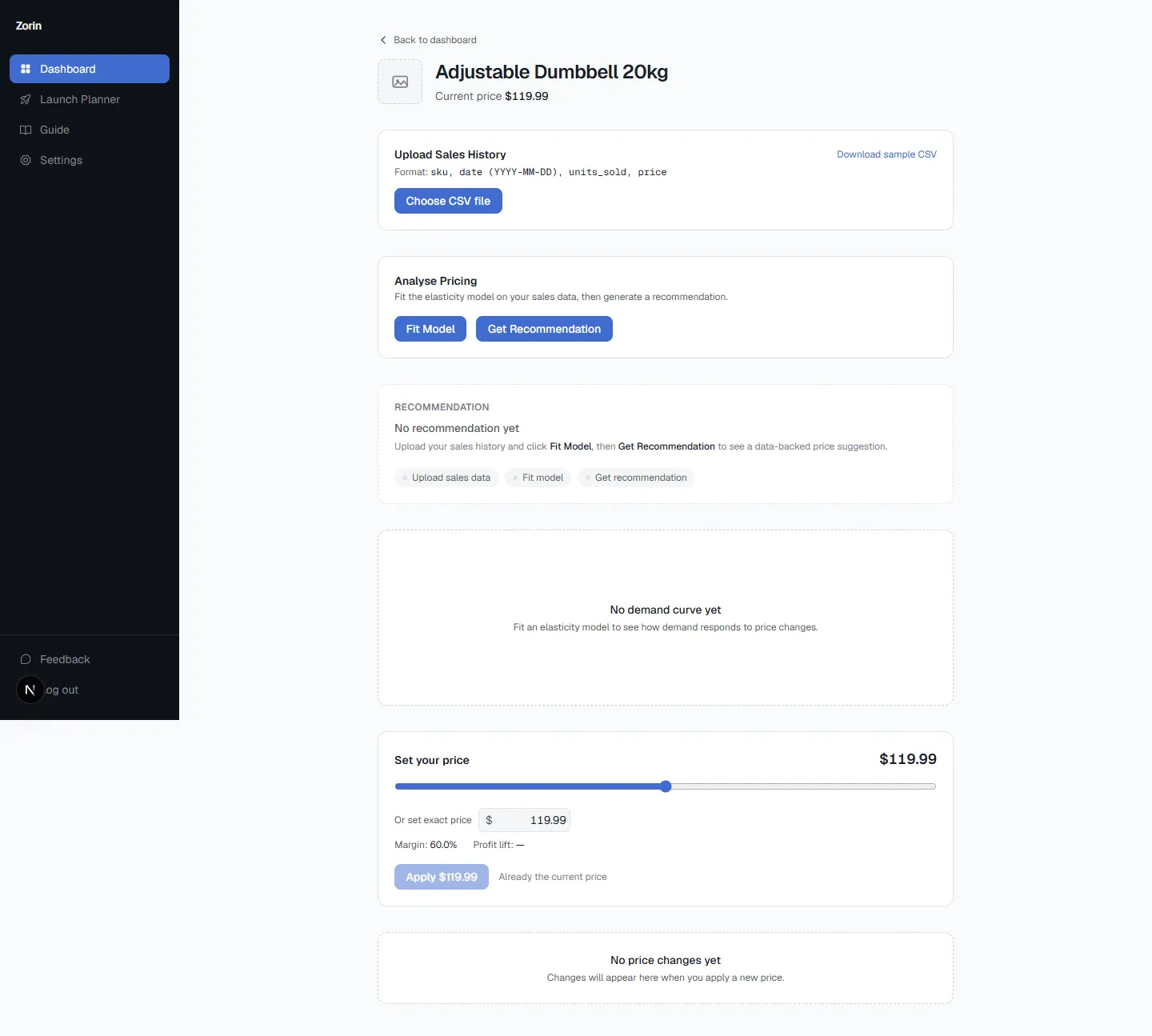
As soon as there's enough sales history with some price variation, an elasticity model can be fit for the product just like any established item in your catalog, with a confidence score reflecting how thin that early data still is, no statistics background required to read it, the calculation itself runs automatically. Early on, expect a Weak or Fair confidence label rather than Strong, and treat the resulting recommendation as directional rather than final until more history accumulates.
| Stage | What you have | What to do |
|---|---|---|
| Pre-launch | No sales data, no elasticity | Value-based estimate, cost-plus floor, light competitive benchmarking |
| First few weeks | Limited data, likely no price variation yet | Test a second price point deliberately to generate real signal |
| After enough variation | Early elasticity estimate, Weak or Fair confidence | Treat as directional; revisit as more data accumulates |
| Established history | Strong-confidence elasticity estimate | Trust the recommendation with normal confidence, same as any mature product |
A Practical Sequence for a New Product
- Set a cost-plus floor first, so no launch price can accidentally sell at a loss.
- Anchor a value-based starting price above that floor, reasoning through what the customer is comparing it against. Once you have that number, whether to end it in .99 or round it is a separate, smaller decision layered on top.
- Avoid underpricing purely to feel safe without a deliberate plan to test higher soon after.
- Test a second price point within the first few weeks to generate real variation.
- Let a confidence-scored elasticity estimate take over once there's enough history, and stop relying on the initial guess.
If you're still comparing tools for when that data does arrive, here's what to actually look for in a price optimization app built for a lean team. Once you have even a few weeks of sales at more than one price, upload that history and see what the earliest elasticity read looks like, flagged with an honest confidence level rather than false certainty.
Key Takeaways
- A launch price without sales history is a starting hypothesis, not a final answer. There's no way to calculate elasticity before real data exists.
- Pricing is usually decided too late: Simon-Kucher reports that 72% of innovations miss their financial targets or fail outright, largely because price is treated as an afterthought.
- Start from a cost-plus floor for safety, then anchor toward value-based reasoning about what the product is actually worth to the customer.
- Deliberate initial price variation (even small, planned tests) is what generates the data you'll need to calculate real elasticity soon after launch.
- Treat the first weeks of sales as the data-gathering phase, and revisit the price with real elasticity as soon as there's enough history to calculate it.
Frequently Asked Questions
How do I price a new product with no sales history?
Start with a cost-plus floor for safety, anchor a value-based starting price above it, and plan to test a second price point soon after launch to generate the data needed for a real elasticity estimate.
Is it safer to underprice a new product at launch?
Not necessarily. Most mispriced new products are priced too low, and underpricing without a deliberate plan to raise the price later often locks in a lower margin permanently.
Should I just match a competitor's price for a new product?
Competitive benchmarking is a reasonable starting anchor with no track record of your own, but it shouldn't replace eventually pricing from your own customers' actual behavior.
How soon can I calculate real elasticity for a new product?
As soon as there's some sales history with real price variation, even a few weeks' worth, though the confidence level will start Weak or Fair until more data accumulates.
Should I test multiple prices right after launch?
Yes, deliberately. A single unchanged price produces no variation to learn from, while testing a second price point early generates the signal elasticity actually needs.
What's the biggest risk with a new product's launch price?
Picking a price by instinct and never revisiting it once real sales data exists, which turns a reasonable starting hypothesis into a permanent, unexamined mistake.
How do I know when to stop trusting my initial guess?
As soon as a confidence-scored elasticity estimate exists for the product, that number should carry more weight than the original launch-day reasoning.
A new product's price is always a hypothesis at launch, not a final answer. Set it deliberately, avoid underpricing purely out of caution, and move quickly toward real sales data so the hypothesis can be replaced by an actual, measurable read on what your customers will pay.
Written by Dexter
Dexter is part of the team at Zorin, building tools that help ecommerce merchants price with data instead of guesswork.
More in Multi-Channel & Launch Pricing
View all →How to Raise Your Price After a Product Launch
When and how much to raise a launch price, in 5 steps, sized with your own elasticity data so the increase sticks instead of stalling sales.
Does a Lower Amazon Price Hurt Customer Trust?
When a lower Amazon price than your own store hurts customer trust, when shoppers don't notice, and how to stop channel price gaps costing repeat buyers.
Channel Pricing: Same Price on Shopify and Amazon?
The same price on every channel means a different margin on each, but a lower Shopify price risks Amazon's Buy Box. How to set channel prices that hold.