Do You Need a Data Analyst to Price Products?
No, you don't need a data analyst to price your products well. The underlying math, elasticity modeling from your sales history, is genuinely statistical, but the calculation itself can run automatically the moment you upload your sales data. What used to require a dedicated analyst is now a mechanical step, not a skill you personally need to acquire.
Why This Question Comes Up So Often
Pricing discussions are full of statistical language, elasticity, regression, confidence intervals, and it's reasonable to assume that anything described that way requires a specialist to actually use. That assumption made more sense when the only way to get an elasticity estimate was to build a spreadsheet model yourself or hire someone who could. It makes much less sense now that the calculation itself is automatable.
What a Pricing Analyst Actually Used to Do
Historically, a pricing analyst's core job was reading a company's own sales data systematically: gathering price and quantity history, running a regression to estimate elasticity, checking the fit of that model, and translating the output into a recommendation a non-technical stakeholder could act on. None of those steps require a human specifically, they require a process, and a process is exactly what a modeling tool automates.
What You Actually Need to Bring Instead
The parts of pricing that genuinely still need a human are judgment calls a model can't make for you: knowing that a product is seasonal for reasons the data alone won't show, recognizing when a competitor's move is temporary versus permanent, deciding whether a recommendation makes sense given something you know about your own customers that isn't captured in the sales history. A tool hands you the statistical output. You still decide what to do with it.
How the Automation Actually Works
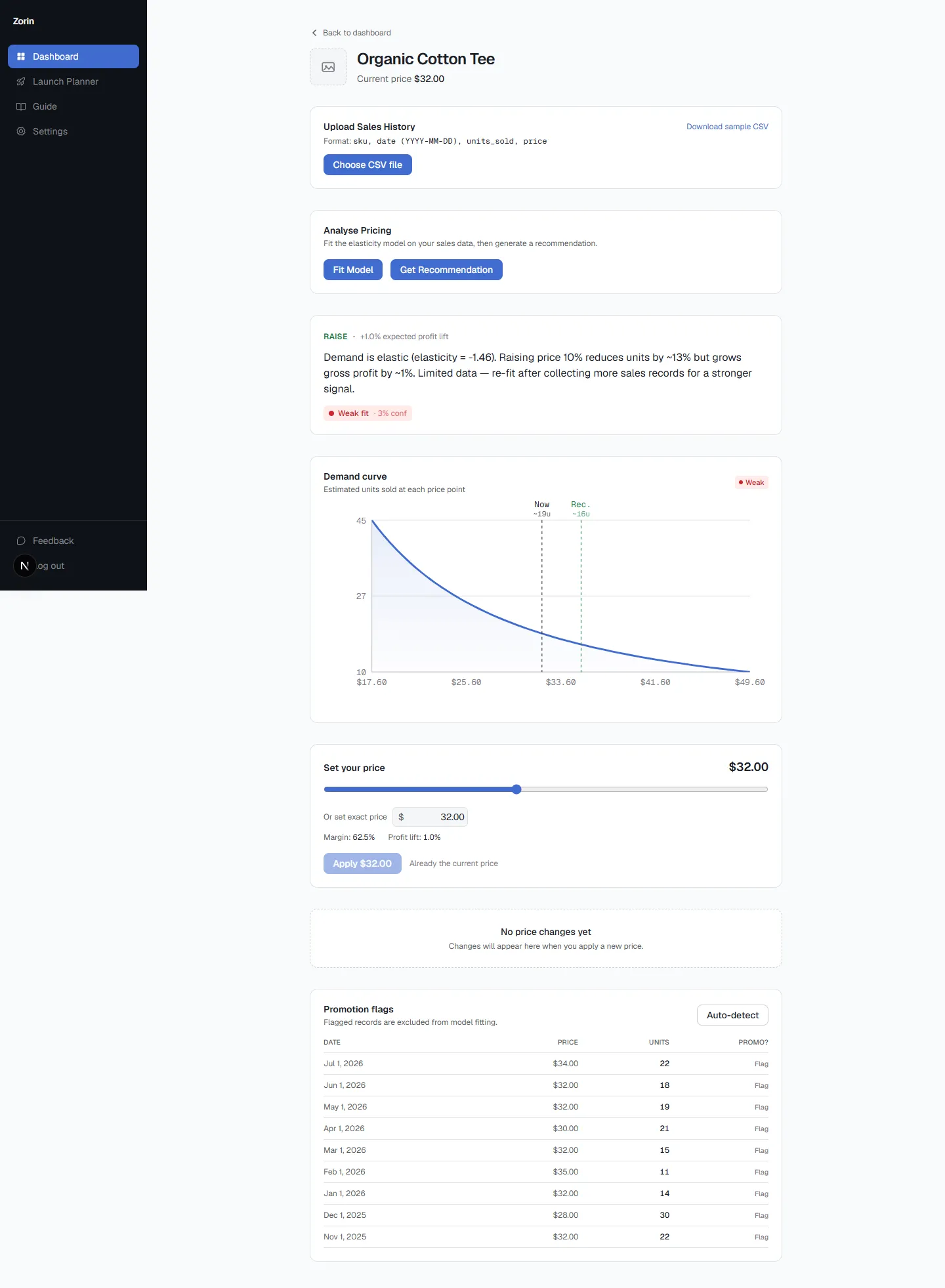
You upload your sales history, a CSV export or a live Shopify or WooCommerce sync, and the tool fits a log-log regression per product automatically. The output isn't a raw statistical readout, it's a plain recommendation: raise, lower, or hold, alongside an estimated profit lift and a confidence label based on how much data supports the estimate. The regression happens, but you never have to run it, read it, or defend the math behind it yourself, though if you're curious what that math actually looks like, here's the formula in plain terms.
| What an analyst used to do by hand | What happens automatically now |
|---|---|
| Gather price and quantity history per product | Reads directly from an uploaded CSV or a live sync |
| Run a regression to estimate elasticity | Fits the model automatically per SKU |
| Check the statistical fit before trusting the output | Returns an R-squared score and a confidence label |
| Translate the output into a plain recommendation | Returns raise/lower/hold with an estimated profit lift |
See what Zorin's elasticity model says about your own catalog.
Start free trialWhy the Confidence Score Matters Here Specifically
Without a background in statistics, it's hard to know from a raw elasticity number alone whether it's actually reliable. A confidence label (commonly something like Strong, Fair, or Weak fit) exists specifically to close that gap, telling you plainly whether a given estimate has enough data behind it to trust, without requiring you to interpret an R-squared value yourself.
What an Analyst Would Cost, and What Pricing Is Worth
For a sense of scale: the U.S. Bureau of Labor Statistics puts the median annual wage for market research analysts, the closest standard job category, at $78,760 in May 2025, before benefits or tools. That's a hard number to justify for a store doing a few hundred thousand a year in revenue, which is exactly why most small stores never have anyone doing this job properly.
The work still matters, though. McKinsey's pricing research found that for the average S&P 1500 company, a 1% price improvement with volume holding steady lifts operating profit by about 8%. Pricing is a big lever. The question isn't whether it deserves attention, it's who, or what, does the number-crunching.
One more finding worth knowing if you're wary of handing this to software: research by Dietvorst, Simmons and Massey found people were far more willing to rely on an imperfect algorithm when they could adjust its output, even slightly, and got better results as a result. Keeping the final say on each price, rather than automating it away, is what makes the approach work in practice.
When a Dedicated Analyst Still Makes Sense
At a large enough scale, with a catalog spanning thousands of SKUs, multiple markets, and pricing questions that go beyond single-product elasticity (bundling strategy, cross-product cannibalization, complex promotional calendars), a dedicated analyst or pricing team earns their keep. That threshold is far higher than most SMB merchants operating a lean one-to-five-person team, which is exactly the gap automated elasticity modeling is built to close in the meantime.
What This Means for a Lean Team
You don't need to learn statistics, hire someone who has, or build a spreadsheet model to price well. What you need instead is the right kind of tool for a lean team, one that reads your own sales data systematically, plus the judgment to apply the resulting recommendation with your own product context in mind. If you want to see what your own catalog's elasticity looks like without doing the math yourself, upload your sales history and let the model run.
Key Takeaways
- Elasticity modeling is real statistics, but running the calculation doesn't require you to understand the underlying regression, just upload sales history and read the output.
- The gap a dedicated pricing analyst used to close, systematically reading your own sales data, can now be closed by a tool rather than a hire.
- What you actually need to bring is judgment: reviewing a recommendation, understanding your own product context, and deciding whether to apply it.
- A confidence score exists specifically so you don't need statistical training to know how much to trust a given output.
- Hiring a dedicated analyst still makes sense at a certain scale, but that threshold is much higher than most SMB merchants assume.
Frequently Asked Questions
Do I need a data analyst to price my products well?
No. The underlying elasticity modeling can run automatically once you upload your sales history, without requiring you to understand or run the regression yourself.
What did a pricing analyst actually do before automation?
Gathered price and quantity history, ran a regression to estimate elasticity, checked the statistical fit, and translated the result into a plain recommendation.
What do I still need to do myself?
Bring judgment: reviewing a recommendation against your own knowledge of the product and deciding whether to apply it, since a model doesn't know everything about your business context.
How do I know if a recommendation is reliable without statistics training?
A confidence label (Strong, Fair, Weak) tells you plainly how much data supports a given estimate, without requiring you to interpret raw statistical output yourself.
Does this replace a pricing analyst entirely?
For most SMB catalogs, yes, the core function (reading your own sales data systematically) is what gets automated. At a much larger scale with more complex pricing questions, a dedicated analyst still adds value.
What data do I need to provide for this to work?
Your sales history, typically a CSV export with date, SKU, units sold, and price, or a live sync from Shopify or WooCommerce.
Is the underlying math still real statistics?
Yes. A log-log regression genuinely runs behind the scenes, it's just automated rather than something you need to perform or understand yourself.
The statistics behind good pricing are real, but running them by hand was always the bottleneck, not a requirement you personally need to meet. Automate the calculation, bring your own judgment to the recommendation, and the analyst-sized gap closes without an analyst-sized hire. Not needing a dedicated analyst doesn't mean the approach stays the same as your store grows, though; how the underlying strategy should evolve from a store's first sale to thousands of orders covers that progression directly.
Written by Dexter
Dexter is part of the team at Zorin, building tools that help ecommerce merchants price with data instead of guesswork.
More in Price Elasticity
View all →How to Calculate Price Elasticity in WooCommerce
Where to find the data in WooCommerce Analytics, the midpoint formula on a real example, and why a pricing plugin isn't an elasticity read.
What Your Price Elasticity Score Actually Means
What your elasticity number means, how to know if it's solid enough to act on, and why products in the same category can have completely different scores.
How to Know If Your Prices Are Too High or Too Low
Declining sales and high close rates are lagging signals. Price elasticity tells you before you change anything, not after the damage is done.