Ecommerce Pricing Strategy by Growth Stage
The right pricing strategy for a store doing its first hundred sales is rarely the right one for a store doing thousands of orders a month, and treating pricing as a single decision made once at launch is one of the clearest ways a strategy falls behind as the business grows. This guide walks through the trajectory most successful stores follow, a checklist for your very first price, how the underlying approach should evolve as sales data accumulates, what a mature pricing setup actually looks like, and how international selling changes the picture.
The Trajectory Every Growing Store Follows
Across most successful ecommerce businesses, pricing strategy follows a consistent sequence rather than a single choice made once and left alone. Establish your floor with cost-plus pricing. Calibrate that floor with competitor research once you have some market context. Then shift progressively toward value-based pricing as your branding, customer understanding, and eventually your own sales data mature.
This isn't three competing strategies to pick between. It's a trajectory, each stage building on what the last one established, and where a store sits on that trajectory should track how much data and market presence it actually has, not how sophisticated the owner wishes their pricing sounded on day one.
New store (early sales): cost-plus as the floor
With no sales history and no established brand recognition, cost-plus pricing is the right starting point, not a compromise to feel embarrassed about. Take your total cost per unit, add a target margin, and that's your price. It guarantees you're not selling at a loss while you're still learning what your market will actually bear. Don't overthink this stage. The goal at launch is a defensible starting price, not a perfectly optimized one, since you don't yet have the data that would make optimization meaningful.
Growing (hundreds of orders): calibrating with competitor research and AOV levers
Once a store has real sales history and enough orders to see patterns, competitor research becomes genuinely useful context rather than a guess about where you sit in the market. This is also the stage where average order value levers, tiered bundles, post-purchase upsells, become worth building, since you now have enough traffic and repeat behavior to make them worthwhile. On your strongest-selling products specifically, this is often where a first shift toward value-based pricing starts to make sense, using early customer feedback, reviews, and brand story to justify pricing above a pure cost-plus number.
Scale (thousands of orders): full pricing architecture
At this stage, a store typically has enough sales history, ideally with genuine price variation across that history, for elasticity-driven, per-SKU value-based pricing to become reliable on established products. This is where a real pricing architecture starts to take shape: segment pricing (wholesale vs retail, loyalty tier pricing), more automated rule-based adjustments (margin floors, competitor-relative rules, time-based triggers), and dedicated review cadences per product rather than a single blanket check across the whole catalog.
Six months of sales history with real price variation is a reasonable rough benchmark for when elasticity data becomes reliable enough to lean on for a specific product. That threshold, not a specific order count or revenue figure, is really what separates the growing stage from the scale stage for pricing purposes: it's about whether the data exists yet, not just about how big the store has gotten.
Before Your First Price: A Pre-Launch Checklist
Setting up the first stage of the trajectory well means working through a few concrete steps before you commit to a launch price, rather than picking a number and hoping.
- Calculate your true cost per unit, including a fair allocation of overhead, not just the number on your supplier invoice. A cost figure that only reflects the product itself will understate your real floor.
- Research competitor pricing on at least 10 comparable products. A single competitor's price is a weak reference point; a spread across ten gives you a genuine sense of where the market sits.
- Choose a primary pricing model to start from. Cost-plus is the standard, defensible default with no sales history yet, as covered above. Decide this deliberately rather than defaulting to it without thinking it through.
- Set a hard margin floor you won't price below, regardless of any promotion, bundle, or discount you run later. Deciding this before launch, rather than in the middle of a promotional decision later, keeps you from talking yourself into an unprofitable price under pressure.
Working through these four before your first sale doesn't need to take long, but skipping them tends to show up later as a pricing decision made in a hurry, under pressure, with no floor to check against.
How Pricing Strategy Differs When You Sell Internationally
International pricing exists on a spectrum, not a single yes-or-no decision about whether to "do" it.
Cosmetic localization, simply displaying your existing prices converted into a customer's local currency, is the baseline every store should have, even a brand-new one. It requires minimal setup, typically just enabling a currency in your payment settings, and it removes a real source of hesitation: an international shopper seeing an unfamiliar currency has to do the conversion, and guess at bank fees, before they know what they will actually pay. This is a low-effort, high-return step that belongs at the earliest stage of the trajectory, not something to defer until later.
Localized pricing, adjusting the actual price by market rather than just converting the display currency, is a later-stage capability. It accounts for differences in local purchasing power, competitive landscape, and cultural price expectations, testing price adjustments of plus or minus 10-20% from your base price in key markets is a common starting range. This requires more infrastructure (most Shopify merchants use Shopify Markets or a similar tool to manage per-market catalogs) and more market-specific data than a new store typically has, which is why it tends to belong at the growing or scale stage of the trajectory rather than at launch.
One practical detail worth knowing regardless of stage: tax display conventions differ by region. Customers in the EU, UK, and Australia generally expect to see tax-inclusive prices, while US and Canadian customers expect exclusive prices with tax added at checkout. Getting this backwards for a given market's customers reads as unfamiliar or untrustworthy even if the underlying price is competitive.
See what Zorin's elasticity model says about your own catalog.
Start free trialWhat a Mature Pricing Strategy Actually Looks Like
The distance between a beginner setup and a mature one isn't about which named strategy you use. It's about how much of the pricing decision has moved from a single default number to a system that reflects the data you actually have.
| Dimension | Beginner setup | Mature setup |
|---|---|---|
| Pricing basis | Single cost-plus markup applied uniformly across the catalog | Blend of cost-plus, competitor-calibrated, and elasticity-driven value-based pricing, applied per SKU based on available data |
| Review cadence | Ad hoc, revisited only when something feels off | Defined triggers per product (new sales data accumulated, cost change, competitor move) plus a scheduled strategy-level review |
| Segment handling | One price for every customer | Segment-specific pricing where it makes sense (wholesale, loyalty tiers, B2B negotiated terms) |
| Channel handling | Same price everywhere | Channel-specific pricing that accounts for each channel's fee structure and margin requirements |
| International handling | Currency display only, or nothing at all | Currency display as a baseline, with localized or purchasing-power-adjusted pricing in key markets |
A store doesn't need every row in the mature column to be "doing it right." A growing-stage store with cost-plus pricing, currency display, and no segment pricing yet isn't behind, it's exactly where the trajectory says it should be. The table is a map of where the trajectory leads, not a checklist every store needs to complete immediately. For the full taxonomy of named pricing strategies (cost-based, competitor-based, value-based, dynamic, and the rest) and how to choose between them at any given moment, the complete pricing strategy guide covers that ground in more depth.
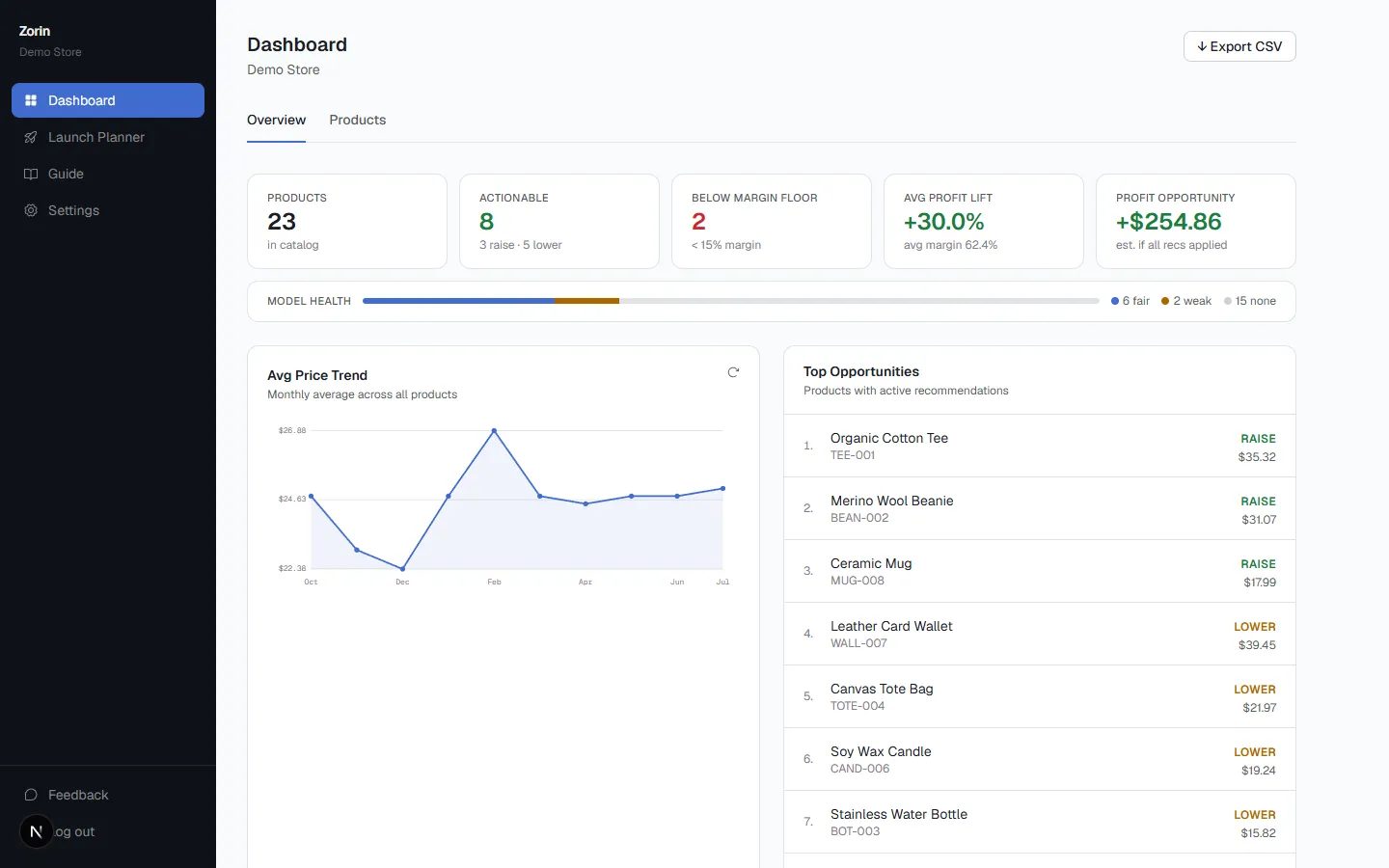
Knowing exactly when you've crossed from "not enough sales history yet" into "enough data for value-based pricing to be reliable" is itself a question worth answering with data rather than a guess. Zorin reads your Shopify or WooCommerce history and tells you, per product, when that threshold has been crossed and what the data suggests you do next.
Why the Launch Price Deserves Extra Care
The earliest stage is where pricing mistakes are most common. Simon-Kucher reports that 72% of innovations miss their financial targets or fail outright, and attributes much of that to price being decided late, with a cost-plus formula, rather than tested against what customers value. The fix at the launch stage is modest: a cost floor, a quick look at the market, and ideally a short customer price survey, then a planned review once real sales data exists.
Key Takeaways
- Pricing strategy follows a trajectory, not a single choice. Cost-plus establishes the floor, competitor research calibrates it, and value-based pricing develops as branding and sales data mature.
- A short pre-launch checklist beats guessing at a first price. True cost per unit, competitor research across at least 10 products, a chosen primary model, and a hard margin floor cover the essentials before your first sale.
- Roughly 6 months of sales history with real price variation is the practical threshold for elasticity-driven, value-based pricing to become reliable on a given product, which is what really separates the growing stage from the scale stage.
- International pricing is a spectrum, not a binary. Currency display (cosmetic localization) belongs at every stage, even launch; deeper localized or purchasing-power-adjusted pricing is a later-stage capability.
- A mature setup isn't a single named strategy, it's a system. Per-SKU pricing basis, defined review triggers, segment and channel handling, and international localization all develop as a store scales.
Frequently Asked Questions
How should my pricing strategy change as my store grows from a few sales to thousands of orders?
It should move through a trajectory: cost-plus pricing to establish a safe floor with no sales history, competitor research to calibrate that floor once you have market context, and value-based, elasticity-driven pricing on established products once you've accumulated enough real sales history, roughly 6 months with genuine price variation is a reasonable benchmark. Segment and channel-specific pricing, along with more formal review cadences, typically enter the picture at the scale stage.
Should my pricing strategy start simple and get more sophisticated over time, or should I set it up properly from day one?
Start simple. Cost-plus pricing with no sales history is the correct starting point, not a compromise, because the data that would justify a more sophisticated approach doesn't exist yet. Sophistication should track the data you've accumulated, not arrive all at once at launch. Trying to build a full pricing architecture before you have any sales history to base it on usually means optimizing against guesses rather than real demand signals.
What pricing strategy questions should I ask myself before I even set my first price?
Four are worth working through concretely: what is your true cost per unit including overhead, not just the supplier invoice; what do at least 10 comparable competitor products charge; which primary pricing model will you start from (cost-plus is the standard default); and what hard margin floor will you never price below regardless of future promotions or discounts.
How does pricing strategy differ if I'm selling internationally versus just domestically?
International pricing exists on a spectrum. At minimum, display your prices in each customer's local currency, since an unfamiliar currency adds friction at the exact moment a shopper is deciding, and this baseline step is worth having even at launch. Deeper localized pricing, adjusting the actual price by market based on purchasing power and local competition, is a later-stage capability that requires more infrastructure and market-specific data than most new stores have yet.
What does a mature, fully-developed pricing strategy actually look like compared to a beginner one?
A beginner setup applies one cost-plus number uniformly across the catalog with no defined review cadence. A mature setup blends pricing bases per SKU depending on available data, has defined review triggers rather than ad hoc checks, applies segment-specific pricing where it makes sense (wholesale, loyalty tiers), accounts for channel-specific fee structures, and layers in localized international pricing beyond simple currency display.
At what point should I stop using cost-plus pricing?
Not entirely, cost-plus remains useful as a margin floor even at a mature stage, but you should start layering value-based pricing on top of it once you have real sales history to work from, typically once a product has accumulated around 6 months of sales with some price variation. Cost-plus alone tends to leave money on the table on your strongest-differentiated products once real demand data exists to price against instead.
Do I need Shopify Markets or a similar tool to sell internationally?
For basic currency display, most Shopify merchants can enable a currency in payment settings without additional tooling. For deeper localized pricing, per-market catalogs, percentage adjustments by region, and duty handling, a tool like Shopify Markets becomes genuinely useful, since managing that level of complexity manually across multiple markets gets difficult to sustain as the number of markets grows.
Pricing strategy isn't a single decision made once at launch, it's a sequence that should track how much your store and your data have actually grown. Cost-plus gets you a defensible first price, competitor research and early value-based pricing carry you through growth, and a full pricing architecture, segment pricing, automated rules, and localized international pricing, is what a mature setup looks like once the data supports it.
Written by Dexter
Dexter is part of the team at Zorin, building tools that help ecommerce merchants price with data instead of guesswork.
More in Pricing Fundamentals & Strategy
View all →Everyday Low Pricing vs High-Low: Which Is Better?
Everyday low pricing keeps prices steady; high-low relies on sales. Pros, cons, a worked profit example, and how Zorin shows which fits each product.
Price Anchoring: Manipulative or Smart Pricing?
Price anchoring works only when the reference price is real. How to use compare-at prices honestly, and where anchoring crosses into deception.
Ecommerce Pricing Strategy: The Complete Guide
Every ecommerce pricing strategy explained, how to pick the right one for your store, and the biggest mistake sellers make when setting prices.