Price Anchoring: Manipulative or Smart Pricing?
Price anchoring itself isn't manipulative. It's a genuine, well-documented cognitive effect, the first price a customer sees really does shape how they judge every price after it. What makes an anchor honest or deceptive comes down to one thing entirely: whether the reference price is real. Anchoring is one form of a broader effect, price priming, where anything shoppers see first shapes how they judge a price. This guide covers exactly where that line sits, how to anchor prices honestly using Shopify's own pricing fields, whether three-tier pricing actually outperforms two options, whether framing a price as a daily cost actually increases sales, and how to know if any of this is working on your specific catalog rather than just trusting a tactic's reputation.
The Short Answer
Anchoring is not inherently manipulative. Psychologists Amos Tversky and Daniel Kahneman documented the underlying cognitive bias decades ago: people don't judge a price in isolation, they judge it relative to whatever reference point they saw first. Showing a real original price next to a real sale price uses that bias honestly, it gives a shopper accurate context for the deal they're being offered. Showing a price that was never actually charged, inflated specifically to make a markdown look bigger, uses the same bias dishonestly. The tactic is neutral. What you anchor against is the entire question.
Where the Line Actually Is
This is the same standard covered in more depth in whether you should raise prices before Black Friday: the FTC's Guides Against Deceptive Pricing require a reference price to be one the product was genuinely, openly sold at for a substantial period, not a number that existed for a day or two purely to be crossed out. That standard doesn't only apply to holiday sales. It applies to every compare-at price on every product page, all year round. If a product has actually sold at $60 for the past two months, anchoring a $45 sale price against that $60 is honest and effective. If you quietly bumped a $45 product to $60 last week specifically to advertise 25% off, you're doing the exact thing that's cost larger retailers real settlements.
How to Anchor Honestly on Shopify
Shopify's product pricing has two relevant fields: Price, what the customer actually pays, and Compare-at price, the reference number shown crossed out above or beside it. When both are populated, most themes automatically render a strikethrough on the compare-at price and often a sale badge alongside it. The mechanic is simple. The discipline is entirely about what you put in that Compare-at field: only ever a price the product genuinely, recently sold at, never a number invented to make the gap look bigger. If a product has never actually sold at a higher price, the honest move is to leave Compare-at price empty rather than fabricate one.
See what Zorin's elasticity model says about your own catalog.
Start free trialDo Three Pricing Tiers Actually Convert Better Than Two
Often, yes, and one of the clearest demonstrations of why comes from outside ecommerce entirely. Behavioral economist Dan Ariely ran a now-classic experiment (described in his book Predictably Irrational and in his TED talk) offering 100 MIT students a choice between three subscription options modeled on a real Economist magazine offer: digital-only for $59, print-only for $125, and print-plus-digital for the same $125. With all three options present, 84% chose the $125 combo. Ariely then removed the print-only option, the one nobody was actually choosing, and repeated the experiment with a new set of 100 students. With only two options left, digital at $59 and the combo at $125, just 32% chose the $125 combo.
The print-only option, seemingly pointless since almost nobody picked it, wasn't pointless at all. It was a decoy: priced identically to the combo but clearly worse, it made the combo look like an obvious win by comparison, more than doubling how often shoppers chose the higher-priced option. The lesson translates directly to a three-tier ecommerce pricing page: a middle or "decoy" tier priced close to your premium tier, but offering meaningfully less, can make the premium tier look like the obvious smart choice rather than an indulgence.
Does "Per Day" Framing Actually Increase Sales
Research from Stephen Atlas (University of Rhode Island) and Daniel Bartels (University of Chicago Booth) on periodic pricing, published in the Journal of Consumer Research, found that breaking a cost into small recurring increments changes how people feel about the same total price, not the math, the perception. Across several studies, they found consistent effects: people were more willing to donate to charity when a $350 annual ask was framed as "$1 a day," MBA students showed higher signup rates for subscriptions when pricing was framed daily rather than as a lump sum, and in a real-world test with a meal delivery company, first-time visitors bought 77% more meals when the banner said "$16 per day" instead of "$99 per week", even though the daily framing actually worked out 13% more expensive.
This works because the math doesn't lie. A $99 monthly plan genuinely is about $3.30 a day, it's not a manufactured number the way a fake compare-at price would be. It's honest reframing of a real total, which is exactly what separates it from the deceptive-anchoring problem covered above.
Testing Whether an Anchor Actually Works
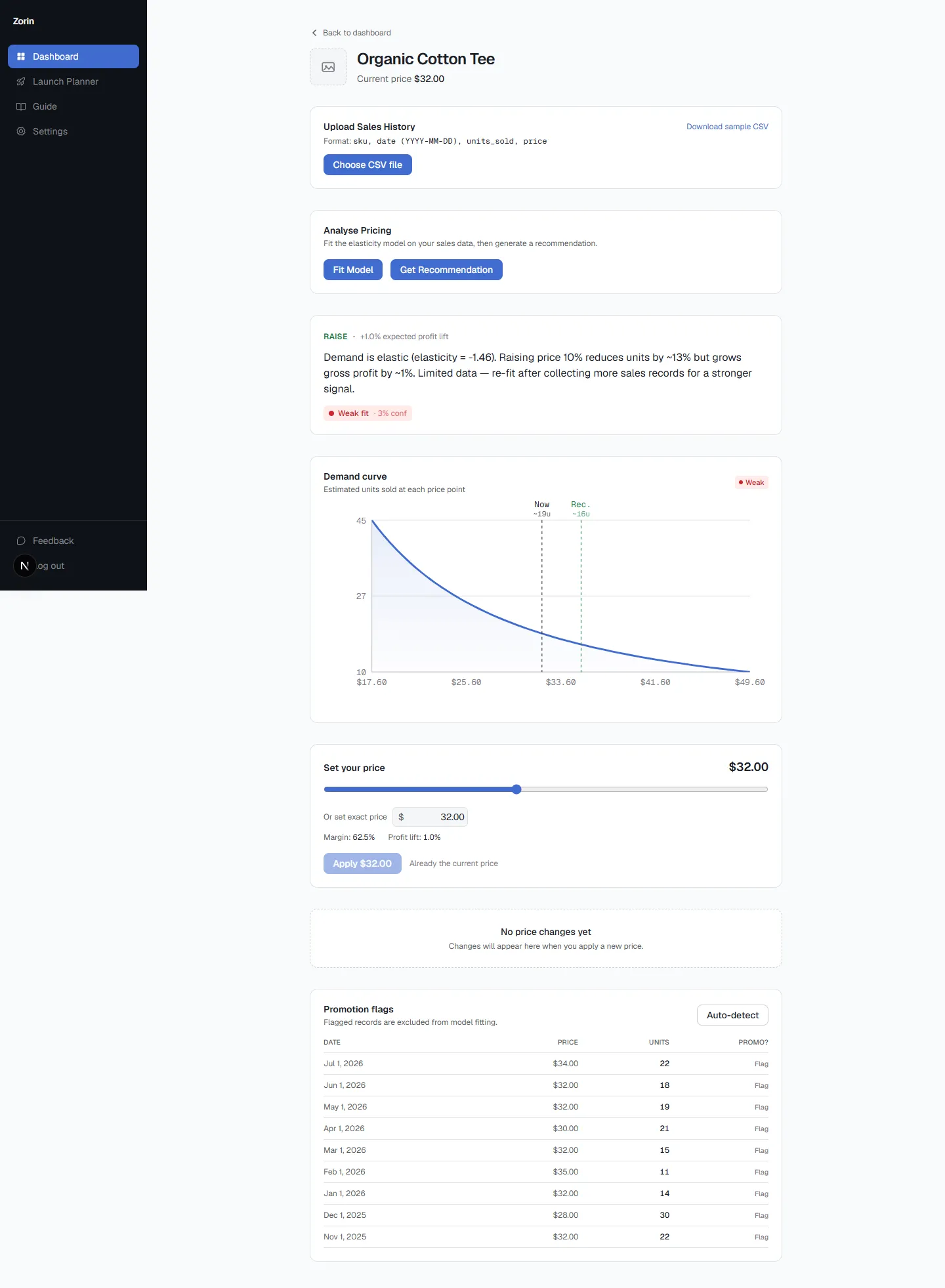
Every tactic above has a real, published effect on average, across the studies that documented it. Whether any of them actually moved units for your specific products is a separate question, and the honest way to answer it is with your own data rather than borrowed confidence from someone else's study. Zorin's elasticity model fits a demand curve to your own Shopify or WooCommerce sales history, so if you introduce a new tier structure, change how a price is framed, or adjust an anchor price, the resulting change in demand shows up in your own numbers, not just in someone else's research.
Key Takeaways
- Anchoring itself isn't manipulative. It's honest when the reference price is real, and deceptive when it's fabricated, the same FTC standard covered for BFCM pricing applies year-round to every compare-at price.
- On Shopify, only ever populate the Compare-at price field with a number the product genuinely, recently sold at. Leave it empty rather than invent one.
- A decoy middle tier, priced close to your premium option but offering clearly less, can more than double how often shoppers choose the premium tier, per Dan Ariely's Economist subscription study (32% to 84%).
- Framing a real total price as a daily cost is honest reframing, not deception, and can meaningfully increase conversion (77% more meals sold in one real-world test, even at a slightly higher effective price).
- Whether any of these tactics actually work on your own catalog is a question your own sales data answers better than a borrowed statistic. Start a free trial to see what your own elasticity data says.
Pricing psychology isn't a trick to feel guilty about using. It only becomes one the moment the reference price stops being real. Anchor honestly, structure tiers thoughtfully, frame the real total clearly, and let your own data confirm what's actually working. Start a free trial to see it for your own store.
Frequently Asked Questions
Does showing a "compare at" price actually increase sales on Shopify?
Yes, when the reference price is genuine. Price anchoring is a well-documented cognitive effect, showing a real prior price gives customers accurate context that makes a discount feel concrete rather than abstract. It only becomes deceptive, and risky, when the compare-at price was never actually charged.
Why do three pricing tiers convert better than two options?
A middle "decoy" tier priced close to the premium option, but offering clearly less, makes the premium tier look like the obvious smart choice by comparison. Dan Ariely's Economist subscription study found this shifted premium-tier selection from 32% to 84% simply by adding the decoy option back in.
Does breaking a price into a "per day" cost actually make people buy more?
Research on periodic pricing found consistent effects across donation asks, subscription signups, and a real-world meal delivery test, where showing "$16 per day" instead of "$99 per week" produced 77% more purchases from first-time visitors. It works because it's honest reframing of a real number, not a fabricated one.
Is price anchoring manipulative, or does it just help customers decide faster?
It depends entirely on whether the reference price is real. A genuine former price used as an anchor gives customers accurate context. A fabricated reference price used only to make a discount look bigger is deceptive, and the FTC's Guides Against Deceptive Pricing (16 CFR Part 233) address exactly this practice directly.
What price should I actually anchor against, MSRP, a competitor, or my own regular price?
Your own genuine regular price is the safest and most defensible anchor, since you control whether it's real. A manufacturer's suggested retail price or a competitor's price can work as a reference point too, but only if it's an accurate, current figure, not one you've selected because it happens to make your price look better.
How do I know if a pricing psychology tactic is actually working for my store?
Published research shows an average effect across the studies that documented it, but your own products, customers, and price points are specific to you. Per-SKU elasticity data, measured from your own sales history before and after a change, is a more reliable answer than assuming a tactic that worked in someone else's study will work identically for you.
The tactics themselves are neutral. Anchoring, tiered pricing, and framing all work because they help customers process a real price more clearly, not because they trick anyone, as long as what you're anchoring against is genuine. Start a free trial and see what your own sales data says about what's actually moving units.
Written by Dexter
Dexter is part of the team at Zorin, building tools that help ecommerce merchants price with data instead of guesswork.
More in Pricing Fundamentals & Strategy
View all →Segment Pricing: How to Charge Different Customers
Segment pricing charges different customer groups different prices. Types, price fences, a worked student-discount example and where the legal line is.
Price Priming: How Cues Shape What Shoppers Pay
Price priming is when a number, image or product order changes how shoppers judge a price. What the research shows and how to test it honestly.
Keystone Pricing: What It Is and When It Fails
Keystone pricing doubles your cost to set the retail price. The formula, variations like triple keystone, a wholesale example, and when 2x isn't enough.