Keystone Pricing: What It Is and When It Fails
Keystone pricing is the retail rule of setting the selling price at double the cost, so a product that costs $20 sells for $40. It gives a 100% markup and a 50% gross margin. Keystone is quick, easy to explain and still the starting point in apparel, jewelry, gifts and wholesale, but it's a rule of thumb about cost, not a measure of what customers will pay. Most stores should treat it as a floor to check against, then adjust product by product.
What Is Keystone Pricing?
Keystone pricing means multiplying your cost by two to get the retail price. It became the default in department stores, specialty retail and wholesale because it's simple: one multiplier, applied to everything, with a healthy margin built in.
The formula is:
Keystone price = Cost × 2
Because the profit equals the cost, keystone always produces a 100% markup and a 50% gross margin. If the difference between those two numbers is fuzzy, our guide to margin vs markup walks through it.
Keystone and Its Variations
| Rule | Price multiple of cost | Gross margin | Where you see it |
|---|---|---|---|
| Below keystone | 1.3x to 1.8x | 23% to 44% | Electronics, appliances, grocery, commodity goods |
| Keystone | 2x | 50% | Wholesale-to-retail default in apparel and gifts |
| Keystone plus | 2x plus a fixed amount (for example + $5) | Slightly above 50% | Low-cost items where 2x doesn't cover handling |
| Triple keystone | 3x | 66.7% | Jewelry, premium accessories, private label |
| DTC multiple | 4x to 5x or more | 75% to 80%+ | Brands selling direct that absorb acquisition, shipping and returns |
How Keystone Works in the Wholesale Chain
For a brand that sells through stores, keystone often happens twice. The brand doubles its production cost to set a wholesale price, and the retailer doubles the wholesale price to set the shelf price. Here's a worked example for a product that costs $12 to make:
- Brand to retailer: $12 × 2 = $24 wholesale. The brand keeps $12 a unit, a 50% margin on the wholesale sale.
- Retailer to shopper: $24 × 2 = $48 retail. The retailer keeps $24 a unit, also a 50% margin.
- Brand selling direct: if the same brand sells on its own store at $48, it keeps $36 a unit, a 75% gross margin. That extra $24 is not free money: it has to pay for ads, fulfillment, payment fees and returns that the retailer would otherwise cover.
This is why the retail price is usually set once, as the MSRP, and kept consistent across channels. If your own site undercuts the price you ask retailers to charge, you damage those relationships. How brands protect that price is covered in our guide to minimum advertised price (MAP) policies.
Real-World Check: Why a 50% Tag Doesn't Mean a 50% Result
Keystone describes the margin on the price tag. What a retailer actually keeps is lower, because markdowns, promotions, shrink and freight all come out of it. Macy's is a useful public example. In its annual report for the year ended January 31, 2026, Macy's reported a gross margin of 38.0% of net sales, down from 38.4% the year before, and said the decline was driven by tariffs net of its mitigation efforts. Selling, general and administrative expenses took another 36.4% of revenue.
Two lessons follow for a smaller store. First, a full-price tag at keystone is not the margin you'll realize once sales and clearance are counted. Second, even a large retailer with a realized margin near 38% spends most of it running the business. A 2x rule leaves less room than it looks, which is why most DTC brands price well above it. Our research on profit margins by product category shows how wide the realized range is across categories.
See what Zorin's elasticity model says about your own catalog.
Start free trialWhen Keystone Pricing Works
- You sell wholesale. Retail buyers expect to double your wholesale price, so pricing wholesale at half your target MSRP keeps you in the conversation.
- You have a large, varied catalog of similar-cost items. A single rule is fast to apply and easy to audit when you're pricing hundreds of SKUs by hand.
- Your costs are moderate. In the middle of the cost range, doubling produces prices that shoppers find normal and that cover typical overhead.
- You need a first price for a brand-new product. With no sales history, keystone is a reasonable starting point to test from, as covered in how to price a new product with no sales history.
When Keystone Pricing Fails
- Very cheap items. A $1.50 phone charm doubled to $3 can't cover a $4 pick, pack and ship. Low-cost products need keystone plus, a minimum order value or bundling.
- Very expensive items. A television that costs a retailer $600 won't sell at $1,200 when rivals sell it for $700. Big-ticket, easily compared products run far below keystone.
- Commodity products shoppers compare. If the identical item is listed by ten sellers, the market sets the price, not your cost.
- High-return categories. Returns can take a large share of apparel margin, so a 2x price that looks healthy on paper can lose money. Our clothing pricing guide covers how returns and tariffs push apparel brands above keystone.
- Unique products customers love. The opposite failure: a distinctive product with loyal buyers may sell just as well at 3x, and keystone quietly leaves money on the table.
How to Move Past Keystone, Step by Step
- Calculate your landed cost. Include freight, duty and packaging, not just the unit cost from the supplier.
- Set keystone as the first test price. $12 landed cost gives a $24 floor.
- Add your per-order costs. If shipping, payment fees and packaging come to $7 an order and your average order is one unit, a $24 price keeps only $5. That's a sign you need to go above keystone.
- Compare with what similar products sell for. If comparable items sell for $34 to $40, there's room to test higher.
- Watch how sales respond. After a few weeks at each price, compare units sold and total profit. The price that earns the most profit, not the most units, wins.
Step five is where a formula can't help. Two products that cost $12 can respond to price completely differently. One might lose half its sales at $30; another might sell almost as well at $36. That's what price elasticity measures.
From a Cost Rule to a Demand Read
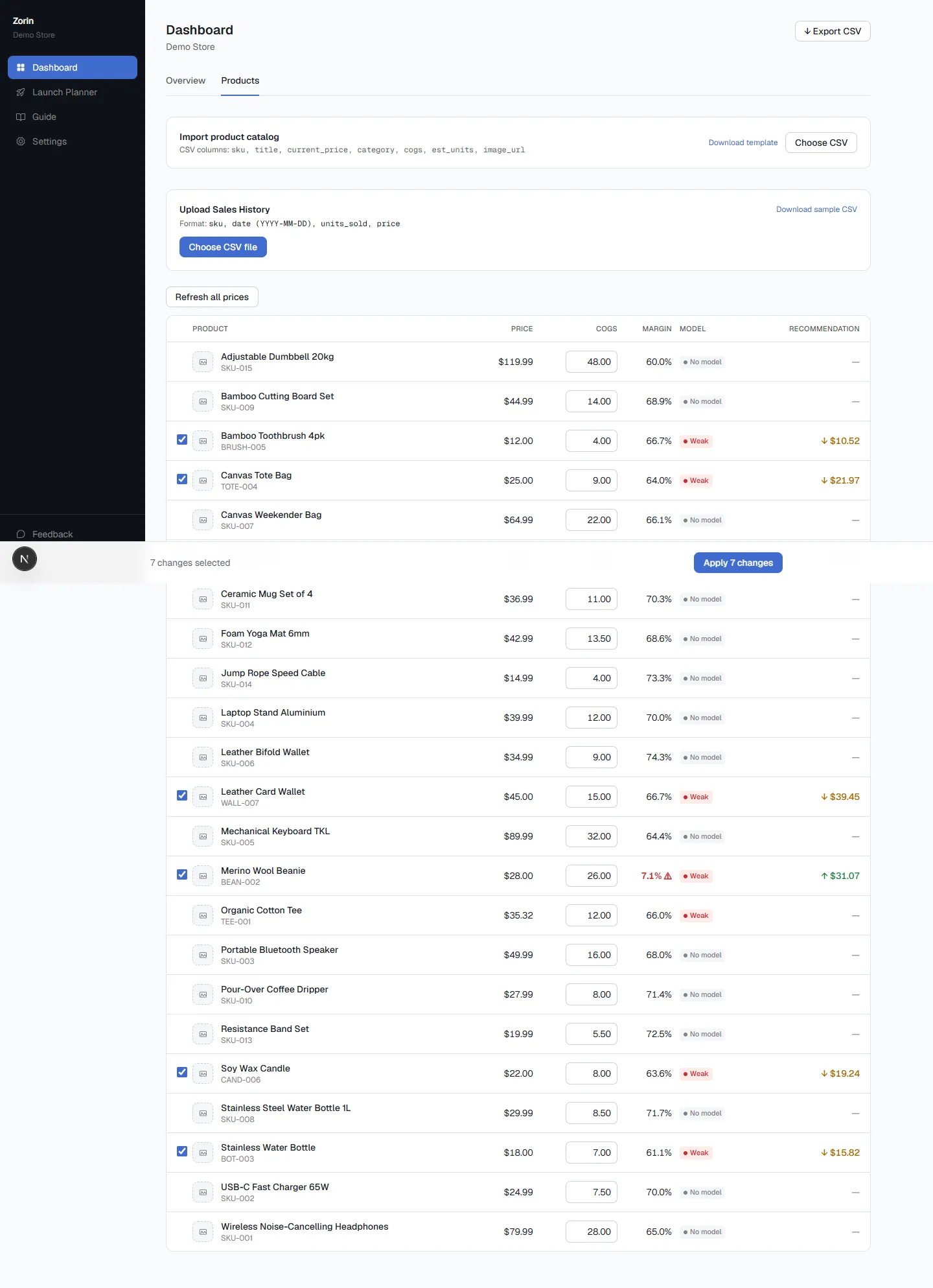
Zorin starts where keystone stops. It reads your Shopify or WooCommerce sales history, fits a price elasticity model for each product, and recommends whether to raise, lower or hold, with an estimated profit impact and a confidence score. You still set your cost floor; Zorin tells you which products have room above it and which are already at the edge.
Key Takeaways
- Keystone pricing sets the retail price at double the cost, giving a 100% markup and a 50% gross margin.
- In wholesale, keystone often happens twice: $12 cost becomes $24 wholesale and $48 retail.
- Realized margins sit below the tag: Macy's reported a 38.0% gross margin for fiscal 2025, with SG&A taking another 36.4% of revenue.
- Keystone fails for very cheap items, big-ticket comparison products, high-return categories and unique products that could carry more.
- Use keystone as a floor, then test prices and let sales data show where profit peaks.
Frequently Asked Questions
What is keystone pricing?
Keystone pricing is a retail rule where you set the selling price at twice the cost. A product that costs $25 sells for $50, which gives a 100% markup and a 50% gross margin.
What is the keystone pricing formula?
Retail price = cost × 2. For triple keystone, multiply by 3 for a 66.7% gross margin. For keystone plus, double the cost and add a fixed amount to cover handling on low-cost items.
Is keystone pricing a 50% or 100% markup?
Both numbers describe the same price. Keystone is a 100% markup on cost and a 50% margin on the selling price, because the profit equals the cost and makes up half of the price.
Is keystone pricing enough for an ecommerce brand?
Often not. Selling online means paying for ads, shipping, payment fees and returns, which can take most of a 50% margin. Many DTC brands price at 3x to 5x cost to cover those costs and still make a profit.
Which industries use keystone pricing?
Apparel, jewelry, gifts, home decor and most wholesale-to-retail relationships use it as a default. Electronics, appliances and grocery usually price well below keystone because shoppers compare those products easily.
What is the difference between keystone pricing and cost-plus pricing?
Keystone is a specific type of cost-plus pricing with a fixed 100% markup. Cost-plus pricing in general lets you pick any markup, such as 40% or 150%, depending on your category and costs.
Keystone pricing is a sensible starting rule and a useful floor, but it can't tell you whether a product would sell just as well at a higher price. That answer is in your sales history. Start a free trial of Zorin to see which of your keystone-priced products have room to move.
Written by Dexter
Dexter is part of the team at Zorin, building tools that help ecommerce merchants price with data instead of guesswork.
More in Pricing Fundamentals & Strategy
View all →Segment Pricing: How to Charge Different Customers
Segment pricing charges different customer groups different prices. Types, price fences, a worked student-discount example and where the legal line is.
Price Priming: How Cues Shape What Shoppers Pay
Price priming is when a number, image or product order changes how shoppers judge a price. What the research shows and how to test it honestly.
Everyday Low Pricing vs High-Low: Which Is Better?
Everyday low pricing keeps prices steady; high-low relies on sales. Pros, cons, a worked profit example, and how Zorin shows which fits each product.