Price Priming: How Cues Shape What Shoppers Pay
Price priming is when something a shopper sees before the price, such as a number, an image, a word or the order products appear in, changes how they judge that price. A premium item shown first makes the next one feel reasonable; a page full of discount language makes shoppers focus on cost. Priming is real and measurable, but it shifts perception at the margin. It can't rescue a price your customers don't value, and it becomes deceptive the moment the cue is false.
What Is Price Priming?
Priming is a psychology term for how exposure to one thing influences the response to the next thing, usually without the person noticing. In pricing, the "next thing" is a judgment about whether a price is fair, high or a bargain. The prime can be almost anything that comes first: a number, a background image, a product shown higher on the page, or whether the price appears before or after the product itself.
Price priming is closely related to price anchoring. Anchoring is one specific kind of priming, where a reference number (a "was" price, a premium tier) becomes the benchmark the shopper compares against. Priming is the broader idea: cues can change which attributes a shopper pays attention to, not just which number they compare to.
What the Research Shows
Arbitrary numbers can move willingness to pay
In one of the best-known experiments, Dan Ariely, George Loewenstein and Drazen Prelec asked students to write down the last two digits of their social security number before bidding on everyday products like wine, chocolates and a cordless keyboard. The number had nothing to do with the products, yet it moved the bids. In their paper in the Quarterly Journal of Economics, students with above-median numbers stated values 57% to 107% higher than those with below-median numbers. Students in the top fifth were willing to pay $56 on average for the cordless keyboard; those in the bottom fifth, $16.
The same study found something just as important for sellers: nearly everyone still ranked the products correctly relative to each other. Shoppers didn't know what a keyboard was "worth", but they knew a keyboard was worth more than a trackball. Primes shift the level; they don't overturn real preferences.
Web page design can change what shoppers care about
Naomi Mandel and Eric Johnson tested priming on an online store. In their Journal of Consumer Research study, they changed only the background of a shopping site. Shoppers who saw a background with pennies focused more on price and chose cheaper sofas; shoppers who saw fluffy clouds focused more on comfort and chose more comfortable ones. The effect showed up for both novices and people who knew the category well.
Showing the price first changes how products are judged
Uma Karmarkar, Baba Shiv and Brian Knutson used brain imaging to test the order in which shoppers see price and product. In their 2015 Journal of Marketing Research study, seeing the product first led to decisions driven by how attractive or desirable it was, while seeing the price first led to decisions driven by whether it was worth the money. Showing the price first increased purchases of bargain-priced products whose value was easy to recognize.
Types of Price Priming You'll See in Ecommerce
| Type | How it works | Store example | Honest when |
|---|---|---|---|
| Numeric priming | A high number seen first raises the sense of what's normal | A $240 bundle shown before the $89 single item | The bundle is a real product people buy |
| Sequence priming | The first product viewed sets the frame for the rest | Collection sorted with the premium version first | The order reflects a genuine range |
| Attribute priming | Images and words make one attribute feel more important | Quality, craft and materials above the fold on a premium product | The claims are true |
| Price-first vs product-first | Price first triggers a value check; product first triggers desire | Price prominent on a bargain line, product story first on a premium line | Always, it's layout, not a claim |
| Reference price | A "was" or "compare at" price becomes the benchmark | "Was $60, now $45" | The product genuinely sold at $60 for a meaningful period |
How to Use Price Priming, Step by Step
- Decide what you want shoppers to weigh. For a premium product, you want quality and desirability in focus, so lead with the product and its story. For a value line, lead with the price, because the price-first research shows it helps when the bargain is easy to see.
- Put a real, higher-priced option first where it makes sense. A genuine premium version or bundle at the top of a collection frames the core product as the sensible middle choice.
- Match imagery and copy to the attribute you compete on. If you win on comfort, materials or results, don't surround the product with sale badges and discount language that prime cost.
- Use real reference prices only. A "compare at" price must be one you actually charged. The FTC's Guides Against Deceptive Pricing treat a fictitious former price as deceptive.
- Test it, and measure profit per visitor, not conversion alone. A prime that raises order value can lower conversion. Only the combined number tells you if it worked.
See what Zorin's elasticity model says about your own catalog.
Start free trialWorked Example: Measuring a Priming Test
Here is how to judge a priming change properly. The figures are illustrative. A store selling a $60 core product (55% gross margin) tests a collection page that shows a $110 premium version first, against its current page that shows the core product first. Each version gets 10,000 visitors.
| Current page | Premium shown first | |
|---|---|---|
| Conversion rate | 2.5% | 2.3% |
| Orders | 250 | 230 |
| Average order value | $60 | $70 |
| Revenue | $15,000 | $16,100 |
| Gross profit (55%) | $8,250 | $8,855 |
| Gross profit per visitor | $0.83 | $0.89 |
Conversion fell, which on its own looks like a loss. But more shoppers chose the premium version, so order value rose enough that profit per visitor went up about 7%. If conversion had fallen to 2.0% instead, the premium-first page would have made $0.77 a visitor and lost. Run the test long enough to reach a reliable result, as covered in how to run a price A/B test the right way.
Where Price Priming Stops Working
- When the price is genuinely wrong. The Ariely study showed primes move the level, but shoppers still rank products sensibly. A product priced well above what customers value won't be saved by a clever page.
- When shoppers compare elsewhere. A prime works in the moment. If the identical product is cheaper one tab away, the comparison wins.
- When it's used to deceive. Fake "was" prices and invented discounts are both a legal risk and a trust problem that outlasts any short-term lift.
- When it contaminates your own research. Showing a price inside a customer survey primes the answers. Ask price questions without revealing your current price.
Like charm pricing, priming is a presentation layer. It works best on top of a price that's already right.
Getting the Underlying Price Right
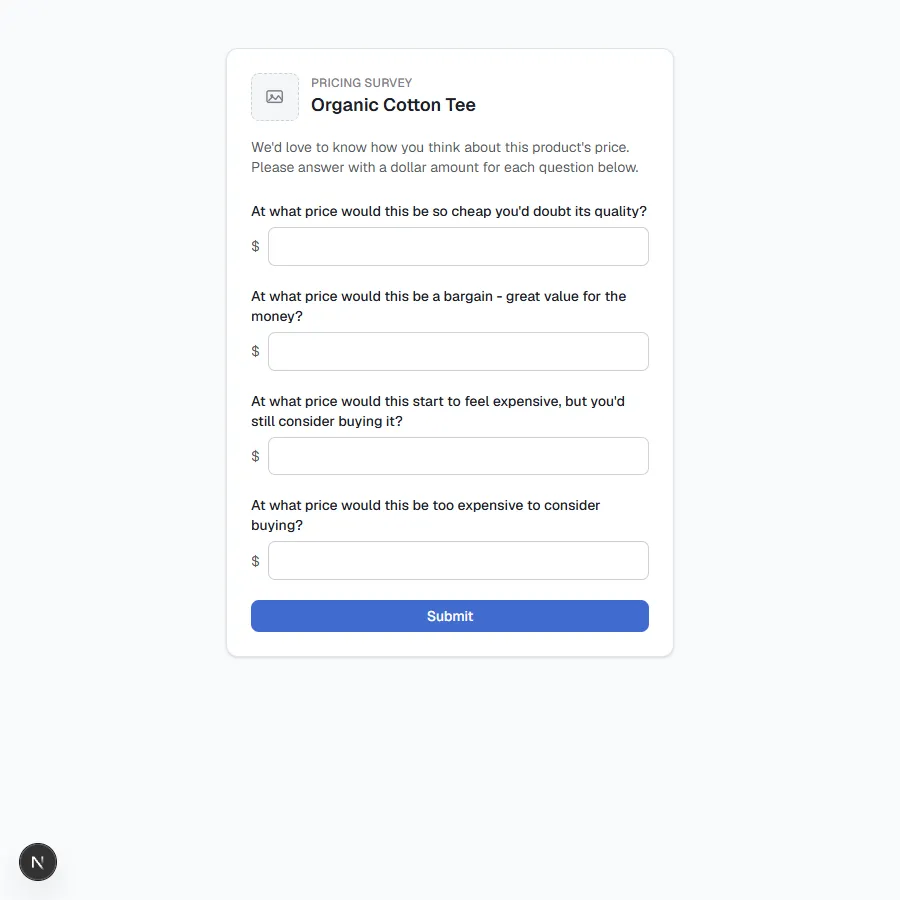
Zorin focuses on the part priming can't fix. It reads your Shopify or WooCommerce sales history and fits a price elasticity model for each product, then recommends whether to raise, lower or hold with an estimated profit impact. For products without enough history, its Van Westendorp price sensitivity survey shows respondents the product's name and image and asks four open price questions, without displaying your current price, so the answers aren't anchored to it.
Key Takeaways
- Price priming is when a cue seen first, such as a number, image or product order, changes how shoppers judge a price.
- Arbitrary numbers moved stated values by 57% to 107% in the Ariely, Loewenstein and Prelec study, but shoppers still ranked products correctly.
- A pennies background made online shoppers focus on price; a clouds background made them focus on comfort.
- Showing the price first triggers a value judgment; showing the product first triggers a desirability judgment.
- Judge any priming change by profit per visitor, keep reference prices genuine, and fix the underlying price first.
Frequently Asked Questions
What is price priming?
Price priming is when information a shopper sees before a price, such as another number, an image, a word or the order of products, influences how they judge that price. It changes perception without the shopper usually noticing.
What is the difference between price priming and price anchoring?
Anchoring is a specific type of priming where a reference number, like a "was" price or a premium tier, becomes the benchmark for comparison. Priming is broader and also covers cues that change which attributes a shopper focuses on, such as price versus quality.
Is price priming ethical?
It is when the cues are true: a real premium product, accurate descriptions and genuine former prices. It becomes deceptive when it relies on fake reference prices or invented discounts, which the FTC's pricing guides treat as misleading.
Should I show the price before or after the product?
Research by Karmarkar, Shiv and Knutson found price-first presentation makes shoppers judge monetary worth and helps obvious bargains, while product-first makes them judge desirability. Lead with price on value lines and with the product on premium lines.
Does sorting products from most to least expensive increase sales?
It can raise average order value by making mid-priced items look reasonable, but it can also lower conversion. Test it and compare gross profit per visitor between versions rather than looking at conversion rate alone.
Can priming fix a price that's too high?
Not reliably. Priming shifts perception at the margin, but shoppers still compare value and alternatives. If a product is priced well above what customers will pay, the fix is the price, not the page design.
Price priming is a real, research-backed effect, and used honestly it helps shoppers see the value you're offering. It works best on top of a price that already fits demand. To find that price for each product from your own sales history, try Zorin free.
Written by Dexter
Dexter is part of the team at Zorin, building tools that help ecommerce merchants price with data instead of guesswork.
More in Pricing Fundamentals & Strategy
View all →Segment Pricing: How to Charge Different Customers
Segment pricing charges different customer groups different prices. Types, price fences, a worked student-discount example and where the legal line is.
Keystone Pricing: What It Is and When It Fails
Keystone pricing doubles your cost to set the retail price. The formula, variations like triple keystone, a wholesale example, and when 2x isn't enough.
Everyday Low Pricing vs High-Low: Which Is Better?
Everyday low pricing keeps prices steady; high-low relies on sales. Pros, cons, a worked profit example, and how Zorin shows which fits each product.