Segment Pricing: How to Charge Different Customers
Segment pricing means charging different prices to different groups of customers for the same or a closely related product, such as student discounts, wholesale price lists, regional pricing or volume tiers. It works when the groups genuinely differ in how much they're willing to pay and you can keep each group in its own lane with a "fence", like student verification or a minimum order quantity. Without a fence, full-price customers simply claim the lower price and you lose margin.
What Is Segment Pricing?
Segment pricing, also called price segmentation or customer segment pricing, splits your market into groups and gives each group a price that fits it. Economists call it third-degree price discrimination, which sounds worse than it is: a student discount, a senior's rate and a trade price list are all examples.
The logic is simple. A single price is a compromise. Set it high and you lose buyers who would have paid a bit less; set it low and you give away money to buyers who would have paid more. Segment pricing tries to capture both groups, provided you can tell them apart and stop them from swapping places.
Types of Segment Pricing
| Segment by | Examples | Typical fence |
|---|---|---|
| Who the customer is | Student, military, healthcare worker, senior | Identity verification service or ID check |
| Type of buyer | Wholesale vs retail, business vs consumer | Trade account approval, minimum order quantity |
| Where they buy | Country or currency pricing, marketplace vs own store | Shipping destination, separate storefront |
| How much they buy | Volume tiers, multipacks, subscriptions | Quantity thresholds, recurring commitment |
| Which version they choose | Good, better, best tiers | Features or bundle contents |
| When they buy | Early bird, off-season, launch pricing | Time window |
The fence is what makes segmentation work. The best fences are easy for the target group to cross and hard or unappealing for everyone else. A student price behind a verification step keeps most regular customers out; a "use code STUDENT" banner does not.
A Real Example: Spotify's Plans
Spotify is a clear public example of segment pricing built on fences. On its US Premium page (checked September 2026), Premium Individual costs $12.99 a month and Premium Student costs $6.99, available only to students at an eligible accredited higher education institution. Duo costs $18.99 for two accounts and Family $21.99 for more. Each plan targets a segment with a different willingness to pay: students with limited budgets, couples, and households. The fences are student verification and account limits, which keep an individual subscriber from simply claiming the student rate.
For an online store, the same principles apply at a smaller scale: a verified student or healthcare discount, a trade price list for salons or boutiques, a subscription price for repeat buyers, or a multipack for heavy users.
Worked Example: Does a Student Discount Pay Off?
You sell a $40 product that costs you $16 landed. About 1,000 students visit each month and convert at 1.5% at full price. You're considering a 20% student discount ($32).
- Before: 15 student orders × $24 profit = $360 a month.
- With a verified discount: say student conversion doubles to 3.0%, giving 30 orders × $16 profit = $480. Gain: +$120 a month.
- With an unfenced public code: the student gain is the same, but suppose 50 of your 500 regular full-price buyers also find and use the code. That costs 50 × $8 = $400 of margin. Net result: $480 − $360 − $400 = −$280 a month.
The discount itself was a good idea. The missing fence turned it into a loss. Before launching any segment price, estimate how much full-price demand could leak into it. The same logic applies to general promotions, covered in which products actually deserve a discount.
See what Zorin's elasticity model says about your own catalog.
Start free trialHow to Set Up Segment Pricing, Step by Step
- Find a real difference in willingness to pay. Check whether a group actually behaves differently: lower conversion at full price, larger orders, a different channel. A segment price with no underlying difference just gives margin away.
- Choose a fence you can enforce. Verification for identity-based segments, account approval for trade buyers, quantity thresholds for volume pricing.
- Set the segment price from your margin, not a round number. Know your floor. Our profit margin calculator shows what each discount leaves after fees.
- Estimate leakage. Assume some full-price buyers will get into the segment and include that cost in your math, as in the example above.
- Measure the segment separately. Track orders and profit for the segment on their own. If the segment's profit gain doesn't exceed the leakage cost, change the price or the fence.
For channel-based segmentation, such as pricing differently on Amazon than on your own store, see channel pricing on Shopify and Amazon.
The Legal Line: Segment Pricing vs Personalized Pricing
Openly offered segment prices, like a posted student rate or a trade price list, are common and generally lawful. Two areas deserve care.
- Business-to-business pricing. In the U.S., the Robinson-Patman Act can prohibit selling goods of like grade and quality to competing business buyers at different prices where it harms competition. The FTC's guide to price discrimination explains the exceptions, such as cost differences and meeting a competitor's price. Keep wholesale tiers based on clear, documented criteria like order volume.
- Individual prices from personal data. This is where regulators are focused. In January 2025, the FTC released initial findings from its surveillance pricing study, reporting that data like precise location, browsing history and even mouse movements can be used to tailor the prices individual shoppers see. New York's Algorithmic Pricing Disclosure Act, in effect since November 10, 2025, requires businesses that set prices with an algorithm using a consumer's personal data to display the notice "THIS PRICE WAS SET BY AN ALGORITHM USING YOUR PERSONAL DATA", with penalties of up to $1,000 per violation.
The practical difference: segment pricing offers a posted price to a defined group that anyone in that group can get. Personalized pricing shows different individuals different prices based on data about them, often without their knowledge. For a small store, the first is a standard tool; the second carries legal and trust risk. This is general information, not legal advice.
Start With How Each Product Responds to Price
Segment pricing works best when you already know how price-sensitive a product is overall. A product with inelastic demand usually doesn't need a discounted segment, because most buyers aren't holding out for a lower price. A highly elastic product may gain more from a segment price, because the lower price genuinely unlocks new buyers.
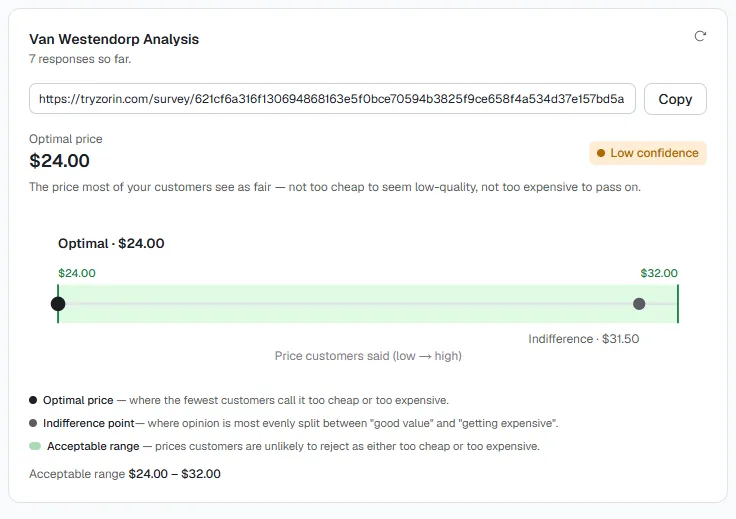
Zorin measures that for each product. It reads your Shopify or WooCommerce sales history, fits a price elasticity model, and returns a raise, lower or hold recommendation with an estimated profit impact and a confidence score. For a group you want to understand better, such as trade buyers or a student audience, you can also share Zorin's Van Westendorp price survey link with just that group to see the price range they find acceptable.
Key Takeaways
- Segment pricing charges different customer groups different prices, such as student, wholesale, regional or volume pricing.
- It only works with a fence, like verification or a minimum order, that keeps full-price buyers out of the discounted segment.
- Spotify prices Premium Student at $6.99 against $12.99 for Individual, fenced by student verification.
- In the worked example, a student discount gains $120 a month when verified but loses $280 when the code leaks to regular buyers.
- Posted segment prices are standard; individual prices based on personal data now draw FTC scrutiny and, in New York, a required disclosure.
Frequently Asked Questions
What is segment pricing?
Segment pricing is charging different prices to different groups of customers for the same or a similar product, based on differences in their willingness to pay. Student discounts, wholesale price lists, regional prices and volume tiers are all forms of segment pricing.
What is an example of segment pricing?
Spotify charges $12.99 a month for Premium Individual and $6.99 for Premium Student in the US, with student verification as the fence. In ecommerce, a trade price list for salons or a verified healthcare worker discount works the same way.
Is segment pricing legal?
Openly offered segment prices are common and generally lawful. Business-to-business price differences can raise Robinson-Patman Act issues in the U.S., and prices set by algorithm from a consumer's personal data require a disclosure in New York. This is general information, not legal advice.
What is a price fence?
A price fence is a rule that stops customers outside a segment from getting that segment's price. Identity verification, account approval, minimum quantities, time windows and different product versions are all common fences.
What is the difference between segment pricing and dynamic pricing?
Segment pricing sets different prices for different groups of customers. Dynamic pricing changes the price over time for everyone, based on demand, inventory or competitor moves. A store can use both at once.
How do I know if segment pricing will be profitable?
Estimate the extra orders the segment price brings in, subtract the margin you give up on those orders, and subtract the margin lost when full-price buyers leak into the segment. If the result is positive with a realistic leakage estimate, the segment price is worth testing.
Segment pricing is one of the oldest ways to serve customers with different budgets without cutting your price for everyone. Get the fence right, do the leakage math, and keep prices posted rather than personalized. To see how price-sensitive each of your products is before you segment, try Zorin free.
Written by Dexter
Dexter is part of the team at Zorin, building tools that help ecommerce merchants price with data instead of guesswork.
More in Pricing Fundamentals & Strategy
View all →Price Priming: How Cues Shape What Shoppers Pay
Price priming is when a number, image or product order changes how shoppers judge a price. What the research shows and how to test it honestly.
Keystone Pricing: What It Is and When It Fails
Keystone pricing doubles your cost to set the retail price. The formula, variations like triple keystone, a wholesale example, and when 2x isn't enough.
Everyday Low Pricing vs High-Low: Which Is Better?
Everyday low pricing keeps prices steady; high-low relies on sales. Pros, cons, a worked profit example, and how Zorin shows which fits each product.