Dynamic vs Variable Pricing: What's the Difference?
The difference between dynamic pricing and variable pricing is timing and automation. Variable pricing sets different prices in advance for known conditions, such as a higher holiday price, a weekend rate or a tier for big orders, and those prices stay fixed until you change the schedule. Dynamic pricing changes prices continuously, usually by software, in response to live signals like demand, inventory or competitor moves. Variable pricing is a plan; dynamic pricing is a system that keeps re-deciding.
What Is Variable Pricing?
Variable pricing means charging different prices for the same product depending on a condition you define ahead of time. The condition might be the date (peak season vs off-season), the time (weekday vs weekend), the quantity (1 unit vs a case), the channel or the customer type. Once the schedule is set, the price at any moment is predictable. Anyone who knows the rules can tell you what next Saturday's price will be.
Many small stores already use variable pricing without calling it that: a holiday price on gift sets, a multipack discount, a lower price on an off-season line.
What Is Dynamic Pricing?
Dynamic pricing means prices move in response to current conditions, often many times a week or day. The inputs are live: how fast a product is selling, how much stock is left, what competitors charge right now, or a demand model's latest estimate. The price tomorrow isn't set in advance; it's decided by the system when the conditions arrive. Airlines, ride-hailing apps and hotels are the classic examples.
Dynamic Pricing vs Variable Pricing at a Glance
| Variable pricing | Dynamic pricing | |
|---|---|---|
| When prices are set | In advance, on a schedule or rule table | Continuously, as conditions change |
| What drives the change | Known conditions: date, day, quantity, customer type | Live signals: sales velocity, inventory, competitor prices, demand models |
| How often prices move | A few times a season or year | Daily or more |
| Who decides | A person, when building the schedule | Software, with or without human review |
| Predictable to customers? | Yes, usually posted or explainable | Less so; the same item can cost more an hour later |
| Data needed | Past seasonal patterns | Live data feeds and enough history to model demand |
| Main risk | Leaving money on the table when conditions differ from the plan | Customer backlash if changes look like exploiting demand |
| Ecommerce example | Gift sets $5 higher from November 15 to December 24 | A bestseller's price rises automatically when stock falls below 15 units |
A Real Example: From Variable to Dynamic in Baseball
Pro sports teams show the difference clearly because many made the switch publicly. For years, baseball teams used variable pricing: tickets cost more or less depending on the opponent and the day, set before the season started. The San Francisco Giants were one of the first teams to go further. According to CIO's account of the rollout, the team piloted dynamic pricing software on 2,000 outfield and upper-deck seats in 2009, the seats that usually sold last, and sold an additional 25,000 tickets for an extra $500,000. It expanded the system park-wide in 2010.
Three details are worth borrowing. The software produced daily recommendations that staff reviewed before anything changed. The team's stated approach was to start low and let demand push prices up, so season ticket holders wouldn't feel they'd overpaid. And the face value of tickets actually fell for 75% of available seats in 2010. Dynamic pricing isn't only a way to raise prices; done well, it lowers them where demand is weak.
The flip side is well known. When Wendy's said in 2024 it would test "dynamic pricing", the reaction was so strong it clarified within days that it would only use the system to lower prices in slow periods. That story, and the 2022 Springsteen ticket backlash, are covered in what dynamic pricing is.
See what Zorin's elasticity model says about your own catalog.
Start free trialWorked Example: Variable Pricing for a Seasonal Product
A candle shop sells a $39 holiday candle that costs $15. It sells 600 units a month in November and December and 250 a month the rest of the year.
- One flat price all year: (1,200 + 2,500 units) × $24 profit = $88,800.
- Variable pricing, $45 in November and December: peak demand is less price-sensitive, so say it dips only to 560 a month. Peak profit: 1,120 × $30 = $33,600. Off-season stays at $39: 2,500 × $24 = $60,000. Total $93,600, or $4,800 more (+5.4%).
That uplift came from a simple, predictable schedule, no software required. A dynamic system could add more by reacting inside the season, for example nudging the price up when stock runs low in mid-December, or down if a warm-weather week slows sales. But it needs reliable data and guardrails, and the extra gain is often smaller than the first step from one flat price to a sensible schedule. The assumption doing the work here is the peak-season dip from 600 to 560 units. Whether your product behaves that way is a question of price elasticity, not a guess.
Which One Should Your Store Use?
- Start with variable pricing if your demand follows a calendar. Seasonal products, gifting peaks and predictable slow months are easy wins with a posted schedule customers understand.
- Add volume or segment tiers where buyers differ. Multipacks and trade prices are variable pricing too, and they carry little trust risk.
- Consider dynamic pricing when conditions change faster than you can plan. Fast-moving inventory, frequent competitor moves or large catalogs where manual schedules can't keep up.
- Keep a human in the loop at first. Like the Giants, review recommendations before they go live, and set a floor and a ceiling for every product.
- Base either approach on measured demand. A schedule or an algorithm built on guesses is still a guess. Rule-based versus model-based approaches are compared in rule-based vs algorithmic pricing.
Setting Prices From Measured Demand
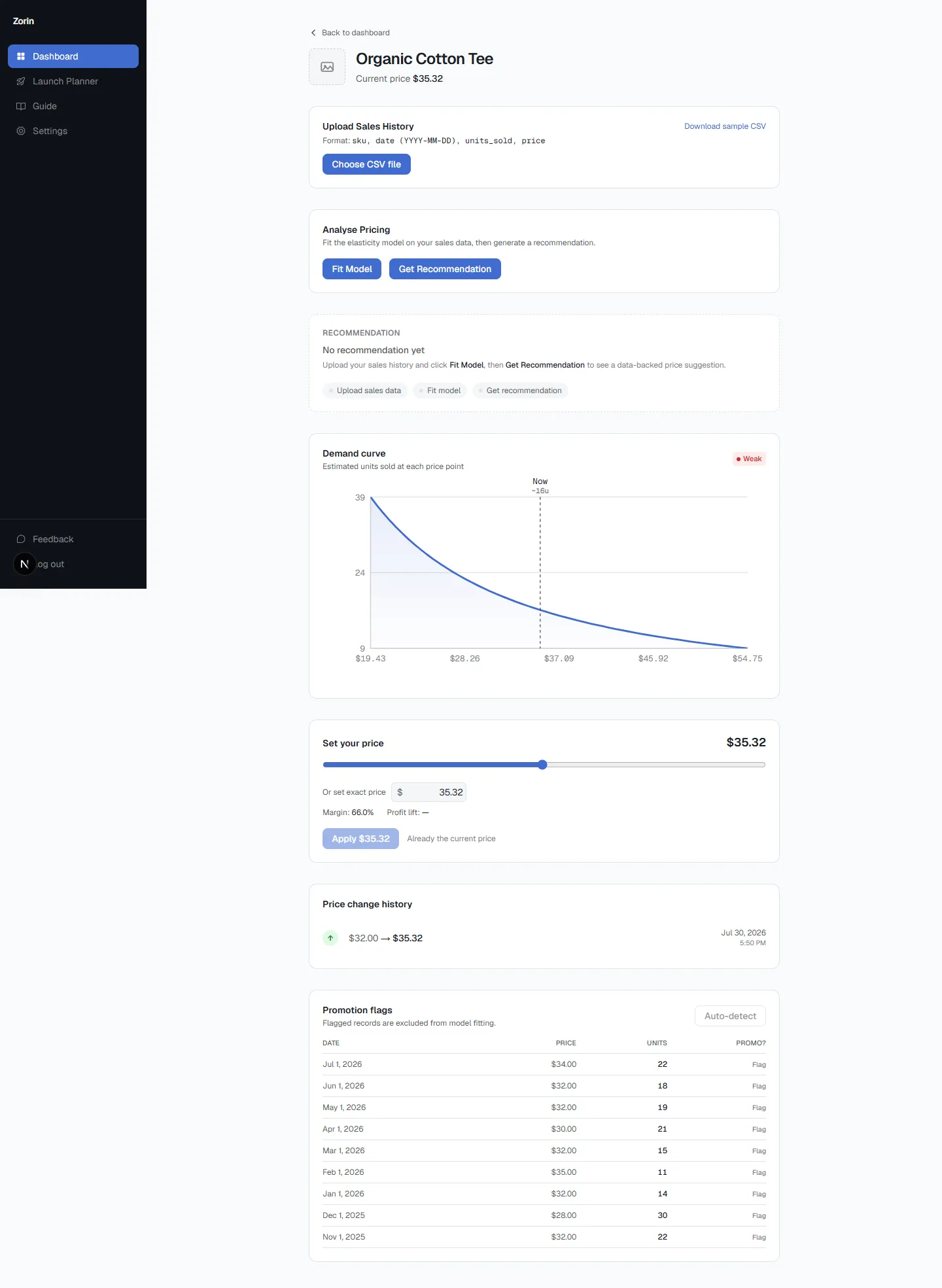
Zorin sits between the two. It doesn't reprice your store on its own every hour. It reads your Shopify or WooCommerce sales history, fits a price elasticity model for each product, and recommends whether to raise, lower or hold, with an estimated profit impact and a confidence score. You review and apply the changes, one product at a time or in bulk. The result is a price you set deliberately, like variable pricing, but based on measured demand rather than a guess.
Key Takeaways
- Variable pricing sets different prices in advance for known conditions; dynamic pricing changes prices continuously from live signals.
- Variable pricing is predictable and low-risk; dynamic pricing reacts faster but needs data, guardrails and careful communication.
- The Giants' 2009 dynamic pricing pilot on 2,000 seats sold 25,000 more tickets for an extra $500,000, and face values fell for 75% of seats in 2010.
- In the candle example, a simple seasonal price schedule added $4,800 a year (+5.4%) with no software.
- Build either approach on measured price elasticity, and keep human review and price limits in place.
Frequently Asked Questions
What is the difference between dynamic pricing and variable pricing?
Variable pricing sets different prices ahead of time for known conditions, like a season, day or order size. Dynamic pricing changes prices continuously in response to live data such as demand, inventory or competitor prices, usually with software.
Is surge pricing dynamic or variable pricing?
Surge pricing is dynamic pricing. The price rises in real time when demand outstrips supply, rather than following a schedule set in advance.
Is a holiday price increase dynamic pricing?
Usually not. A holiday price set in advance and applied on fixed dates is variable pricing. It becomes dynamic only if software adjusts it during the season based on live sales or stock levels.
Are volume discounts variable pricing?
Yes. Charging less per unit for larger quantities is variable pricing based on order size. The tiers are set in advance and every customer who meets them gets the same price.
Which is better for a small online store?
Most small stores get the biggest, safest gain from variable pricing first: seasonal schedules, volume tiers and segment prices. Dynamic pricing makes sense later, when the catalog or the market moves faster than you can plan by hand.
Do customers react differently to dynamic and variable pricing?
Generally yes. Variable pricing is predictable and easy to explain, so it rarely causes backlash. Dynamic price rises that look like exploiting demand, as with Wendy's in 2024, can trigger strong reactions, while dynamic price cuts in slow periods are usually welcomed.
Variable pricing and dynamic pricing both let price follow demand; one plans ahead and the other keeps re-deciding. Whichever fits your store, it only works if you know how each product responds to a price change. Start a free Zorin trial to see that for your catalog from your own sales history.
Written by Dexter
Dexter is part of the team at Zorin, building tools that help ecommerce merchants price with data instead of guesswork.
More in Discounts & Promotions
View all →Which Products Should You Discount? Use Your Data
Discount the products whose demand actually responds to price, not whatever is overstocked. How to pick sale candidates from your own sales history.
Should You Raise Prices Before Black Friday?
Raising prices before Black Friday to fake a discount backfires with shoppers and regulators. How deep to actually discount for BFCM and keep margin.
How to Run a Price A/B Test the Right Way
Sample size, test duration, and how much to change the price. The mechanics of a real price test, no data scientist required.