Zorin vs Prisync: Which Fits Your Store?
| Feature | Zorin | Prisync |
|---|---|---|
| Core mechanism | Fits an elasticity model to your own sales history (log-log regression per SKU) | Tracks competitor prices and applies a rule to match or undercut them |
| Competitor price monitoring | Manual entry only, name, price, optional URL per product, no automatic scraping | Automatic tracking across your own site, Amazon, eBay, Google Shopping, and more, in real time |
| Automatic repricing | None, every recommendation requires manual review before it's applied | Dynamic pricing rules apply automatically on Premium and Platinum plans |
| Confidence on each recommendation | R²-based confidence label on every read, so thin-data SKUs aren't presented with false certainty | No statistical confidence score, output is a rule result, not a modeled estimate |
| Entry pricing | $39/mo for up to 25 products (Starter) | $99/mo for up to 100 products (Professional, URL-based monitoring) |
| Stock and availability monitoring | Not offered | Included on all plans |
| Customer price-sensitivity survey | Included, a 4-question Van Westendorp survey for a stated-preference read alongside the elasticity model | Not offered |
If your problem is staying visible against competitor listings on a marketplace, Prisync's automated tracking and repricing rules do that job well. If your problem is figuring out what your own customers will actually pay as your price moves, that's a question only your own sales history can answer, and it's the one Zorin was built to read.
Start your free trialPrisync and Zorin both get filed under "pricing software," but they solve different problems from different data. Prisync watches your competitors and reprices to match or beat them. Zorin reads your own sales history and models how your specific customers respond when your price moves. Picking between them comes down to which question you're actually trying to answer, not which tool has more features.
What Prisync Actually Does
Prisync is a competitor price monitoring and repricing tool, not a demand-modeling one. It tracks competitor prices across your own storefront, Amazon, eBay, Google Shopping, and general ecommerce sites, alerts you to changes, and, on its Premium and Platinum plans, applies dynamic pricing rules that automatically adjust your price in response. Plans start at $99/month for up to 100 products under URL-based monitoring, scaling to $399/month for 5,000 products on Platinum, with channel-based monitoring running higher still and API access adding a further 20% on top.
The mechanism is entirely external. Prisync doesn't touch your own sales history at all, it's reading someone else's storefront and telling you where you sit relative to it. That mechanism has real fans: Prisync holds a 4.7-out-of-5 rating across 168 reviews on G2, with 94% of reviewers rating it positively for ease of use and 92% for ease of setup, most of the praise centers on how quickly it surfaces competitor movement, not on any demand-forecasting capability, which the product doesn't claim to have.
What Zorin Actually Does
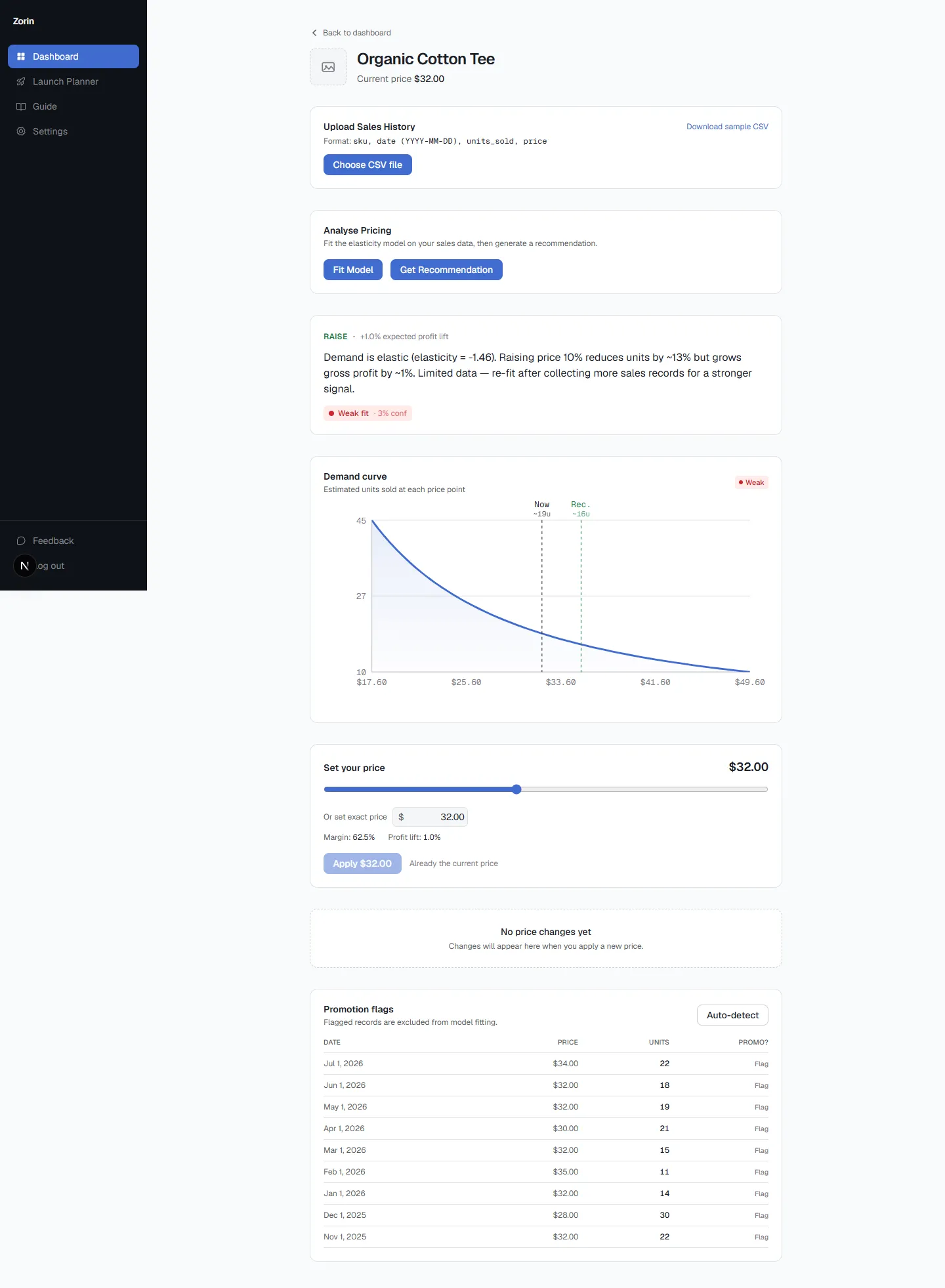
Zorin connects to your Shopify or WooCommerce store, or takes a CSV upload, and fits a price elasticity model to your own price-and-quantity history, per SKU. The output is a plain raise, lower, or hold recommendation, an estimated profit lift, and an R²-based confidence score so a thin-data product is never presented with the same certainty as an established one. Nothing applies automatically, every change goes through your review first. Zorin's plans start at $39/month for up to 25 products, up to $249/month for unlimited products and multi-store support.
Why the Underlying Data Source Matters More Than the Feature List
The two tools aren't just different in scope, they're built on different assumptions about what actually moves profit. McKinsey's analysis of S&P 1500 companies found that a 1% price increase, with volume held constant, lifts operating profit by roughly 8%, a bigger swing than an equivalent cut in costs or gain in volume produces. That number is exactly why "get the price right" and "match what everyone else charges" aren't the same goal. Matching a competitor's price tells you where you sit in a lineup; it says nothing about whether that specific number is actually the one that maximizes what your own customers are willing to pay before demand drops off. An elasticity read is aimed directly at that second question. A repricer isn't built to answer it at all.
Where Prisync Wins
If you're selling a genuine commodity, a product that's identical to five other listings and where buy-box visibility on a marketplace decides the sale, Prisync's automatic, real-time competitor tracking and repricing rules are doing exactly the job that situation calls for. Zorin has no equivalent: its competitor feature is a manual per-product entry (name, price, optional URL) that computes a min/median/max, not a live-monitoring subscription. If stock and availability tracking across channels matters to your operation, that's also a Prisync strength Zorin doesn't offer at all.
Ready to see your own numbers?
Start your free trialThe Race-to-the-Bottom Risk Automatic Repricing Doesn't Solve on Its Own
Automatic repricing has a known failure mode worth understanding before turning it on. Price2Spy's own analysis of the pattern describes it plainly: multiple sellers repeatedly undercut one another, each reduction triggers another, and the cycle continues until margins become unsustainable, usually starting from uncertainty rather than strategy, a retailer sees a competitor's price move, matches it "just to be safe," and the next competitor does the same back. A rule that always matches or undercuts, without a margin floor set underneath it, can walk a whole catalog into exactly that spiral without anyone deciding to start a price war on purpose. Prisync's own dynamic pricing lets you configure a floor to guard against this, but the floor still has to be set from real judgment about what a product can actually absorb, and that's a decision an elasticity read is better positioned to inform than another competitor's price ever is.
Where Zorin Wins
If your store has its own brand and its own customer base, and your real question is "what will my customers actually pay," a competitor's listed price doesn't answer that, it reflects their costs and their audience, not yours. Zorin's elasticity read comes from your own sales history, with a stated confidence level attached to every recommendation, and it's paired with a separate Van Westendorp price-sensitivity survey for a second, stated-preference signal Prisync has no equivalent to. Entry pricing is lower too, $39/month for a store just starting to test data-driven pricing versus Prisync's $99/month floor.
Can You Use Both
Yes, and for some stores that's the right answer. The two tools read different signals, one external, one internal, and nothing about running an elasticity model conflicts with also keeping an eye on marketplace price position for the subset of SKUs where that actually matters. The mistake is assuming either one alone answers the whole pricing question. A store selling a mix of commodity and branded SKUs might reasonably run Prisync on the commodity subset to stay visible on marketplaces, while letting an elasticity read set price on everything with real brand pull. A fuller breakdown of the category difference, including where enterprise elasticity platforms fit into the picture, is worth reading if you're still deciding which category your store needs at all.
Frequently Asked Questions
Is Zorin a Prisync alternative?
Not a direct one. Prisync is competitor price monitoring and repricing; Zorin is elasticity modeling based on your own sales history. They answer different questions, and some stores use both.
Does Zorin track competitor prices like Prisync does?
Not automatically. Zorin doesn't scrape or live-monitor competitor sites. You can manually add a competitor's name, price, and an optional URL per product, and Zorin computes the min, median, and max across what you've entered, but it isn't a subscription tracking service the way Prisync is.
Which is cheaper, Zorin or Prisync?
Zorin's entry plan is $39/month for up to 25 products. Prisync's entry plan is $99/month for up to 100 products under URL-based monitoring, rising to $399/month for 5,000 products, with API access adding roughly 20% more.
Does Prisync do price elasticity modeling?
No. Prisync's own pricing and feature pages describe dynamic pricing as competitor-based repricing rules, not demand elasticity or a proprietary model built from a merchant's own sales data.
Can automatic repricing hurt my margin if I'm not careful?
Yes, if a repricing rule always matches or undercuts without a margin floor, it can pull a whole catalog into a race-to-the-bottom cycle with other sellers doing the same thing. Setting a real floor, informed by what a product can actually absorb rather than a guess, is what keeps automatic repricing from working against you.
Can Zorin automatically change my prices the way Prisync's dynamic pricing does?
No. Every Zorin recommendation requires manual review. You can adjust it with a slider or your own number, preview the margin impact, and apply changes one product at a time or in bulk, but nothing changes without you approving it.
Prisync and Zorin aren't really competing for the same job. If the question is "am I priced right relative to what else is listed for this product," Prisync answers that, and its 4.7-star G2 rating reflects real strength at that specific job. If it's "what would my own customers actually do if I changed this price," that's a question only your own sales history can answer, and Zorin was built specifically to read it. Weighing more than one option? See Prisync alternatives for a broader shortlist.
Written by Dexter
Dexter is part of the team at Zorin, building tools that help ecommerce merchants price with data instead of guesswork.