Sales Dropped After a Price Increase? Here's Why
You raised a price by what felt like a small amount, and sales fell off a cliff. That drop almost always traces back to one of three things: your product is more price elastic than you assumed, customers feel a price hike more sharply than they'd have felt an equivalent discount, or something else entirely, like a competitor's move, happened to land at the same time. Each cause has a different fix, and the first step is figuring out which one you're actually looking at.
The Math Behind a Small Increase Causing a Big Drop
On a price-sensitive product, a 10% price increase can easily cost you 20% of your unit sales, and the reason has a name: price elasticity of demand.
Say you sold 500 units a month at $20 each. You raise the price to $22, a 10 percent increase. The next month you sell 400 units, a 20 percent drop. Divide the percentage change in quantity by the percentage change in price and you get an elasticity of -2. That means for every 1 percent you raised price, demand fell about 2 percent. Your product isn't just elastic, it's highly elastic, and the sales chart is doing exactly what the math predicts.
Economists sort products into three broad zones:
| Classification | Elasticity (absolute value) | What it means |
|---|---|---|
| Elastic | Greater than 1 | Small price moves cause disproportionately large swings in demand. Discretionary goods with easy substitutes, fashion items, anything a customer can simply skip buying this month. |
| Inelastic | Less than 1 | Demand barely moves even with a real price change. Necessities, products with no close substitute, items that make up a tiny share of a customer's budget. |
| Unitary | Around 1 | The percentage change in quantity roughly matches the percentage change in price, so total revenue holds steady either way. |
The uncomfortable part is that most merchants don't know which zone a given SKU sits in until after they've already tested it the hard way, by raising the price and watching what happens.
Quick Self-Check: Is Your Product Too Elastic to Raise Safely
Before you touch a price again, run through this checklist. The more boxes a product checks, the more likely it's sitting in elastic territory:
- Substitutes are one click away. If a customer can find a near-identical product from another store in under a minute, price sensitivity goes up.
- It's discretionary, not a necessity. Products a customer can delay or skip buying entirely tend to be more elastic than things they need regardless of price.
- It's a meaningful share of the customer's budget. A $5 increase on a $15 item registers very differently than a $5 increase on a $150 item.
- There's little brand loyalty built up. New customers and low-repeat categories tend to be far more price sensitive than an established base with a habit of buying from you specifically.
- You've never tested a price change on this SKU before. Without any price variation in your own sales history, you're guessing, not measuring.
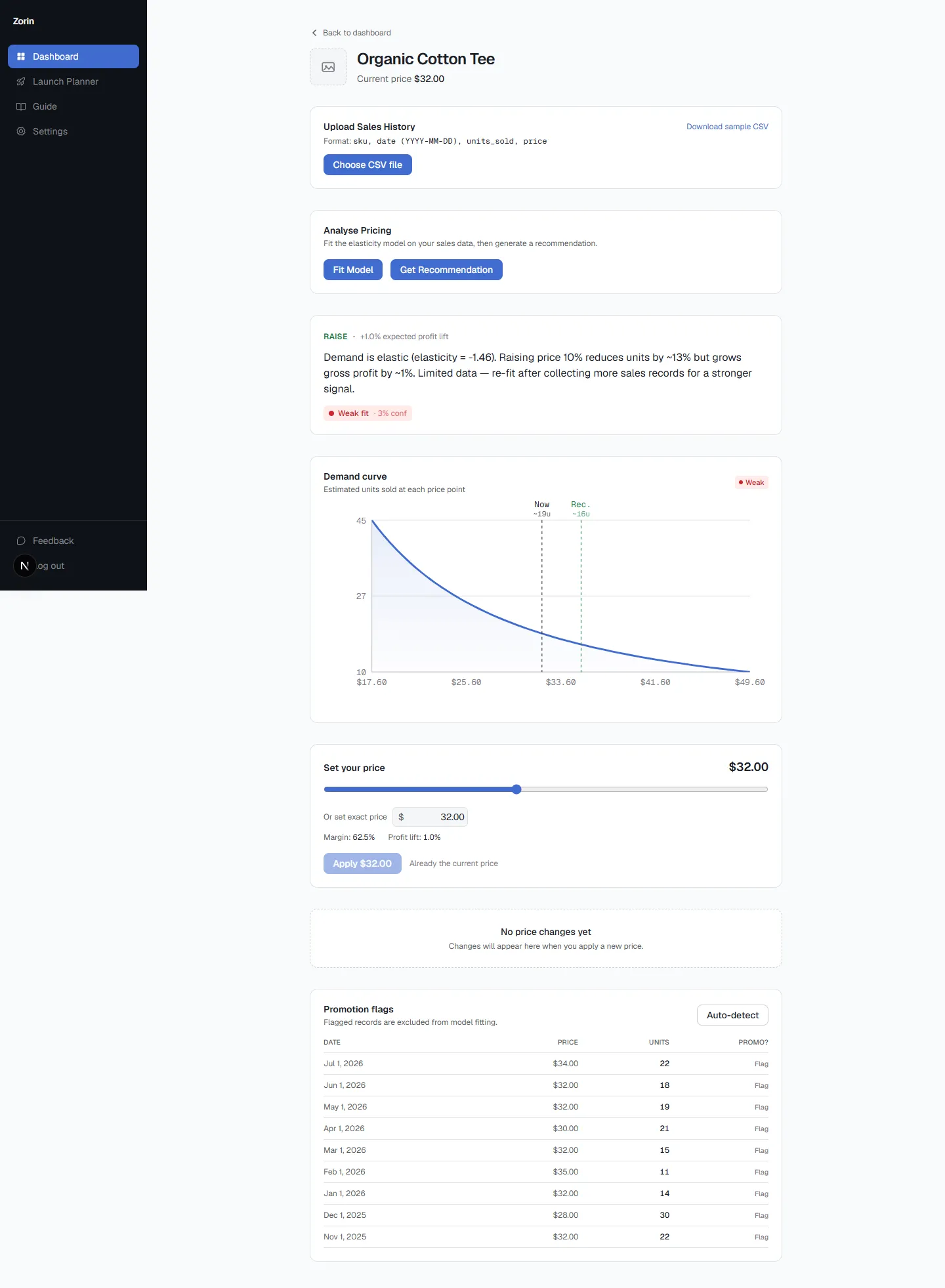
This checklist gets you a rough read. Zorin turns the same underlying signals into an actual number: it fits a price elasticity model from your own sales history per SKU, and returns your elasticity coefficient alongside a confidence label based on how much real price variation is in that history. A product that's never had its price moved before shows up with a lower confidence score, which is often the exact situation behind a price increase that hurt more than expected. You're not just told the product is "probably elastic," you get the coefficient and how much you should trust it.
Why Customers Punish a Price Hike Harder Than They'd Reward a Discount
Customers feel the sting of a price increase more intensely than they'd have felt the pleasure of an equivalent discount, a well-documented behavioral pattern called loss aversion.
Loss aversion comes from Daniel Kahneman and Amos Tversky's prospect theory. Their research estimated that losses weigh roughly twice as heavily as equivalent gains; the 1992 version of the theory put the ratio at about 2.25. Applied to pricing, that means a $2 price increase doesn't just cancel out the goodwill a $2 discount would have earned, it actively costs you more goodwill than the discount would have gained you.
The mechanism behind this is the reference price. Every returning customer carries a mental anchor of what your product "should" cost, built from the price they paid last time. When your new price comes in above that anchor, they don't evaluate it neutrally, they evaluate it as a loss relative to what they'd already mentally budgeted. That's why a price increase can trigger a sharper drop in sales than the raw elasticity math alone would predict, you're not just pricing above what some customers will pay, you're asking every returning customer to give something up relative to their own reference point.
This explains a pattern a lot of merchants notice and can't quite name: the drop after a price increase is often front-loaded and disproportionate, heaviest right after the change, among your most price-aware repeat customers, then it partially recovers as the new price becomes the new reference point over time. If your sales data shows a sharp initial dip followed by partial stabilization a few weeks later, that shape itself is a loss-aversion signature, not necessarily proof your long-run elasticity is as bad as the first week suggested.
See what Zorin's elasticity model says about your own catalog.
Start free trialRuling Out Your Competitors Before Blaming Your Price
A sales drop that lines up with a price increase isn't automatic proof the price caused it. A competitor's simultaneous discount, a stockout on their end resolving, or a seasonal dip can produce a nearly identical-looking chart.
Before you conclude your price increase was the problem, run a few checks:
- Check the timing precisely. Did the drop start the exact week you changed price, or did it start a few days earlier or later? A mismatch in timing points away from your price as the sole cause.
- Check whether the drop is catalog-wide or isolated to the SKU you repriced. If products you didn't touch also saw a dip at the same time, something bigger than your one price change is happening, likely a traffic or seasonal issue, not elasticity.
- Check your traffic, not just your conversion rate. A drop in visits with a stable conversion rate points to a demand-side or marketing issue. A stable traffic number with a falling conversion rate points more clearly at the price itself.
- Check what your direct competitors did that same week, if you have any visibility into it. A rival running a flash sale or restocking a popular item can pull share away from you in a way that looks, on your dashboard, exactly like a bad reaction to your own price change.
This is one reason Zorin's elasticity model doesn't automatically scrape or live-monitor competitor prices for its core recommendation in the first place. It fits its recommendation from your own sales history, your own customers, your own demand curve, so the raise, lower, or hold call you get isn't quietly reacting to a competitor's pricing move mixed in with the data. That separation matters most exactly in a situation like this one: when you're trying to figure out whether a drop was really your price, or something happening one tab over on a rival's storefront.
How to Raise Prices Without Losing Customers Next Time
A safer price increase combines three things: sizing the increase to what your actual elasticity can absorb, staging it incrementally instead of all at once, and communicating the change in a way that resets the customer's reference price instead of leaving it exposed as a pure loss.
A few concrete tactics:
- Test on a subset of SKUs first, not your whole catalog at once. A single bad reaction on one product tells you something specific about that product's elasticity. A catalog-wide increase tells you nothing you can isolate.
- Move in smaller increments over time rather than one large jump. A staged path gives the reference price room to shift gradually instead of asking customers to absorb the whole increase as a single loss.
- Pair a price increase with visible added value where you can, a packaging upgrade, an included extra, a service improvement, anything that gives the customer a reason the new number reflects something different, not just a straight increase on the same thing.
- Preview the outcome before you commit. Look at the estimated profit impact of a given price, not just the unit-volume impact, before applying it. A price that drops units but raises total profit is often still the right call, and a price that raises units but tanks margin is often the wrong one, even though the sales chart alone won't tell you which is which.
That last point is where Zorin's review and apply workflow is built to help. Instead of guessing a new price and watching what happens, you can adjust any recommendation with a slider or type in your own number, and see a live preview of the resulting margin and profit lift before you commit. You can apply a change to one product at a time, or across your whole catalog, with each product's apply handled independently so one SKU's issue never blocks the rest. And if you want a second signal before committing catalog-wide, Zorin's Van Westendorp price sensitivity survey gives you stated customer preference, what customers say they'd tolerate, sitting alongside the elasticity model's revealed preference, what your customers have actually done. Nothing changes automatically. You review the reasoning and the confidence behind it, and you decide.
Key Takeaways
- A small price increase causing a large sales drop usually means the product has elastic demand, where a percentage price change produces a proportionally larger percentage change in quantity sold.
- Loss aversion means customers feel a price increase roughly twice as intensely as they'd have felt an equivalent discount, which can make the drop sharper than pure elasticity math predicts, especially right after the change.
- Before blaming your price, check whether the drop is catalog-wide, whether the timing lines up exactly, and whether traffic (not just conversion) dropped too, since a competitor move can produce an identical-looking dip.
- A diagnostic checklist (substitutes, discretionary spend, budget share, brand loyalty, no price-testing history) gives a rough read on elasticity before you ever touch a price again.
- The safer path is sizing the increase to your actual elasticity, staging it incrementally, and previewing profit impact, not just unit-volume impact, before committing.
Frequently Asked Questions
Why did a small price increase cause such a big drop in sales?
Your product likely has elastic demand, where a small percentage change in price produces a larger percentage change in units sold. A 10% increase causing a 20% drop is what an elasticity of about -2 looks like, not a sign something went wrong with the price change itself.
How do I know if my product's demand is too price elastic to raise prices safely?
Check for easy substitutes, discretionary (not necessity) purchases, a large share of customer budget, low brand loyalty, and no prior price-testing history. The more of these apply, the more likely the product is elastic. A per-SKU elasticity model gives you the actual coefficient instead of a guess.
Why do customers punish a price increase more than they'd reward an equivalent discount?
Loss aversion, a concept from Kahneman and Tversky's prospect theory, means people feel the pain of a loss roughly twice as strongly as the pleasure of an equivalent gain. A price increase reads as a loss relative to a customer's remembered reference price.
Could my competitors' pricing be the real reason my sales dropped, not my price increase?
Yes, this is common. Check whether the drop is isolated to the SKU you repriced or catalog-wide, whether the timing matches exactly, and whether traffic dropped too. A competitor's simultaneous discount or restock can produce a nearly identical-looking sales dip.
How can I raise prices without losing customers or tanking my conversion rate?
Size the increase to your product's actual elasticity, stage it in smaller increments instead of one jump, pair it with visible added value where possible, and preview the profit impact before committing rather than reacting to the sales chart alone.
Does a sales drop always mean I raised the price too much?
No. A drop in units doesn't automatically mean a drop in profit. If the new price lifts your margin enough, total profit can rise even with fewer units sold. Check the estimated profit impact, not just the unit count, before deciding the increase was a mistake.
How much price variation do I need in my sales history before an elasticity estimate is trustworthy?
More than a single price change on a single product. A confidence label based on how much real price variation exists in your data tells you whether an estimate is well-supported or still thin, so you're not treating an early guess as a settled number.
Should I test a price increase on my whole catalog at once?
No. Testing on a subset of SKUs first isolates what a single product's elasticity actually looks like. A catalog-wide change at once makes it much harder to tell which products reacted and why.
Does Zorin compare my prices against competitors to make recommendations?
No. Zorin fits its elasticity model from your own sales history only. It doesn't scrape or match competitor prices, so a raise, lower, or hold recommendation reflects your own customers' demonstrated behavior, not a competitor's move.
What's the difference between Zorin's elasticity model and the Van Westendorp survey?
The elasticity model reads revealed preference, what your customers have actually done, from your sales history. The Van Westendorp survey captures stated preference, what customers say they'd tolerate, through a short four-question survey. They're kept as separate signals on purpose.
Start with the product that hurt the most. Run it through the checklist above, rule out a same-week competitor move, and look at the actual elasticity behind the drop before you decide whether to hold, reverse, or stage the next increase differently. Zorin fits a price elasticity model from your own sales history per SKU and shows you the estimated profit impact before you commit to anything.
Written by Dexter
Dexter is part of the team at Zorin, building tools that help ecommerce merchants price with data instead of guesswork.
More in Price Elasticity
View all →How to Calculate Price Elasticity in WooCommerce
Where to find the data in WooCommerce Analytics, the midpoint formula on a real example, and why a pricing plugin isn't an elasticity read.
What Your Price Elasticity Score Actually Means
What your elasticity number means, how to know if it's solid enough to act on, and why products in the same category can have completely different scores.
How to Know If Your Prices Are Too High or Too Low
Declining sales and high close rates are lagging signals. Price elasticity tells you before you change anything, not after the damage is done.