How to Price Your Whole Catalog at Once
You can price a whole catalog without reviewing every product manually by letting each SKU's own elasticity model generate a recommendation automatically, then applying the ones you trust in bulk while reviewing individually only the products flagged with lower confidence or bigger changes. The manual, one-by-one approach isn't a discipline worth admiring, it's a bottleneck that doesn't scale past a small handful of products.
Why One-by-One Doesn't Scale
Reviewing ten products individually is manageable for an afternoon. Reviewing a few hundred, the reality for many established SMB catalogs, simply isn't, not without either a dedicated team or an unreasonable amount of time taken away from running the rest of the business. The manual approach isn't more careful, it's just slower, and slowness at that scale usually means most of the catalog never gets reviewed at all, not that it gets reviewed thoroughly. Once you trust the pattern of recommendations, automating the export-review-apply cycle removes even more of that manual overhead.
What a Catalog-Wide View Actually Replaces
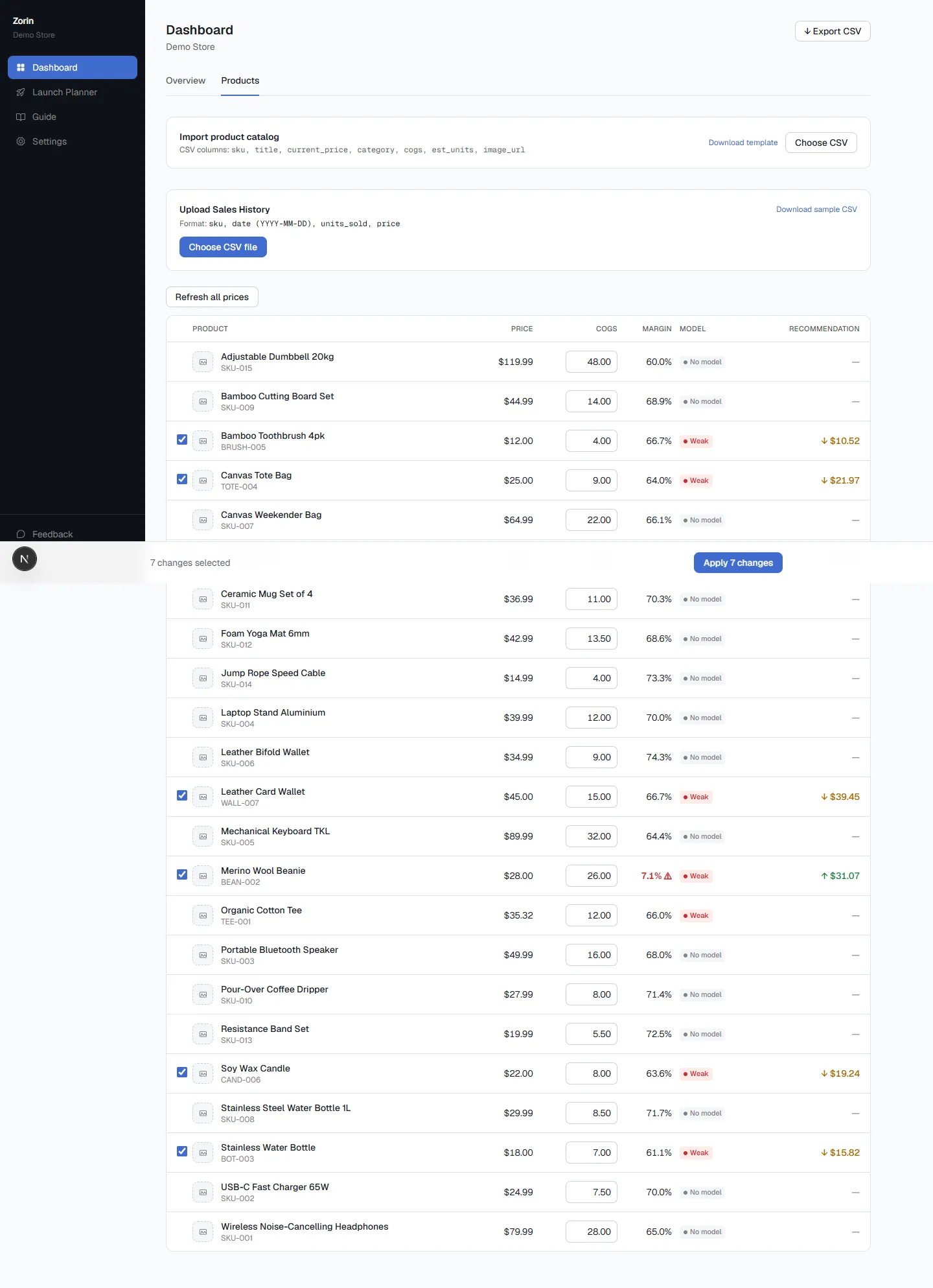
Instead of opening each product's page individually, a catalog view shows every SKU's recommendation (raise, lower, or hold) and estimated profit lift in one list, sortable and scannable in a single pass. This turns "review my whole catalog" from a multi-day task into something you can meaningfully process in one sitting, because you're scanning a list of outcomes rather than re-deriving each one from scratch.
| Product | Recommendation | Est. profit lift |
|---|---|---|
| Wireless Headphones | Raise | +18.3% |
| Mechanical Keyboard | Lower | +6.1% |
| Ergonomic Mouse | Hold | , |
| USB-C Hub | Raise | +11.7% |
This table is illustrative of the format, not a claim about any specific catalog; actual recommendations depend entirely on each product's own sales history.
How Big Retailers Handle It
Large retailers stopped pricing one product at a time years ago. NBER research by Alberto Cavallo found that the share of products changing price each month at big multi-channel U.S. retailers roughly doubled, from 15% in 2008-10 to almost 30% in 2014-17. Nobody reviews that many prices by hand. They use systems that flag which prices need attention and batch the rest.
A small store doesn't need that speed, but the arithmetic is the same. At ten minutes per product, a careful review of 200 SKUs takes more than 33 hours, and by the time you finish, the first prices you checked are a month out of date. The practical answer is to let a model sort products by how confident it is and how big the suggested change is, apply the obvious ones in bulk, and spend your own time on the handful that actually need judgment.
Where Bulk Applying Is Genuinely Safe
A high-confidence recommendation, backed by a strong model fit and a meaningful volume of historical data, is a reasonable candidate for bulk applying without individual review, since the statistical support behind it is already substantial. This is where most of your time savings actually come from: not skipping review entirely, but not needing to re-verify a conclusion that's already well supported. That statistical support is exactly what separates this from a repricing tool applying the same rule across the board regardless of each product's own data.
See what Zorin's elasticity model says about your own catalog.
Start free trialWhere Individual Review Still Earns Its Keep
A Weak-confidence recommendation, an unusually large suggested change, or a product where you have outside context the model can't see (a known upcoming promotion, a supplier issue, a seasonal quirk) is worth a quick individual look before applying. The point isn't to review everything by hand, it's to concentrate your limited attention on the subset that actually benefits from it.
Why Per-Product Independence Matters During a Bulk Apply
When applying changes across many SKUs at once, a single product hitting an issue, a sync failure, a flagged inconsistency, shouldn't block the rest of the catalog from updating. A well-built bulk apply flow handles each product independently, applying the ones that succeed and clearly reporting which ones didn't, rather than an all-or-nothing operation that stalls the entire batch over one problem product.
A Practical Way to Roll This Out
- Start with a subset, ten to twenty products in a category you know well, and review those individually first.
- Compare the recommendations against outcomes you'd expect, building trust in the pattern before scaling up.
- Bulk apply high-confidence recommendations across the rest of the catalog once you trust the pattern.
- Reserve individual review for low-confidence products, unusually large changes, or SKUs with context the model wouldn't know about.
- Repeat on your normal review cadence, not as a one-time catalog cleanup.
If your catalog has grown past what you can reasonably review product by product, connect your sales history and see the full-catalog recommendation view rather than opening each product one at a time.
Key Takeaways
- A catalog-wide view that shows every product's recommendation and estimated profit lift at once replaces reviewing SKUs one at a time.
- Bulk applying is safe for high-confidence recommendations, while low-confidence or unusually large changes are worth a quick individual look first.
- Per-product independence during a bulk apply matters: a failure or issue on one SKU shouldn't block the rest of the catalog from updating.
- Starting with a subset before trusting the whole catalog to bulk apply is a reasonable way to build confidence in the pattern of recommendations.
- The goal isn't zero human review, it's concentrating your limited review time on the products that actually need it.
Frequently Asked Questions
How do I set prices for my whole catalog without doing it one by one?
Let each product's own elasticity model generate a recommendation automatically, then bulk apply the high-confidence ones and individually review only those flagged with lower confidence or unusually large changes.
Is it safe to bulk apply price changes across many products at once?
For high-confidence recommendations backed by substantial sales history, yes. Lower-confidence or unusually large changes are worth a quick individual look first.
What happens if one product fails during a bulk price update?
A well-built bulk apply process handles each product independently, so a single failure doesn't block the rest of the catalog from updating successfully.
Should I review every recommendation individually the first time?
Starting with a smaller subset and comparing recommendations against expected outcomes is a reasonable way to build trust before applying changes across your full catalog.
Does bulk applying mean I skip review entirely?
No. The goal is concentrating your limited review time on products that genuinely need it, not eliminating review for the whole catalog.
How often should I run a catalog-wide pricing review?
On a regular cadence, commonly monthly for a small catalog, rather than as a one-time cleanup, since costs and demand continue shifting over time. The pricing review cadence guide covers both the fixed schedule and the signals that should trigger an off-cycle review.
What size catalog actually needs this instead of manual review?
Once a catalog grows past what you can reasonably review in an afternoon, commonly a few dozen SKUs or more, manual one-by-one review stops being a practical option for a lean team.
Pricing a whole catalog doesn't have to mean reviewing every product by hand. Let the data sort high-confidence recommendations from the ones that need a closer look, and your limited review time goes to the products that actually benefit from it.
Written by Dexter
Dexter is part of the team at Zorin, building tools that help ecommerce merchants price with data instead of guesswork.
More in Margin & Profit Fundamentals
View all →Margin vs Markup: Formulas, Chart & Examples
Markup is profit over cost; margin is profit over price. Formulas, a margin to markup chart, Costco and e.l.f. examples, and the mistake that costs you.
WooCommerce vs Shopify Fees: Real Margin Compared
No platform fee doesn't mean better margin. WooCommerce vs Shopify transaction, hosting and plugin costs compared, and how to find your real net profit.
Ecommerce Profit Margins: Benchmarks & Tracking
Healthy ecommerce profit margins by category, gross vs net, margin vs markup, and how to track the gap on Shopify before it quietly eats your profit.