How Often Should You Change Your Prices?
Most small online stores should review their prices monthly and change an individual product's price only when the data gives a reason: a real cost change, a sustained shift in sales, or a new channel. For context, half of U.S. retail prices last less than about four months, and large online-competing retailers now change close to 30% of their prices every month. A small store doesn't need to move that fast, but leaving prices untouched for a year means they're almost certainly out of date.
How Often Do Retailers Actually Change Prices?
It helps to know what "normal" looks like before picking a cadence. Two well-known studies give a good benchmark:
- Across the U.S. economy: Mark Bils and Peter Klenow analyzed Bureau of Labor Statistics price data covering about 70% of consumer spending and found that half of prices last less than 4.3 months. Even excluding temporary sales, half last 5.5 months or less.
- Where online competition is intense: Alberto Cavallo found that the share of products changing price each month at large multi-channel U.S. retailers roughly doubled, from 15% in 2008-10 to almost 30% in 2014-17, with the biggest increases in categories like electronics where Amazon competes hardest.
So a store that last touched its prices a year ago is well outside the norm, while one reacting daily is behaving like a large retailer with a pricing team and repricing software. For most small catalogs, a monthly review with targeted changes sits comfortably in between.
Two Failure Modes, Not One
Merchants tend to worry about only one direction: not changing prices often enough. The opposite mistake is just as real. Reacting to every small fluctuation, a competitor's temporary discount, a single slow week, treats noise as signal and can lead to price changes that don't reflect any real underlying shift in demand. The goal isn't maximum frequency, it's the right frequency for what's actually changing underneath.
Why a Fixed Cadence Beats Ad Hoc Reactions
A regular review, commonly monthly for a small catalog, forces a deliberate look at whether each price still reflects current elasticity and cost structure, rather than leaving that question to whenever something prompts you to think about it. Ad hoc reviews tend to happen only when something goes visibly wrong, which means the quiet, gradual drift, a price slowly falling out of alignment with actual demand, never gets caught until it's already cost meaningful profit.
What Actually Changes Between Reviews
- Costs: supplier pricing, shipping rates, and platform fees shift over time, changing your true landed cost and therefore your margin floor.
- Customer mix: different acquisition channels can bring in buyers with different price sensitivity, shifting your effective elasticity even if nothing about the product changed.
- Seasonality and demand patterns: a product's demand curve can genuinely differ across the year, not just its volume.
None of these show up as an alert. They show up as a slowly widening gap between your price and what your own sales data would now recommend, which only a deliberate review catches.
See what Zorin's elasticity model says about your own catalog.
Start free trialLet Confidence Scores Set the Pace Per Product
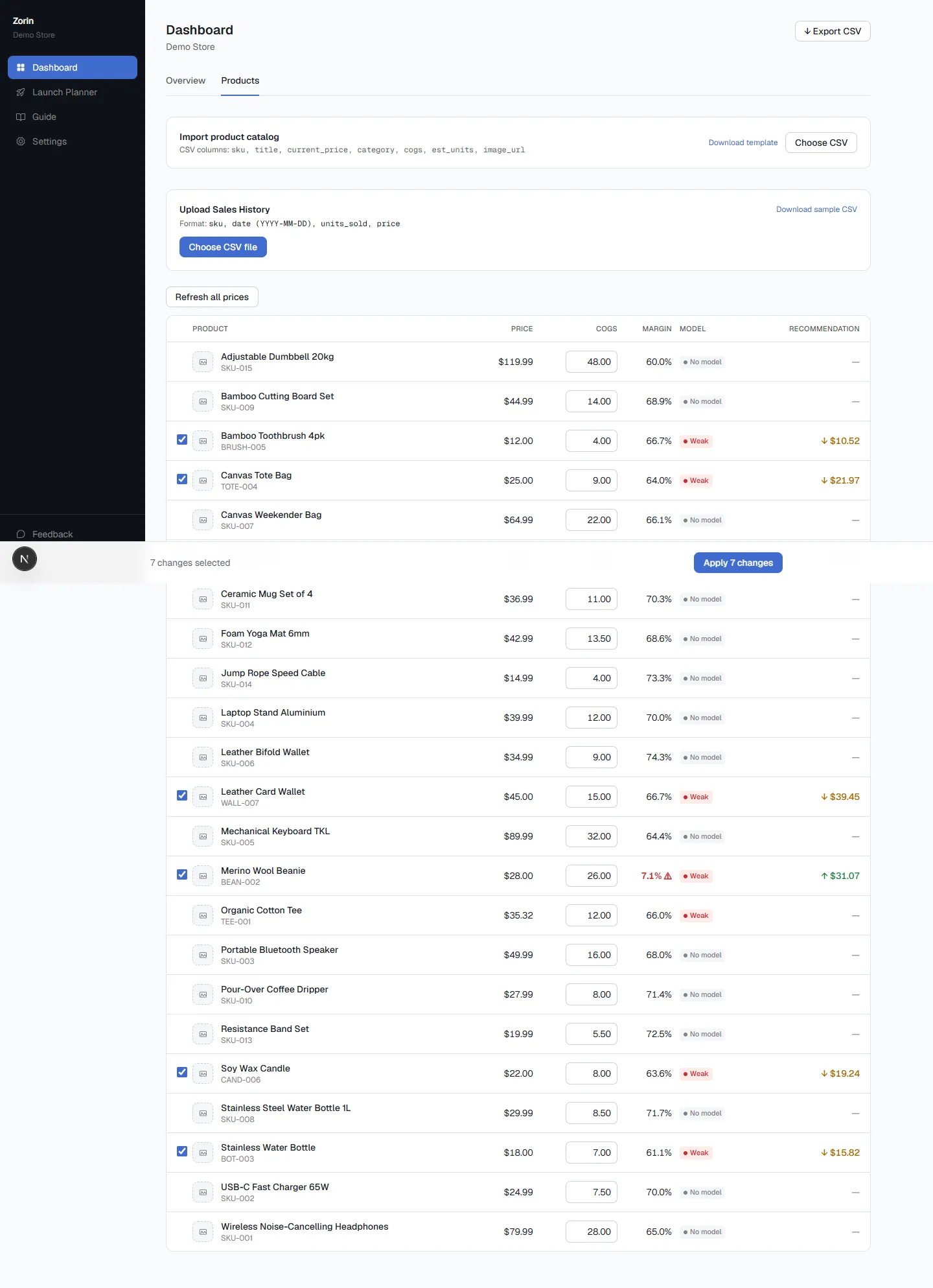
Not every product needs the same review frequency. A Strong-confidence product with a well-established elasticity estimate can be reviewed on your normal cadence without much concern. A Weak-confidence product, one with thin data or limited price history, benefits from more frequent attention, since each new data point meaningfully improves the estimate's reliability.
| Situation | Suggested review frequency |
|---|---|
| Established product, Strong confidence | Standard cadence (e.g. monthly) is usually sufficient |
| New or thin-data product, Weak/Fair confidence | More frequent review as new sales data accumulates |
| Recent cost change (supplier, fees, shipping) | Off-cycle review triggered immediately, not on the next scheduled date |
| Post-promotion period | Review once the promo period is excluded from baseline data, not immediately during the post-sale dip |
Triggers Worth an Off-Cycle Review
Regardless of your regular schedule, certain events are worth an immediate look rather than waiting for the next scheduled review: a real cost change (a supplier price increase, a new platform fee), a meaningful and sustained swing in sales that doesn't match a known promotion or seasonal pattern, or entering a new sales channel with its own distinct customer base.
What This Looks Like in Practice
Set a recurring monthly (or whatever cadence fits your catalog's pace of change) review across your full product list, using each product's confidence score to decide how much attention it needs that cycle. Layer in off-cycle checks whenever a real trigger occurs, rather than waiting for the scheduled date. This combination catches both the slow drift a fixed schedule alone would miss between cycles, and the noise a constantly-reactive approach would otherwise chase.
If you're not sure how out of date your current prices already are, here's how to check, and once you've set your cadence, connect your sales history so each review is based on a current, automatically updated elasticity estimate rather than a stale one.
Key Takeaways
- A regular review cadence (commonly monthly for small catalogs) beats both constant reactive changes and leaving prices untouched indefinitely.
- Reacting to every minor competitor or demand fluctuation adds noise without adding real signal, since short-term swings often reverse on their own.
- Costs, product mix, and channel mix all shift over time, and a price that was correct when set can quietly become wrong without anything obviously breaking.
- A confidence score tells you which products can handle a longer review interval and which need closer attention due to thin data.
- Certain triggers (a cost change, a new competitor, a big swing in sales) warrant an off-cycle review regardless of your regular schedule.
Frequently Asked Questions
How often should I change my prices?
Review prices monthly and change an individual product when the data gives a reason, such as a cost change or a sustained shift in sales. For comparison, half of U.S. retail prices last less than about four months.
Is it bad to change prices too often?
Yes, if the changes are reacting to short-term noise rather than a real underlying shift in cost or demand. Frequent reactive changes add confusion without adding real signal.
What happens if I don't review prices often enough?
Costs, customer mix, and demand patterns shift gradually, and a price that was correct when set can quietly drift out of alignment without any obvious sign that it happened.
Should every product be reviewed on the same schedule?
Not necessarily. Products with thin data or a Weak confidence score benefit from more frequent attention, while well-established, Strong-confidence products are fine on a standard cadence.
What events should trigger an off-cycle price review?
A real cost change, a meaningful and sustained swing in sales unrelated to a known promotion, or entering a new sales channel are all worth reviewing immediately rather than waiting for the next scheduled date.
Does seasonality affect how often I should review prices?
Yes. Products with clear seasonal demand patterns may warrant a review timed around those shifts, in addition to your regular cadence.
The right pricing cadence isn't a universal number, it's whatever catches real drift in your costs and demand without chasing every short-term fluctuation. A regular review, adjusted by confidence score per product and layered with off-cycle checks for real triggers, does that better than either extreme. That cadence itself tends to shift as a store grows, too; how pricing strategy evolves from a store's first sale through thousands of orders covers how review discipline changes alongside the data you have to work with.
Written by Dexter
Dexter is part of the team at Zorin, building tools that help ecommerce merchants price with data instead of guesswork.
More in Pricing Fundamentals & Strategy
View all →Everyday Low Pricing vs High-Low: Which Is Better?
Everyday low pricing keeps prices steady; high-low relies on sales. Pros, cons, a worked profit example, and how Zorin shows which fits each product.
Price Anchoring: Manipulative or Smart Pricing?
Price anchoring works only when the reference price is real. How to use compare-at prices honestly, and where anchoring crosses into deception.
Ecommerce Pricing Strategy by Growth Stage
A checklist for your first price, a framework for growth, and what mature pricing architecture looks like, stage by stage for ecommerce stores.