Ecommerce Margin Too Low? How to Find the Leak
If your ecommerce margin is too low, the cause is usually not one big problem but several small leaks between the price on the product page and the money you keep: discounts, returns, shipping you subsidize, payment fees and ad spend. Find the leak by building a per-order margin waterfall, then fix the biggest item first. In most stores, pricing is the most powerful lever, because a price rise flows almost straight to profit while every other fix only trims a cost.
Why a Healthy Gross Margin Can Still Mean a Thin Business
Many online stores look fine at the gross margin line and struggle everywhere below it. Finaloop's ecommerce profit benchmarks, which cover hundreds of seven- and eight-figure DTC brands with $3.16 billion in combined sales, put the median net profit margin in 2024 at about 3%, even though gross margins at these brands commonly look healthy. The gap is where the leaks live.
If you aren't sure whether your margin is actually low, compare it with the benchmarks in ecommerce profit margins: what to target and our profit margins by product category research first. A 40% gross margin is thin for beauty and normal for electronics.
Step 1: Build a Per-Order Margin Waterfall
Take one typical order and follow every dollar. Here's an example for a store selling a $60 product with a $24 landed cost:
- 40% of orders use a 12% discount code, an average of $2.88 per order.
- 10% of orders are returned. Each return costs $12 in shipping and handling, and 30% of returned items can't be resold.
- Shipping costs $7; customers pay $2 on average.
- Payment processing runs about 3% plus $0.30 per order.
- Blended ad spend is $16 per order, and apps and other overhead come to $3 per order.
| Line | Per order | Left after this line | % of net revenue |
|---|---|---|---|
| List price | $60.00 | $60.00 | |
| Discounts | −$2.88 | $57.12 | 100% |
| Landed cost of goods | −$24.00 | $33.12 | 58.0% |
| Returns | −$1.92 | $31.20 | 54.6% |
| Shipping subsidy | −$5.00 | $26.20 | 45.9% |
| Payment fees | −$2.01 | $24.19 | 42.3% |
| Advertising | −$16.00 | $8.19 | 14.3% |
| Apps and overhead | −$3.00 | $5.19 | 9.1% |
A 58% gross margin becomes a 9% net margin. No single line looks alarming, but together they take more than four-fifths of the gross profit. Run the same waterfall with your own numbers; the biggest bar is where to start.
Step 2: Check the Usual Suspects
- Cost of goods is understated. If you use the supplier's unit price instead of landed cost (freight, duty, packaging), every margin figure you look at is too optimistic. Tariffs have made this gap bigger for importers since 2025.
- Discounts have become the default. When a large share of orders use a code, the discount is really a permanent price cut. Check what share of revenue carries a discount and whether those promotions brought in new customers or just subsidized people who would have bought anyway. Our guide to how much to discount without losing your margin shows the break-even math.
- Returns cost more than the refund. Return shipping, handling and unsellable stock add up. The NRF and Happy Returns estimate that 19.3% of U.S. online sales will be returned in 2025, and apparel runs higher; see return rates by product category.
- Free shipping is priced into nothing. If shipping is free but prices weren't set with it in mind, you pay it out of margin on every order.
- Fees are counted as overhead instead of per-order cost. Payment processing, marketplace commissions and per-order app fees scale with sales and belong in the waterfall.
- Ad spend per order has crept up. Rising acquisition cost quietly eats margin even when nothing else changes.
- The product mix has shifted. If low-margin products are growing faster than high-margin ones, your blended margin falls even though no individual product changed.
- Prices haven't moved while costs have. A price set two years ago against a lower cost base is often the single biggest leak.
See what Zorin's elasticity model says about your own catalog.
Start free trialStep 3: Compare What Each Fix Is Worth
Using the waterfall above, here's what four common fixes are worth per order, holding order volume steady:
| Fix | Profit per order | Change |
|---|---|---|
| Current state | $5.19 | |
| Cut return rate from 10% to 8% | $5.57 | +7% |
| Halve how often the discount code is used (40% to 20% of orders) | $6.58 | +27% |
| Free shipping threshold so customers cover $3.50 on average | $6.69 | +29% |
| Raise the price 5%, from $60 to $63 | $7.96 | +53% |
The price change wins because almost all of it reaches the bottom line; only the discount and payment fee scale with it. It also has room to absorb some lost volume: even if the 5% rise cost you 10% of orders, you'd earn 0.9 × $7.96 = $7.16 per original order, still well above $5.19. That's the store-level version of a pattern McKinsey found across large companies, where a 1% price increase with stable volume raised operating profit by about 8% for the average S&P 1500 company.
The catch is the phrase "with stable volume". A price rise on a product whose customers are highly price-sensitive can lose more in volume than it gains in margin. Which products can take it is the question to answer before you change anything.
Step 4: Raise Prices Where Demand Allows
- Sort products by margin and sales volume. Low-margin bestsellers are often the biggest opportunity, because a small increase applies to a lot of units.
- Estimate each product's price sensitivity. Products with few substitutes, strong reviews or loyal repeat buyers usually tolerate a rise; commodity products listed by many sellers usually don't.
- Raise in small steps on the most promising products first. 3% to 8% is a common first move. Watch units and profit for a few weeks.
- Keep the products that can't move where they are. Fix their margin through cost, shipping or bundling instead.
The full process, including how to communicate increases, is in how to raise prices without losing customers.
Finding Which Products Can Carry a Higher Price
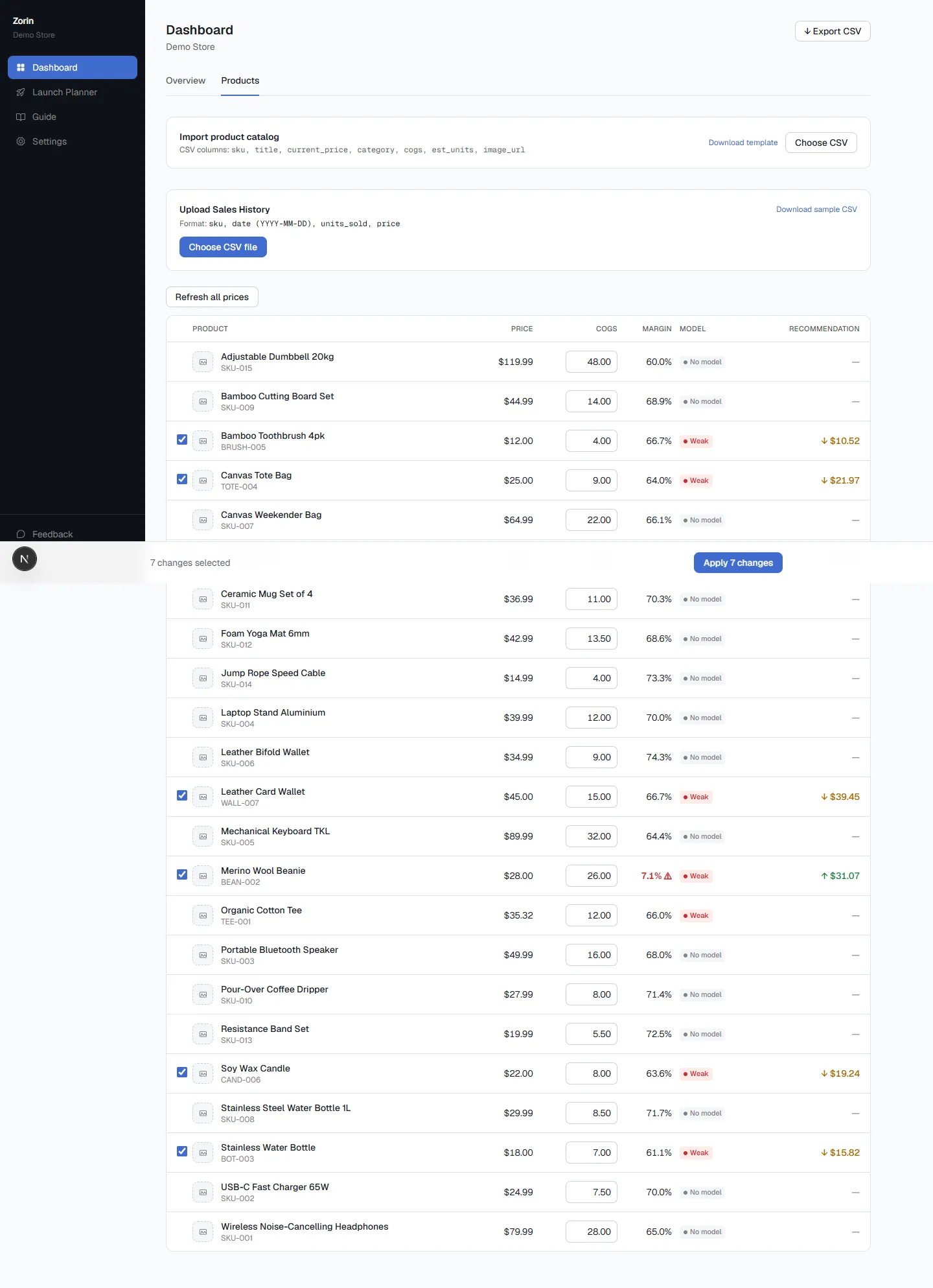
That second step is what Zorin does. It reads your Shopify or WooCommerce sales history, fits a price elasticity model for each product, and shows margin, model confidence and a raise, lower or hold recommendation side by side, with the estimated profit impact of each change. Instead of a storewide increase that hits sensitive products as hard as loyal ones, you raise where demand allows and hold where it doesn't.
Key Takeaways
- A low ecommerce margin is usually several leaks, discounts, returns, shipping, fees and ads, rather than one problem.
- Finaloop's benchmarks put median DTC net margin around 3% in 2024 despite healthy-looking gross margins.
- In the worked example, a 58% gross margin shrinks to a 9.1% net margin per order after every cost is counted.
- A 5% price rise added 53% to profit per order in the example, more than cutting returns, discounts or shipping costs.
- Raise prices only where demand allows: check each product's price sensitivity before changing anything.
Frequently Asked Questions
Why is my ecommerce profit margin so low?
Usually because costs below the gross margin line add up: discounts, returns, shipping subsidies, payment fees, advertising and app costs. Build a per-order margin waterfall to see which one takes the most, and check that your cost of goods includes freight and duties.
What is a low profit margin for an online store?
It depends on the category, but a net margin below about 5% leaves very little room for error. Finaloop's benchmarks found a median net margin of about 3% for established DTC brands in 2024, so thin margins are common, not a sign you're doing something unusual.
What is the fastest way to improve ecommerce margins?
A targeted price increase on products that can carry it usually has the biggest and fastest effect, because almost all of it reaches profit. Cutting discount frequency and adding a free shipping threshold are the next quickest wins.
Should I raise prices or cut costs to fix low margins?
Do both, but start by testing price on the products with the least price-sensitive demand. Cost cuts are worth pursuing, but in most stores they recover less per order than a well-chosen price change.
How do returns affect my margin?
Each return costs return shipping and handling, and some items can't be resold. In the example above, a 10% return rate cost $1.92 per order. The NRF estimates 19.3% of U.S. online sales will be returned in 2025, so for many categories returns are a major margin line.
Do discounts hurt my margin more than I think?
Often, yes. A discount comes straight off the selling price while your costs stay the same, so a 20% discount on a 40% margin product halves your gross profit on that sale. If a large share of orders use a code, it has become a permanent price cut.
A margin that's too low is fixable once you can see where it goes. Build the waterfall, fix the biggest leak first, and use price where demand allows it. To see which of your products have room for a higher price, try Zorin free with your own sales history.
Written by Dexter
Dexter is part of the team at Zorin, building tools that help ecommerce merchants price with data instead of guesswork.
More in Margin & Profit Fundamentals
View all →Margin vs Markup: Formulas, Chart & Examples
Markup is profit over cost; margin is profit over price. Formulas, a margin to markup chart, Costco and e.l.f. examples, and the mistake that costs you.
WooCommerce vs Shopify Fees: Real Margin Compared
No platform fee doesn't mean better margin. WooCommerce vs Shopify transaction, hosting and plugin costs compared, and how to find your real net profit.
Ecommerce Profit Margins: Benchmarks & Tracking
Healthy ecommerce profit margins by category, gross vs net, margin vs markup, and how to track the gap on Shopify before it quietly eats your profit.