Competitor Undercutting Your Prices? What to Do
When a competitor undercuts your prices, don't match automatically. First check whether it's really the same offer and whether your sales have actually dropped. Then do the break-even math: matching a cut only pays if holding your price would lose more sales than the margin you'd give up. For a product with a 40% margin, matching a 10% cut only makes sense if holding would cost you more than a quarter of your volume. Most of the time, holding and competing on something other than price is the better move.
Why Undercutting Happens More Than It Used To
Online, a competitor can change a price in seconds and a repricing tool can do it for them all day. A study of Amazon Marketplace by researchers at Northeastern University tracked every seller on 1,641 best-selling products for four months and identified 543 sellers using algorithmic pricing, with prices pegged to the lowest price, the second-lowest price or Amazon's own price. Those sellers won the Buy Box more often, sometimes even when they weren't the cheapest, because Amazon also weighs seller feedback.
Automated undercutting can also go badly wrong. In 2011, biologist Michael Eisen noticed an out-of-print book, The Making of a Fly, listed on Amazon for $23,698,655.93. Two sellers' algorithms were reacting to each other: one priced at 0.9983 times its rival, the other at 1.270589 times the first. Each day the prices ratcheted up until someone noticed. The lesson for sellers is simple: a rule that reacts to a competitor's price without a floor, a ceiling and a human check can do strange things.
Step 1: Confirm It's a Real Undercut
- Is it the same product? Check condition, size, bundle contents and whether it's genuine. A "cheaper" listing is sometimes used, refurbished, grey-market or a smaller pack.
- Is it the same total price? Add shipping, taxes and delivery time. A lower item price with $8 shipping may not be cheaper at all.
- Is it the same seller quality? Ratings, return policy and delivery speed all change what shoppers are willing to pay.
- Is it a MAP violation? If you both sell a brand with a minimum advertised price policy, the undercut may break it. Report it to the brand rather than follow it down. See our guide to minimum advertised price.
- Is it temporary? A flash sale or clearance ends on its own. Matching it can leave you with a lower price long after theirs has gone back up.
Step 2: Check Whether It's Actually Hurting You
Look at your own sales, not their price. Compare units sold and conversion rate on the affected product for the two to four weeks since the undercut with the same period before, and against the same weeks last year if the product is seasonal. If sales haven't moved, your customers aren't choosing on price alone, and there's nothing to fix. A rival's price usually pulls your sales much less than sellers fear (economists measure that pull as cross price elasticity of demand), and your product's own price elasticity is the best guide to how exposed you are.
Step 3: Do the Break-Even Math
Say you sell a product at $50 that costs you $30, and you sell 400 a month. A competitor cuts their price to $45.
| Response | Price | Profit per unit | Units (assumption) | Monthly profit |
|---|---|---|---|---|
| Before the undercut | $50 | $20 | 400 | $8,000 |
| Match the cut | $45 | $15 | 400 (you keep every sale) | $6,000 |
| Hold your price | $50 | $20 | 352 (you lose 12%) | $7,040 |
| Hold and add value (free shipping, costs $2 a unit) | $50 | $18 | 380 (you lose 5%) | $6,840 |
Matching feels safe, but it locks in a 25% drop in profit per unit on every sale, including all the customers who would have stayed anyway. Holding only loses to matching if you'd lose more than 100 units a month (400 × $15 = $6,000, and $6,000 ÷ $20 = 300 units). The general rule:
Matching pays only if holding would lose more than: 1 − (new profit per unit ÷ old profit per unit) of your volume.
Here that's 1 − ($15 ÷ $20) = 25%. For a product with a thinner margin the threshold is even higher. At a $40 cost, matching to $45 halves your profit per unit, so you'd need to be losing more than half your sales before matching made sense.
See what Zorin's elasticity model says about your own catalog.
Start free trialStep 4: Choose Your Response
- Ignore it. If sales haven't moved, or the undercut is temporary, do nothing.
- Hold and differentiate. Improve the reasons to buy from you: faster shipping, better photos and reviews, a guarantee, a bundle, a loyalty perk. Compete on the things a cheaper listing doesn't have.
- Match selectively. Match only on the few products where your sales clearly follow the competitor's price, and hold everywhere else. A storewide response to one rival's move is almost always an overreaction. Our guide to competitive pricing strategy covers when sitting below the market is worth it.
- Enforce your policy if you're the brand. If resellers are breaking your MAP policy, enforcement protects your price and your other retailers.
- Change the product, not the price. If a commodity SKU keeps getting undercut, consider a bundle, an exclusive variant or dropping it for something only you sell.
A price war is expensive for everyone involved. As a Harvard Business Review article on the subject observed, price is increasingly "the weapon of choice", and skirmishes can degenerate into full price wars. The seller who can afford to stay out usually does best.
If You Use a Repricer, Set Guardrails
- A hard floor based on your landed cost plus a minimum margin, never "match the lowest price" with no limit.
- A ceiling, so a reacting algorithm can't run away upward as in the book example.
- Rules that ignore listings from sellers with poor ratings or much slower shipping.
- A human review of large moves before they go live.
The trade-offs between reacting to competitors and modeling your own demand are compared in price elasticity software vs repricing software.
Knowing Which Products Can Hold Their Price
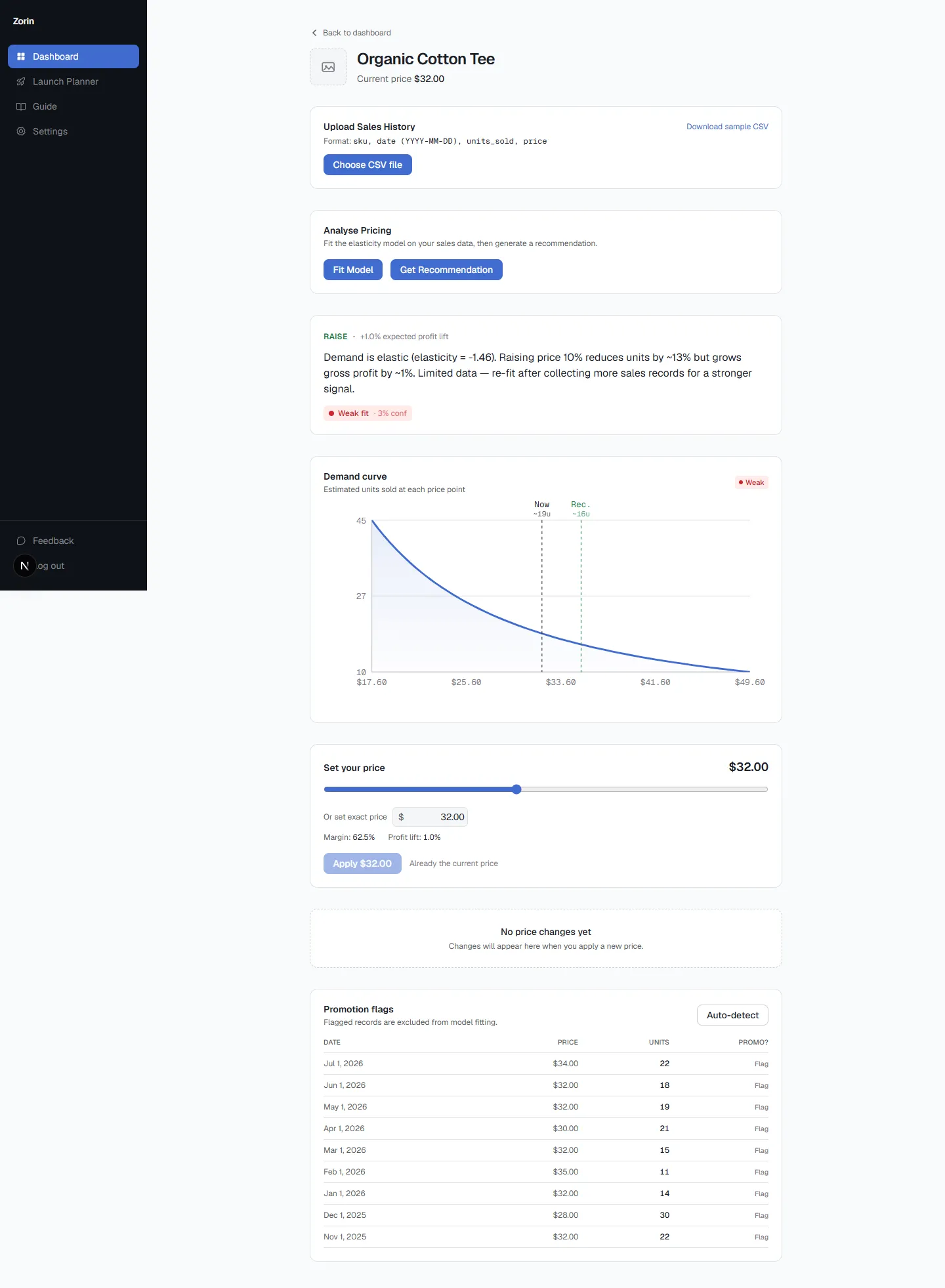
The key number in every step above is how much your own sales respond to price. Zorin measures that from your Shopify or WooCommerce history: it fits a price elasticity model for each product and recommends raise, lower or hold with an estimated profit impact and a confidence score. You can also log the competitor prices you know about for each product, and Zorin shows their minimum, median and maximum next to your own numbers. Zorin doesn't scrape or monitor competitor sites automatically; it's built to tell you whether a price move by someone else is worth reacting to.
Key Takeaways
- Before reacting, confirm the undercut is the same product at the same total price, and that your sales have actually dropped.
- Matching pays only if holding would lose more than 1 − (new profit per unit ÷ old profit per unit) of your volume, 25% in the $50 example.
- A study of 1,641 Amazon best-sellers found 543 sellers repricing algorithmically, most pegged to the lowest or second-lowest price.
- Two unchecked repricing algorithms once pushed an out-of-print biology book to $23.7 million on Amazon, so always set floors and ceilings.
- Hold and differentiate on most products, match only where your sales clearly follow the rival's price.
Frequently Asked Questions
What should I do when a competitor undercuts my prices?
Check that it's the same product at the same total price, then look at whether your sales have actually dropped. If they have, compare the profit from matching with the profit from holding. In most cases holding your price and improving your offer beats matching.
Should I match a competitor's lower price?
Only if holding would lose more sales than the margin you give up by matching. With a $50 price, $30 cost and a $45 competitor, you'd need to lose more than 25% of your volume before matching earned more.
How do I compete with cheaper competitors without lowering my price?
Compete on what the cheaper seller lacks: faster delivery, a better return policy, stronger reviews, bundles, guarantees or exclusive variants. Many shoppers pay a small premium for a seller they trust.
Is undercutting prices illegal?
Generally no. Setting a lower price is normal competition. Exceptions include breaking a brand's minimum advertised price agreement, which is a contract issue, and predatory pricing by dominant firms, which is rare for small sellers. This is general information, not legal advice.
How do I stop a price war?
Stop following the other seller down. Hold a price floor based on your costs, compete on non-price factors, and focus on products where you have an advantage. A price war only continues while both sides keep reacting.
Do I need a competitor price tracking tool?
Only if you sell identical products against many sellers and your sales clearly follow their prices. For most stores with differentiated products, checking key competitors manually is enough. See whether you need a competitor price tracking app, and if you do, the main tools compared.
A competitor's lower price is a question, not an instruction. Check the offer, check your sales, and do the break-even math before you move. To know which of your products can hold their price, start a free Zorin trial and see your demand data product by product.
Written by Dexter
Dexter is part of the team at Zorin, building tools that help ecommerce merchants price with data instead of guesswork.
More in Pricing Fundamentals & Strategy
View all →Segment Pricing: How to Charge Different Customers
Segment pricing charges different customer groups different prices. Types, price fences, a worked student-discount example and where the legal line is.
Price Priming: How Cues Shape What Shoppers Pay
Price priming is when a number, image or product order changes how shoppers judge a price. What the research shows and how to test it honestly.
Keystone Pricing: What It Is and When It Fails
Keystone pricing doubles your cost to set the retail price. The formula, variations like triple keystone, a wholesale example, and when 2x isn't enough.