Price Elasticity Examples by Ecommerce Category
Price elasticity varies enormously by category. Fashion and standard electronics tend to be highly price sensitive, beauty and skincare split depending on whether the purchase is routine or discovery driven, and handmade goods often resist typical elasticity patterns altogether because there's rarely a true competitor to compare against.
The same 15% discount that moves fashion inventory fast can barely register on a niche product with genuine uniqueness behind it. That gap is the whole reason category-level examples matter more than a single formula. Once you know where your category tends to sit, pricing decisions get a lot less speculative. Zorin calculates this exact elasticity per product automatically from your own sales history, and it's most useful precisely in the categories below where a real number, not a guess, actually settles the question. This guide walks through where each major ecommerce category tends to fall on the spectrum. For the sourced, citable version of these category patterns, with links to the underlying published research behind each figure, see our price elasticity by category reference.
Why Elasticity Looks Different in Every Ecommerce Category
The same size price change can produce wildly different sales responses depending on category, because substitute availability, necessity, and how easily a customer can comparison shop all vary enormously across ecommerce niches. Two extremes make the range clear before going category by category.
On one end, casual and athletic apparel, measured at around -2.86: a 10% discount can lift units by roughly 29%, a strong elastic response driven by how many similar items a customer could buy instead. On the other end, a staple good like salt or basic groceries: even a real price increase barely reduces purchases, because there's no meaningful substitute and the purchase is essentially automatic regardless of price.
Most ecommerce categories fall somewhere between those two poles, and where they fall usually comes down to three questions:
| Question | Why it matters |
|---|---|
| How many close substitutes exist? | More alternatives means customers can walk away from a price increase easily, pushing demand toward elastic |
| How essential or habitual is the purchase? | Necessities and established routines get repurchased regardless of moderate price moves, pushing demand toward inelastic |
| How easily can a customer compare your price to someone else's? | Heavy comparison shopping (multiple tabs, review sites, marketplaces) amplifies elasticity across an entire category |
The takeaway: elasticity ranges from strongly elastic categories like fashion to strongly inelastic staples, and where any given category falls depends on substitute availability, necessity, and price comparability.
Price Elasticity Examples in Fashion and Apparel Ecommerce
Fashion and apparel sit toward the elastic end of the spectrum. Steep substitute availability and seasonal urgency both push demand to respond strongly to price, though this isn't uniform across every price tier within the category.
The clearest example is apparel. Published estimates compiled in our price elasticity by category reference put basic t-shirts at about -1.17 and casual or athletic wear at about -2.86, so a 10% discount on an athletic top can lift units by roughly 29%, while the same discount on a basic tee lifts them by about 12%. A last-season clearance shows why the elastic end behaves this way: shoppers have no urgency or loyalty to last season's stock once new styles arrive, so price becomes the main lever.
Fashion isn't uniformly elastic, and the gap between those two apparel figures shows it. Products with a real point of difference, such as a distinctive design, a brand customers already trust, or a size and fit they can't easily find elsewhere, tend to sit toward the less elastic end. Crowded mid-market basics, with fast-fashion alternatives one click away, tend to react most sharply to a price change.
The takeaway: fashion and apparel lean elastic, with a 10% discount sometimes lifting sales by 30% or more, though mid-market products respond more sharply than true budget or true luxury tiers.
Price Elasticity Examples in Beauty and Skincare
Beauty and skincare show more mixed elasticity than fashion. Mass-market items behave elastically under heavy competitive pressure, while routine, loyalty-driven skincare purchases often behave more inelastically once a customer has found something that works for their skin.
The split comes down to purchase motivation. A shopper browsing new makeup shades or trying a trending product is behaving the way a fashion shopper does: comparing, substituting, price sensitive. A shopper reordering the same moisturizer they've used for two years is behaving very differently. They've already done the comparison shopping once, found their answer, and are far less likely to switch over a modest price increase.
This is directionally consistent with the broader pattern of loyalty softening elasticity across categories, this is a qualitative pattern worth knowing rather than a single citable coefficient: premium products with strong brand attachment tend toward more inelastic behavior than their category average would suggest, even in categories that skew elastic overall, the same dynamic behind why bestsellers and slow sellers need different pricing strategies.
Practically, this means a beauty brand's pricing strategy probably needs two different postures: more price-competitive on new or discovery-oriented products where customers are still comparison shopping, and more confident holding price on established, repeat-purchase items where switching costs, a new product not working as well, needing to find a fresh solution, are doing real work to keep customers in place.
The takeaway: mass-market and discovery-driven beauty products behave elastically, while established, routine skincare purchases often behave more inelastically due to switching costs and loyalty.
Price Elasticity Examples for Subscription Box Businesses
Subscription boxes complicate elasticity because the purchase decision happens once, at signup, rather than repeatedly at every transaction. That shifts most of the price sensitivity to the initial price point and any renewal price change, rather than to ongoing per-item demand the way a typical retail purchase works.
Established subscription tiers illustrate how price positioning maps to a target subscriber segment rather than a single market-clearing price. Entry-level curated boxes commonly sit in a roughly $15 to $30 monthly range, while premium multi-category boxes with full-size products can run well over $50 to $70 per box. That spread isn't arbitrary. It reflects different willingness-to-pay segments choosing their box based on value expectations set at signup, not a single elastic response to price the way a one-time purchase would show.
Where elasticity really shows up in subscriptions is at the renewal or price-increase moment. A customer who signed up expecting a certain price is far more price sensitive to a mid-subscription increase than a new customer evaluating options from scratch, since the increase feels like a broken expectation rather than a fresh comparison. A specialty subscription with a loyal base, coffee, books, a niche hobby box, can often absorb a modest price increase tied to a real cost change (shipping, sourcing) with minimal churn, precisely because subscribers value the specific, hard-to-replace product they signed up for. This is a meaningfully different elasticity dynamic than a retail product where every purchase is a fresh price evaluation.
The takeaway: subscription box pricing sensitivity concentrates around the initial signup decision and renewal price changes, rather than showing up as ongoing per-purchase elasticity the way retail products do.
See what Zorin's elasticity model says about your own catalog.
Start free trialPrice Elasticity Examples in Consumer Electronics Ecommerce
Standard consumer electronics sit firmly on the elastic end of the spectrum, driven by heavy comparison shopping and frequent product cycles that make last year's model feel replaceable fast. Flagship or premium brands, though, often behave more inelastically thanks to loyalty and perceived differentiation.
The category example most sources point to directly: smartphones, gaming consoles, and standard accessories tend to fall into the elastic bucket, alongside other non-essential, easily comparable categories. This tracks with how customers actually shop electronics, specs, reviews, and prices sit side by side across multiple tabs before a purchase, which is about as much price transparency as a category can have.
But not every electronics purchase behaves the same way. A well-known flagship brand with a loyal customer base can hold price more confidently than a generic accessory in the same broad category, because customers aren't comparing it against every alternative the same way they would a commodity charger cable or phone case.
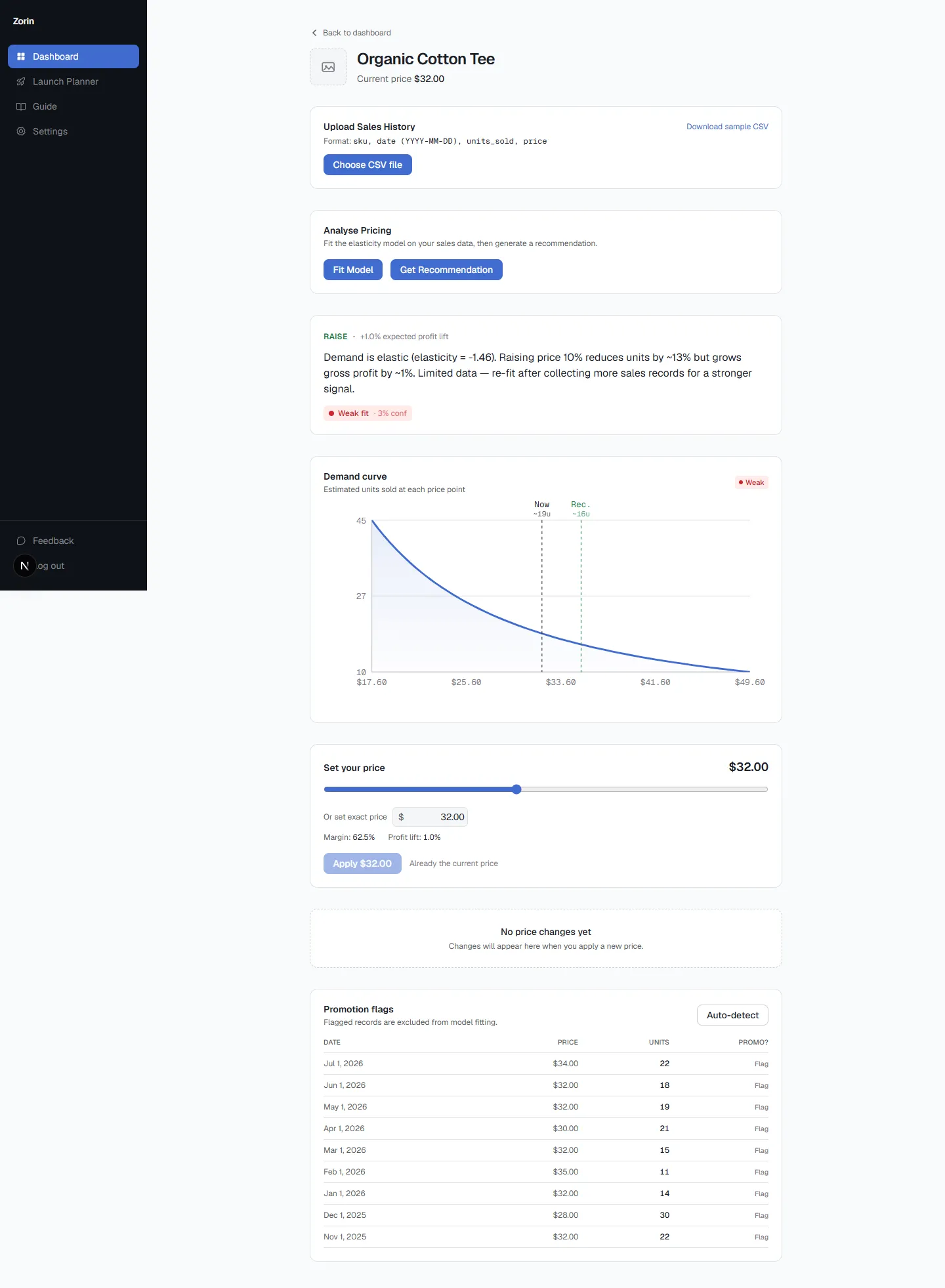
Zorin's core mechanism, fitting an elasticity model from a product's own sales history before recommending a raise, lower, or hold, is especially useful in a category like this, where real price variation in the data gives the model plenty to work with. A merchant selling a standard, easily comparable electronics accessory can use that recommendation to see whether demand has genuinely shifted or whether a recent dip is just noise, since the model is reading actual customer behavior, not a snapshot of what a competitor happens to charge this week. The confidence label underneath the recommendation reflects how much real data supports it, and it tends to run higher in a category with frequent, real sales volume to learn from.
The takeaway: standard consumer electronics lean strongly elastic due to comparison shopping and fast product cycles, while flagship and premium brands within the category can behave more inelastically due to loyalty.
Price Elasticity Examples for Handmade and Craft Sellers
Handmade and craft goods often resist standard elasticity analysis, mainly because a true competitor comparable rarely exists. Uniqueness and gift motivation tend to drive the purchase decision far more than price does, which changes what "price sensitivity" even means in this category.
Handmade and personalized goods show this clearly. A buyer ordering a personalized item for a wedding or another one-off occasion is buying something they can't get elsewhere, often against a deadline, so a modestly higher price rarely changes the decision. The more unique and time-sensitive the purchase, the less price comparison happens.
Gift-driven purchases compound this further. A gift purchase is treated as an exceptional occasion, not a routine transaction, which means the usual price sensitivity logic barely applies. A customer isn't weighing this candle against that candle on price. They're weighing whether it feels like the right gift.
It's worth being direct about a limit here: there isn't a single, reliable, citable elasticity coefficient for handmade and craft goods as a category, and any source handing you one with that kind of false precision is worth being skeptical of. What the evidence supports is a qualitative pattern, low comparability plus uniqueness and gift motivation tend to push this category toward much weaker price sensitivity than commodity goods, not a specific number to plug into a formula.
This is exactly where Zorin's mechanism still works differently from a competitor-repricing tool. There's no competitor set to compare against for a one-of-a-kind handmade item, which is exactly why a tool built around matching competitor prices has nothing to offer here. Elasticity calculated from your own sales history doesn't have that problem, it only needs your own price-and-quantity history, not a comparable competitor listing, so it still functions even in a category where true comparables barely exist, provided there's enough of your own sales history to fit a model against.
The takeaway: handmade and craft goods often lack a reliable elasticity coefficient because true competitor comparables are scarce, and uniqueness or gift motivation frequently outweighs typical price sensitivity patterns.
Category Elasticity at a Glance
| Category | Typical tendency | What drives it |
|---|---|---|
| Fashion and apparel | Elastic (often 1.5 to 3.0) | Many substitutes, seasonal urgency, strongest in the mid-market |
| Beauty and skincare | Mixed | Elastic for discovery purchases, inelastic for established routine items |
| Subscription boxes | Concentrated at signup/renewal | One decision point rather than ongoing per-item demand |
| Consumer electronics | Elastic, less so for flagship brands | Heavy comparison shopping, fast product cycles |
| Handmade and craft goods | Often resists typical patterns | Scarce true comparables, gift and uniqueness motivation |
If you want the real number for your own catalog instead of a category estimate, here's how elasticity is calculated from your own sales history, or see the full formula and worked examples if you want to run it yourself first. Connecting your store runs the calculation automatically per product.
A Real-World Measurement Outside Ecommerce
One of the largest elasticity studies ever run used almost 50 million Uber ride requests. Economists measured how riders responded to surge prices and found demand was surprisingly inelastic, with most estimates between -0.4 and -0.6. When people need something right now, even a visible price jump changes behavior less than intuition suggests. The same logic applies to urgent or deadline-driven purchases in any category.
Key Takeaways
- Elasticity ranges from strongly elastic categories like fashion to strongly inelastic staples, driven by substitute availability, necessity, and how easily a customer can comparison shop.
- Fashion and apparel lean elastic: published estimates range from about -1.17 for basic t-shirts to about -2.86 for casual and athletic wear.
- Beauty and skincare split by purchase motivation: discovery-driven purchases behave elastically, established routine purchases behave more inelastically.
- Subscription businesses concentrate price sensitivity around the signup and renewal moments, not ongoing per-item demand the way retail products show it.
- Handmade and gift-driven goods often resist typical elasticity patterns entirely, since uniqueness and occasion can outweigh price comparison altogether.
Frequently Asked Questions
What are some price elasticity examples in fashion and apparel ecommerce?
Fashion tends toward elastic demand. Published estimates compiled in our price elasticity by category reference range from about -1.17 for basic t-shirts to about -2.86 for casual and athletic wear, so how elastic a fashion product is depends heavily on how many close substitutes it has.
What are some price elasticity examples in beauty and skincare?
Mass-market beauty items tend to behave elastically due to heavy competition, while routine, loyalty-driven skincare purchases often behave more inelastically since customers stick with products that work for their skin.
What are some price elasticity examples for subscription box businesses?
Subscription pricing sensitivity concentrates around the initial signup price and renewal price changes, rather than per-item demand, since the purchase decision happens once rather than repeatedly.
What are some price elasticity examples in consumer electronics ecommerce?
Standard consumer electronics tend toward elastic demand due to heavy comparison shopping. Flagship or premium brands often behave more inelastically due to brand loyalty.
What are some price elasticity examples for handmade and craft sellers?
Handmade goods often resist typical elasticity patterns since true competitor comparables are scarce. Gift-driven and uniqueness-driven purchases can support premium pricing regardless of typical price sensitivity patterns.
Why is fashion more elastic than skincare?
Fashion has more direct substitutes and shorter urgency windows tied to seasonality, while skincare purchases are often tied to a customer's established routine and perceived efficacy, which softens price sensitivity.
Are premium or luxury products always inelastic?
Not always, but loyalty and lack of direct substitutes often push premium products toward more inelastic behavior than their category average would suggest.
Does elasticity apply differently to one-time purchases versus subscriptions?
Yes. Subscriptions concentrate elasticity around the initial and renewal price points, while one-time purchase categories show elasticity at every individual transaction.
Every category in this guide reacts to price differently, but the underlying question is always the same: does this customer have an easy alternative, and how much do they actually care about comparing you to it. Fashion and standard electronics answer yes on both counts. Loyal skincare buyers and handmade gift shoppers usually answer no. Knowing which answer applies to your product is worth more than any single elasticity formula. Across every category, elastic or not, Zorin calculates this exact elasticity automatically from your own sales history, so you're reading your own customers' real behavior instead of guessing which end of the spectrum your catalog falls on. If fashion or skincare specifically is your category, apparel pricing and skincare pricing each get a dedicated, category-specific breakdown beyond the general patterns covered here.
Written by Dexter
Dexter is part of the team at Zorin, building tools that help ecommerce merchants price with data instead of guesswork.
More in Price Elasticity
View all →How to Calculate Price Elasticity in WooCommerce
Where to find the data in WooCommerce Analytics, the midpoint formula on a real example, and why a pricing plugin isn't an elasticity read.
What Your Price Elasticity Score Actually Means
What your elasticity number means, how to know if it's solid enough to act on, and why products in the same category can have completely different scores.
How to Know If Your Prices Are Too High or Too Low
Declining sales and high close rates are lagging signals. Price elasticity tells you before you change anything, not after the damage is done.