How to Price Bundles Without Giving Away Your Margin
The right bundle discount for most ecommerce stores is 10-20% off the combined individual price, but the exact number depends on your margin structure, not an industry average. A store with 60% gross margins can comfortably offer 15% off a bundle. A store with 35% gross margins offering the same discount is operating at razor-thin profit after fees and shipping. Before you set any bundle price, you need to know what each product's margin can absorb, and tools like Zorin can show you which SKUs can handle a price cut based on actual demand data rather than guesswork.
This post walks through the full process of pricing a product bundle: checking your individual margins, picking the right products, setting the discount depth, framing the price so customers feel the deal, and making sure the bundle actually makes you more money than selling the same items individually.
The Bundle Pricing Mistake Most Shopify Stores Make
The standard approach to bundle pricing goes something like this: pick a few related products, offer 15% off the combined price, launch it, and watch your average order value climb. The AOV almost always goes up. That's the easy part. The harder question is whether the larger order actually put more profit in your pocket.
It's easy to launch a bundle that loses money without noticing. The store ships more products per order, does more fulfillment work, and nets the same or less profit, while the average order value chart goes up and makes it look like a win.
This happens because most merchants set their bundle discount by feel or by copying what competitors do. "15% off the bundle" sounds reasonable. But "reasonable" and "profitable for your specific cost structure" are two different things.
AOV is a vanity metric for bundles. The number that actually matters is contribution dollars per order: what's left after you subtract cost of goods, payment processing fees, shipping, and packaging from the bundle's selling price. If that number is lower than what you'd earn selling the same items individually in separate orders, the bundle is costing you money even though the top-line order value went up.
Step 1: Check Your Individual Product Margins First
You can't set a bundle discount without knowing what each item in the bundle can absorb. This sounds obvious, but most merchants skip straight to "15% off sounds about right" without running the product-level math first.
Here's a simple way to think about it. Take three products you're considering bundling:
| Product | Retail price | COGS | Gross margin |
|---|---|---|---|
| Product A | $40 | $14 | 65% |
| Product B | $28 | $12 | 57% |
| Product C | $22 | $11 | 50% |
| Combined | $90 | $37 | 59% |
At a 15% bundle discount, the bundle sells for $76.50. Your COGS are still $37. Add payment processing (~3%), shipping ($6-8), and packaging ($2), and your contribution per order is roughly $26-28. Compare that to what you'd earn if the customer bought just Product A at full price: $40 minus $14 COGS minus ~$9 in fees/shipping/packaging = roughly $17. The bundle earns more contribution dollars in this case, so the math works.
Now imagine the same bundle but with 35% gross margins across all three items instead of 50-65%. A 15% bundle discount on thinner margins can push contribution per order below what you'd earn on a single full-price sale. That's the scenario where bundles silently destroy profit.
A useful rule of thumb: never launch a bundle that drops below a 30% gross margin floor after the discount. If your blended gross margin on the bundle items is already close to 30%, you have almost no room to discount at all, and the bundle should rely on perceived value (complementarity, convenience) rather than price cuts.
This is where per-SKU margin and demand data becomes valuable. If you're using Zorin, the elasticity model tells you which products in a potential bundle can handle a lower price and which ones can't. A product flagged as "lower" with strong confidence means the data shows a price cut would drive enough additional volume to increase total profit. That product is a natural bundle candidate. A product flagged as "hold" or "raise" is one you should protect at full price, not discount into a bundle unless the bundle drives enough incremental volume on other items to compensate.
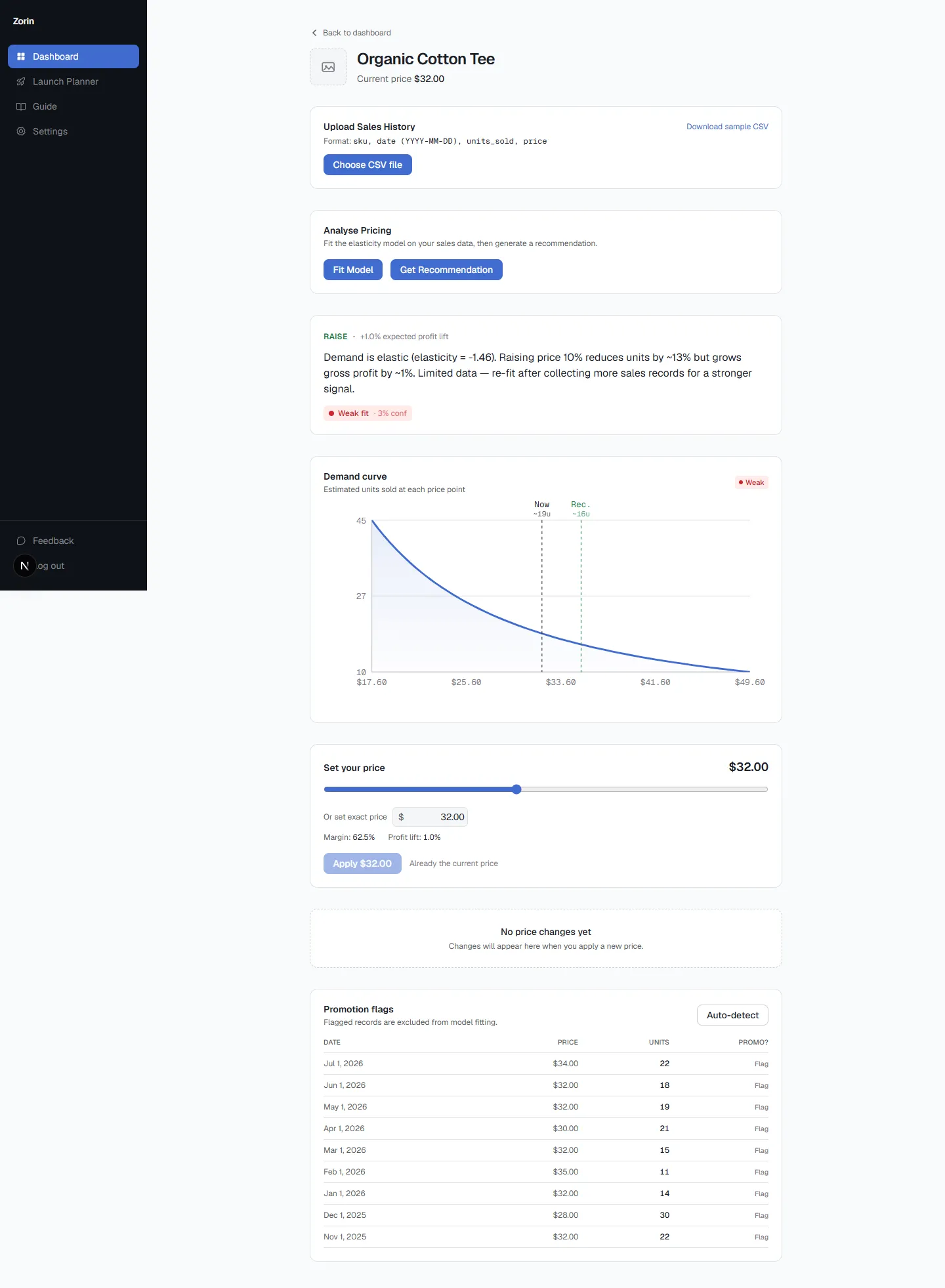
The difference between guessing "15% off feels right" and knowing which SKUs can absorb a discount based on actual demand data is the difference between a profitable bundle and one that just looks good in your AOV dashboard.
Step 2: Pick Products That Belong Together
The strongest bundles are built from two signals: co-purchase patterns and margin-profile complementarity. The worst bundles are built from a desire to move inventory that isn't selling.
Co-purchase patterns tell you which products customers already buy together. If customers frequently add a cleanser, a toner, and a moisturizer to the same cart, bundling those three is reinforcing a behavior that already exists. You're making it easier and slightly cheaper for them to do something they were going to do anyway. Look at your Shopify analytics for products that appear in the same order at a rate of 5-10% or higher. Those are your natural bundle candidates.
Margin-profile complementarity means pairing a high-margin anchor product with lower-margin add-ons that increase perceived value without destroying the blend. A skincare set anchored around a $40 serum with 65% margins, bundled with a $15 travel-size cleanser at 45% margins and a $12 sample pack at 70% margins, gives you a blended margin that can absorb a reasonable discount. A bundle of three items that are all sitting at 35% margins has no room to discount without going underwater.
What doesn't work: bundling random slow-moving products together and calling it a "value pack." Customers can tell the difference between a curated set and a clearance grab bag. A Harvard Business School study of Nintendo's Game Boy Advance era found that when Nintendo switched from mixed bundling (customers could buy items individually or as a bundle) to pure bundling (bundle only), revenues dropped by more than 20% compared to the mixed-bundling scenario. Giving customers no choice but to buy the bigger package deterred a large number of buyers who only wanted one or two of the items. Customers want to feel like the bundle was designed for them, not assembled to solve the store's inventory problem.
One more thing to consider: cannibalization risk. If a customer would have bought Product A at full price regardless, and your bundle discounts Product A along with two items they weren't going to buy, you've discounted your best seller to move products the customer didn't want. The bundle needs to drive genuine incremental purchases, not just discount existing demand. Check whether your bundle attach rate (percentage of buyers who choose the bundle vs. the lead product alone) is actually adding new items to the cart or just wrapping a discount around what was already selling.
See what Zorin's elasticity model says about your own catalog.
Start free trialStep 3: Set the Right Discount Depth
With your margin math done and your products selected, you can now set the discount. Across the examples above, 10-20% off the combined individual price is where most successful ecommerce bundles land.
Within that range, your specific number depends on your margin structure:
| Your blended gross margin on bundle items | Safe discount depth | Why |
|---|---|---|
| 60%+ | 15-20% | Plenty of margin cushion; customers feel a meaningful deal |
| 45-60% | 10-15% | Moderate cushion; stay closer to 10% unless volume uplift is significant |
| 30-45% | 5-10% | Thin margins; the bundle's value should come from complementarity and convenience, not a deep price cut |
| Below 30% | 0-5% or no discount | Almost no room to discount; consider a value-add (free shipping, bonus sample) instead of a price cut |
Below 10%, customers generally don't feel the deal enough for it to influence their purchase decision. Above 20%, you're usually handing back the margin the bigger basket created, unless you're deliberately acquiring customers at a loss (which is a valid strategy, but a different one from "pricing bundles profitably").
The three-way contribution test. Before launching, calculate contribution dollars per order in three scenarios:
- Full price, one cart. The customer buys all three items individually in a single order. Your contribution = combined revenue minus combined COGS minus one set of order-level variable costs (payment fees, shipping, packaging).
- Bundle price. The same items at the discounted bundle price. Contribution = bundle price minus the same COGS minus one set of variable costs on the lower revenue.
- Single item only. The customer buys only the anchor product at full price. Contribution = single item revenue minus single item COGS minus variable costs.
If Scenario 2 beats Scenario 3, the bundle is profitable compared to a single-product order, which is the most common real-world counterfactual. If Scenario 2 also beats Scenario 1, you're in excellent shape. If Scenario 2 loses to both, your discount is too deep or the product mix is wrong.
One nuance worth flagging: scenario 1 assumes the customer would have bought all three items anyway. For most stores, that's the less common case. The more realistic comparison is bundle vs. single item purchase (Scenario 2 vs. Scenario 3). If the bundle gets a customer who would have bought one item at $40 to instead buy three items at $76.50, and your contribution per order is higher at $76.50, the bundle is working.
Step 4: Frame the Price So the Deal Lands
A well-priced bundle can still underperform if the savings aren't visible and concrete on the product page. The psychology of bundle pricing is about making the customer feel smart for choosing the bundle.
Show the individual prices alongside the bundle price. The customer needs to see the math: "Product A ($40) + Product B ($28) + Product C ($22) = $90 individually. Bundle price: $76.50. You save $13.50." Without the individual prices, the savings are invisible and the bundle loses its psychological appeal. Shopify's compare_at_price field handles this natively, displaying a strikethrough on the higher combined price.
Lead with the dollar amount saved, not the percentage. "Save $13.50" is more compelling than "Save 15%" for most audiences because dollars are concrete and percentages require mental math. If a customer has to calculate what 15% of $90 is, that cognitive effort reduces the impact of the deal. Ecommerce pricing research consistently finds that dollar framing outperforms percentage framing for most price ranges, with the exception of very high-ticket items where the dollar amount can trigger sticker shock.
Use anchoring deliberately. The combined individual price is your anchor. Display it prominently, with a strikethrough, directly next to the bundle price and the savings callout. The anchor reframes the decision from "Is $76.50 worth it?" to "Am I getting a good deal compared to $90?" That reframing is what makes bundles psychologically different from a flat discount, even when the math is similar.
Pre-validate with customers if you're uncertain. If you're not sure whether your bundle price lands in the "great deal" zone or the "suspiciously cheap" zone, Zorin's Van Westendorp survey can tell you before you launch. The four-question survey identifies the price range customers consider acceptable, the point where it starts feeling too expensive, and the point where the price is so low they'd question quality. Running this on a bundle concept before committing to a live offer costs almost nothing and prevents the two worst outcomes: pricing the bundle too high (customers don't bite) or too low (you leave margin on the table and customers wonder what's wrong with the products).
When Bundles Beat Discounts (and When They Don't)
Bundles and sitewide discounts both reduce price, but they work through different mechanisms and produce different results.
A sitewide percentage discount (e.g., "20% off everything") discounts your entire catalog, including items the customer would have bought at full price. It drives urgency and conversion, but it gives away margin on products that didn't need a discount to sell. It also trains customers to wait for the next sale, especially if you run them regularly. Over time, this erodes full-price credibility.
A curated bundle discounts only the specific products you choose, at a depth you control, and increases units per order. A customer who would have bought one item at $40 now buys three items at $76.50. You gave up $13.50 in discount but gained $36.50 in additional revenue from the two extra items, and your contribution per order is higher. The discount is contained to the bundle rather than applied across your entire catalog.
Bundles generally outperform sitewide discounts when you want to increase cart size without touching your full-price architecture. They're the right tool when you have complementary products that make sense together, healthy enough margins to absorb a modest discount, and a goal of increasing revenue per order rather than driving traffic.
Bundles are the wrong tool when the products don't naturally go together (customers can tell), when your margins are too thin for any discount (consider a value-add like free shipping instead), or when the real problem is traffic, not cart size. A bundle won't fix a lack of visitors. It converts existing traffic into larger orders.
For a deeper look at when discounting makes sense and when it doesn't, see our posts on how to run a sale without wrecking your margin and how to price a discount without losing your margin. The same margin-first thinking applies to bundles.
Key Takeaways
- AOV is a vanity metric for bundles. The number that matters is contribution dollars per order, and roughly 60% of DTC bundles are margin-dilutive at launch because the discount was set by feel.
- The sweet spot for most ecommerce bundle discounts is 10-20% off the combined individual price, but the right number depends on your margin structure, not an industry average. Never drop below a 30% gross margin floor.
- Build bundles from co-purchase patterns and margin-profile complementarity, not from slow-moving inventory you need to clear.
- Run the three-way contribution test (full price in one cart, bundle price, single item only) before every bundle launch to confirm the bundle actually earns more contribution dollars per order.
- Use Zorin's per-SKU elasticity data to identify which products can absorb a bundle discount and which should be protected at full price.
Frequently Asked Questions
How much of a discount should I give on a product bundle without killing my margins?
Most successful ecommerce bundles discount 10-20% off the combined individual price. The exact right number depends on your margin structure. With 60%+ gross margins, you can comfortably offer 15-20%. With 35-45% margins, stay closer to 5-10% and let the bundle's value come from complementarity and convenience rather than a deep price cut. Never launch a bundle below a 30% gross margin floor after the discount.
Is bundling products on Shopify actually more profitable than just discounting individual items?
Usually, yes, because a bundle controls which products get discounted and increases units per order, while a sitewide discount discounts everything including items the customer would have bought at full price. A 15% bundle discount on three complementary items typically produces more contribution dollars per order than a 15% sitewide discount. But the bundle still needs margin math behind it: if the discount depth exceeds what the margin can absorb, neither approach is profitable.
How do I figure out which products to bundle together on my online store?
Start with co-purchase data: look at which products appear in the same order at a rate of 5-10% or higher in your Shopify analytics. Those are natural bundle candidates. Then check margin compatibility: pair a high-margin anchor product with complementary add-ons so the blended margin can absorb a discount. Avoid bundling random slow-moving products together, as this signals clearance rather than curation. Zorin's elasticity data can also flag which products are price-elastic enough that a small discount drives meaningful volume uplift.
Why did my average order value go up from bundles but my profit stayed the same?
Because the bundle discount ate the extra margin the larger order was supposed to create. If you sell three items at 15% off and your blended gross margin on those items is 40%, you're operating at 25% margin before fees and shipping. Contribution dollars per order may be no higher, or even lower, than what you'd earn selling a single item at full price. Run the three-way contribution test to check: compare contribution per order at full price, at the bundle price, and for a single-item purchase.
What's the best way to price a product bundle so customers feel like they're getting a deal?
Show the individual prices alongside the bundle price so the savings are visible, not buried. Use Shopify's compare_at_price to display a strikethrough on the combined individual total. Lead with the dollar amount saved ("Save $13.50") rather than the percentage ("Save 15%"), because dollars are concrete and percentages require mental math. The anchoring effect of seeing "$90" crossed out next to "$76.50" does most of the psychological heavy lifting.
Should I bundle a high-margin product with a low-margin product?
You can, but be deliberate about how it affects the blended margin. A low-margin filler pulls the bundle's overall margin rate down before you apply any discount. Sometimes that's fine because it moves slow inventory or raises perceived value. But check whether the contribution dollars per order still beat the counterfactual of selling the high-margin anchor product alone at full price. If adding the low-margin item to the bundle costs you more in margin than it adds in revenue, the bundle mix needs reworking.
What's the difference between a fixed-price bundle and a percentage-off bundle?
A fixed-price bundle ("Any 3 items for $50") is easier for the customer to understand and gives you tighter control over margin because you can design the eligible product pool to exclude thin-margin SKUs. A percentage-off bundle ("15% off when you buy these together") is more flexible but harder for the customer to evaluate quickly. Fixed pricing tends to outperform in testing because it removes the math from the customer's decision.
How do I know if my bundle is cannibalizing full-price sales?
Track your bundle attach rate (percentage of buyers who choose the bundle vs. the lead product alone) alongside overall revenue per visitor. If the bundle attach rate is high but revenue per visitor hasn't increased, the bundle may be wrapping a discount around purchases that would have happened at full price. Also compare the number of single-item orders before and after the bundle launch. A sharp drop in full-price orders on the anchor product is a cannibalization signal.
Can I use elasticity data to decide which products to put in a bundle?
Yes. Zorin's per-SKU elasticity coefficients tell you how much demand shifts when price moves. Products with high elasticity (demand is very sensitive to price) are natural bundle candidates because even a small discount drives meaningful volume uplift. Products with low elasticity (demand barely changes when price moves) should be protected at full price, or positioned as the anchor in a bundle where the discount is absorbed by the more elastic items. Using the Shopify profit margin calculator to preview the margin impact at different discount depths helps you model this before committing.
A bundle that raises AOV but not contribution dollars per order isn't a win, it's a discount wearing a nicer outfit. Check the individual margins first, build the bundle from real co-purchase and margin data, run the three-way contribution test before launch, and let the price framing do the rest. Start a free trial to see which of your products are natural bundle candidates.
Written by Dexter
Dexter is part of the team at Zorin, building tools that help ecommerce merchants price with data instead of guesswork.
More in Discounts & Promotions
View all →Which Products Should You Discount? Use Your Data
Discount the products whose demand actually responds to price, not whatever is overstocked. How to pick sale candidates from your own sales history.
Should You Raise Prices Before Black Friday?
Raising prices before Black Friday to fake a discount backfires with shoppers and regulators. How deep to actually discount for BFCM and keep margin.
How to Run a Price A/B Test the Right Way
Sample size, test duration, and how much to change the price. The mechanics of a real price test, no data scientist required.