Why a 'Correct' Price Can Still Convert Badly
The price was right. The math checked out. Conversion dropped anyway. That sentence describes more pricing decisions than most sellers want to admit, and the biggest one in retail history ran the experiment at a scale nobody else ever will.
JCPenney's Fair and Square Experiment
In 2012, JCPenney's new CEO Ron Johnson killed the coupon. Out went the sales, the markdowns, the "40% off, this weekend only" banners. In came "Fair and Square" pricing: one honest price on the tag, set at what Johnson's team calculated the item was actually worth. No games. By every internal metric his team used to price the merchandise, the numbers were correct.
Comparable sales fell 25.2% for the year. Online sales fell 34.4%. The company posted a net loss of $985 million and logged its lowest annual revenue since 1987. Johnson was out about a year and a half after the strategy launched.
The Default Response, and Why It Misses
When a "correct" price underperforms, the instinct is to treat it as a pricing-software problem. Blame the tool. Revert to the old number. Run the test again with a bigger sample.
JCPenney's board did something close to that. They brought back the sales and the coupons.
That worked, but not because the coupons were secretly a better math answer than the honest price. Johnson himself later acknowledged the shift plainly, effectively conceding that the customer wanted the ritual of a sale and a reference price to compare against, not just a lower number on the tag. The math wasn't the problem. The customer needed a signal that told her she'd found a deal, and "Fair and Square" removed it without replacing it with anything.
Price Is the Last Mile of Positioning, Not a Standalone Lever
Here's the part that's easy to miss when you're staring at an elasticity model: a mathematically optimal price for the wrong buyer, or for a buyer who doesn't yet see why the product is worth what it costs, still won't convert. The resistance was never really about the number. It was about what the number needed to communicate, and the model doesn't know what that is unless someone tells it.
JCPenney's own data made the point without meaning to. That same year, the jewelry department ran its pricing differently: honest appraisals, paired with a modest 20% discount instead of an aggressive one. The jewelry business grew 36% that year. Not because the discount math was more advanced. Because the offer matched what the customer needed to feel in order to say yes.
See what Zorin's elasticity model says about your own catalog.
Start free trialA Three-Way Check Before You Blame the Price
When a data-driven price change underperforms, run this before touching the model again:
| Symptom | Likely cause | Not the actual problem |
|---|---|---|
| Converts at the old price but not the new one | A trust or value-communication gap. Something about the new number broke a signal the buyer was relying on | Elasticity |
| Neither price converts, and traffic is healthy | A positioning or audience mismatch. The visitors arriving aren't the ones the product was built for | The price itself |
| Nobody's finding the page at all | A distribution problem, has nothing to do with the price and everything to do with whether the right person ever saw the tag | The price itself |
Only the first case is actually about the price.
The Same Misdiagnosis, One Category Over
This isn't unique to retail pricing. Tom Berger, who writes about go-to-market decision-making for early-stage companies at bergerCMO.ai, makes almost the identical argument about product development: founders treat a stalled launch as a product problem that turns out to be a positioning problem in disguise. The build wasn't wrong. Nobody had answered who it was for. Price is the retail version of the same mistake, just measured in dollars and cents instead of feature checklists.
A correct price is not the same thing as the right price for the right person. Only one of those is a math problem.
Key Takeaways
- JCPenney's 2012 "Fair and Square" pricing was mathematically defensible and still cost the company 25.2% of comparable sales and a $985 million net loss.
- A price change that underperforms isn't automatically a pricing problem. It can be a trust gap, a positioning mismatch, or a distribution problem wearing a pricing symptom.
- Only "converts at the old price but not the new one" is actually a pricing question. The other two failure modes need a different fix entirely.
- JCPenney's jewelry department grew 36% the same year by pairing an honest appraisal with a modest discount, proof the format of the offer mattered as much as the math behind it.
- A mathematically optimal price for the wrong buyer, or a buyer who doesn't yet see the product's value, still won't convert. Re-run the diagnosis before re-running the model.
Frequently Asked Questions
Why did JCPenney's "Fair and Square" pricing fail if the prices were mathematically correct?
The prices reflected genuine value, but removing all sales and coupons also removed a psychological signal customers relied on to feel they'd found a deal. The math wasn't wrong, the offer format didn't match what the customer needed to say yes.
How do I tell whether an underperforming price is actually a pricing problem?
Check whether conversion happened at the old price but stopped at the new one. If so, that's a pricing or trust issue. If neither price converts despite healthy traffic, it's a positioning mismatch. If traffic itself is low, it's a distribution problem, not a pricing one.
What does "price is the last mile of positioning" mean?
A price is the final number a buyer sees after everything else about the product, the audience fit, the perceived value, has already been established. A mathematically optimal number can't fix a product being shown to the wrong audience or one that hasn't yet demonstrated its worth.
Why did JCPenney's jewelry department perform better than the rest of the store?
It paired an honest appraisal with a modest 20% discount instead of removing discounting entirely, giving customers both a credible value anchor and the psychological signal of a deal. The category grew 36% that year while the broader "Fair and Square" strategy was failing store-wide.
Does this mean data-driven pricing doesn't work?
No, it means data-driven pricing answers a narrower question than "will this convert." The model can tell you what price maximizes profit for a given demand curve, but it can't diagnose a trust gap, a positioning mismatch, or a distribution problem on its own.
How does Zorin help avoid this kind of misdiagnosis?
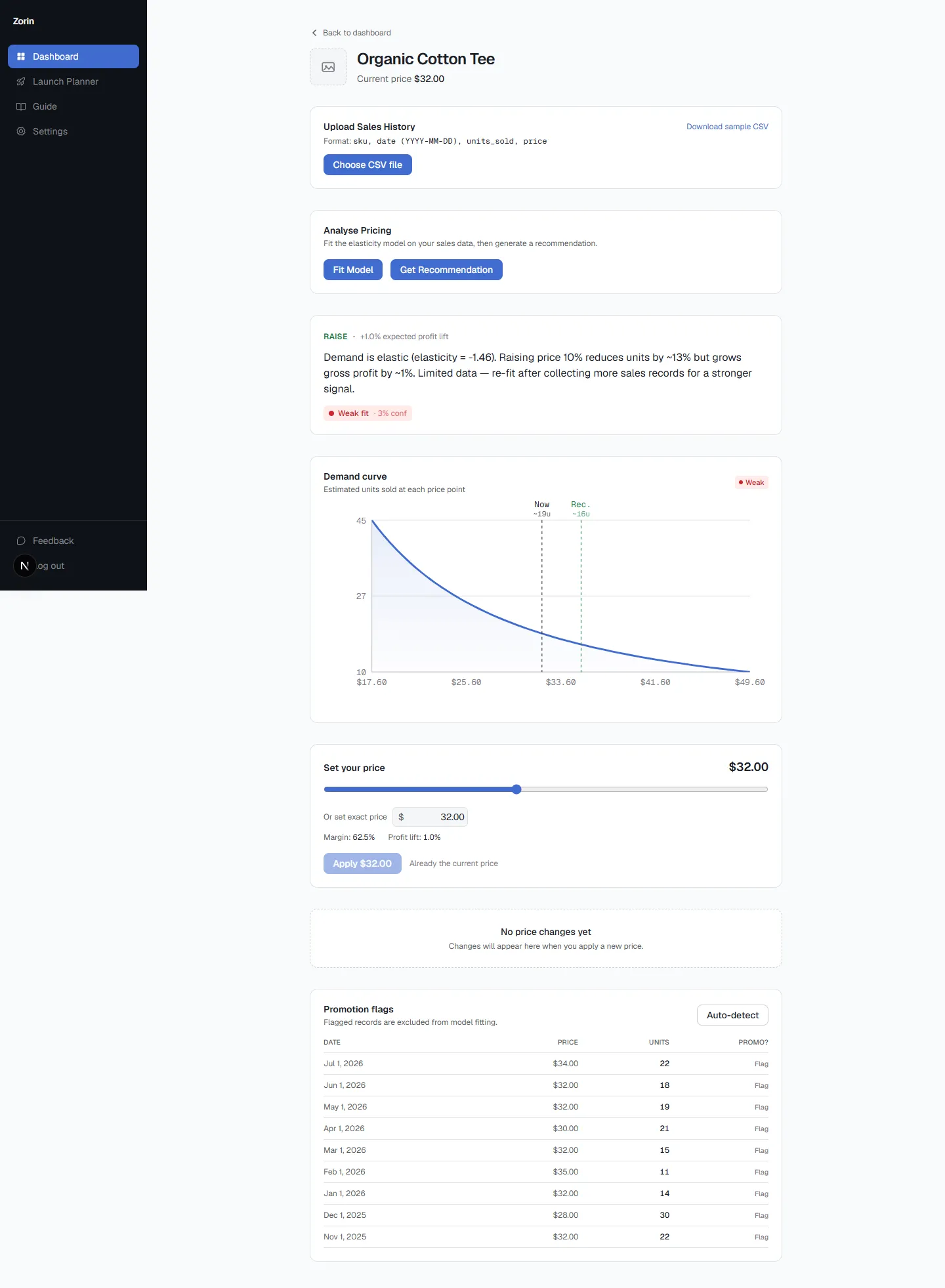
Zorin's recommendation ships with the elasticity coefficient behind it and a confidence score, so a merchant can see whether an underperforming price is genuinely a demand-curve issue or whether the confidence label itself is signaling the data doesn't yet support a confident read, a cue to look elsewhere before assuming the price is the problem.
For the full case on why a single blended price test can hide the real signal, your price sensitivity data might be wrong covers the segmentation side of this same diagnosis. Curious whether your own pricing is actually the problem? See what Zorin's elasticity model says about your catalog.
A "correct" price is not the same as the right price for the right person. Only one of those is a math problem. So before you re-run the model, re-run the diagnosis. Find out which of the three cases you're actually in.
Written by Tom Berger
Tom Berger is a Portfolio CMO for B2B SaaS with 25+ years of experience building and leading marketing functions from Series A through growth stage, including VP Marketing roles at DigitalOcean, Bolt, and Sift. He writes about go-to-market strategy at bergerCMO.ai.