Zorin vs Symson: Which Fits Your Store?
| Feature | Zorin | Symson |
|---|---|---|
| Elasticity data source | Fits its model to your own first-party sales history only, no external data blended in | Blends your sales data with scraped competitor prices (Google Shopping, website scrapers) and seasonality |
| Target buyer and buying process | Self-serve, connect Shopify or WooCommerce or upload a CSV, no sales call required | Mid-market to enterprise, demo request and sales-assisted onboarding, no public self-serve signup |
| Pricing transparency | Published tiers, $39 to $249/mo | Custom quote only, no published pricing |
| Confidence scoring per recommendation | R²-based confidence label on every SKU-level recommendation | Configurable Smart Business Rules layered on the model; no public confidence-score mechanism described |
| Competitor price monitoring | Manual entry only, name, price, optional URL per product, no automatic scraping | Automated tracking via Google Shopping and website scrapers, built directly into the pricing model |
| Cross-category elasticity modeling | Per-SKU only | Cross-elasticity modeling across category Key Value Items, suited to large commodity assortments |
| Customer price-sensitivity survey | Included, a 4-question Van Westendorp survey for a stated-preference read | Not offered |
Symson's elasticity modeling is real, not marketing language stretched over a repricer. But it's built for a mid-market or enterprise catalog with a sales-assisted rollout and custom pricing. If you're running a Shopify or WooCommerce store without a pricing team, Zorin gets you a comparable per-SKU elasticity read without a sales cycle.
Start your free trialA merchant running a catalog that's outgrown gut-feel pricing usually notices the pattern before they know what to call it: margin creeping down on some SKUs even as volume holds steady, and no clear read on which products can actually absorb a price increase and which can't. That's the problem before it has a product name attached to it, and it's the same underlying problem that eventually leads a search to both Zorin and Symson.
What Problem Symson Actually Solves
Symson is built for a merchant whose problem has already grown past a single SKU. It gathers your own sales and cost data, then blends in scraped competitor prices from Google Shopping and website scrapers, plus seasonality, and runs cross-elasticity models across what it calls Key Value Items within a category, useful when discounting one product measurably shifts demand for another sitting next to it on the same shelf. That's the specific problem it's aimed at: commodity-heavy assortments where products compete with each other, not just with a competitor's storefront. Symson's own product page cites a customer case with over 800,000 prices automated and 273,000 optimized for margin, real scale, but scale that assumes a pricing team is already in place to configure the Smart Business Rules the model feeds into. There's no published pricing; solving this problem starts with a demo request. Reviews are thin but strongly positive: 4.9 out of 5 on Capterra, across 11 verified reviews, a small sample worth noting honestly rather than treating as a large-scale signal.
What Problem Zorin Actually Solves
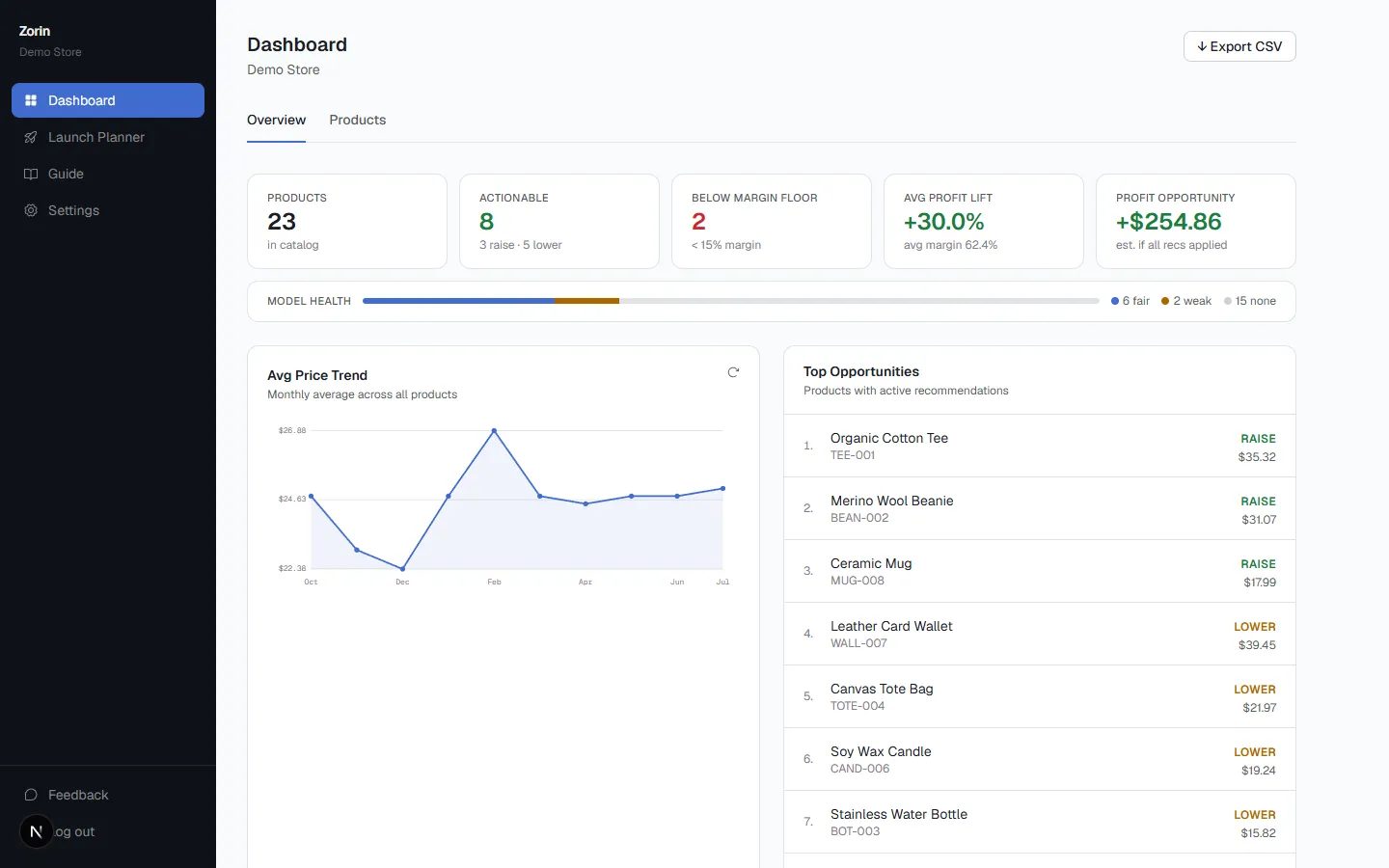
Zorin is built for the version of that same problem that shows up before a store has a pricing team, or headcount for one. Connect Shopify or WooCommerce, or upload a CSV, and it fits a price elasticity model to your own price-and-quantity history only, per SKU, with no competitor data blended into the read. The output is a plain raise, lower, or hold recommendation, an estimated profit lift, and an R²-based confidence score so a thin-data product is never presented with the same certainty as an established one. Nothing applies automatically, every change goes through manual review first. The problem it's solving isn't just "what's my elasticity," it's "how do I get an answer to that without a sales call or a custom quote standing between me and a first recommendation." Published pricing runs $39 to $249 a month depending on catalog size.
Reading the Table Above by Problem, Not Feature List
The comparison above is easier to read as answers to different questions than as a feature checklist. Pricing transparency and self-serve setup answer "can I get a recommendation today, without a sales cycle." Cross-category elasticity and built-in competitor tracking answer "does my catalog have complexity a single-SKU model can't see." Confidence scoring and the Van Westendorp survey answer "how much should I trust this specific number." None of those questions has a universally right answer, they depend entirely on which problem sent you searching in the first place.
Worth grounding that in something outside either vendor's own claims: a 2026 benchmark of 939 B2B SaaS companies by Optifai found self-serve deals under $15,000 in annual value typically close in 14 to 30 days, while enterprise deals above $100,000 run 90 to 180-plus days once RFPs, buying committees, and procurement reviews are involved. Symson's demo-and-quote model sits on the slower end of that range by design. If the problem you're solving is urgent, an empty answer for 90 days isn't a neutral tradeoff, it's a cost.
Ready to see your own numbers?
Start your free trialWhere Symson Wins
If the problem is cross-category cannibalization inside a large, commodity-heavy assortment, discounting one SKU visibly pulling demand from another in the same category, Symson's cross-elasticity modeling reaches further than a per-SKU-only read. Blending in competitor price data also solves a real problem for commodity categories where market position genuinely affects demand alongside your own price history. For a mid-market or enterprise catalog with a dedicated pricing function already in place, that's a real advantage, not a feature-list checkbox.
Where Zorin Wins
If the problem is access, a Shopify or WooCommerce merchant with no pricing team and no time for a sales cycle before getting a first answer, Zorin solves that directly. Published pricing, no demo requirement, and a confidence label on every recommendation so a newer SKU with thin data isn't presented with false certainty. It's also paired with a separate Van Westendorp price-sensitivity survey, a stated-preference signal Symson doesn't offer, for a second read next to the elasticity model rather than blended into it.
The Question That Actually Decides This
Set the feature list aside for a moment and ask one question instead: does solving this problem require someone on staff to configure and maintain the model, or does it need an answer today from whoever currently owns pricing as one job among several? The first profile fits Symson. The second is exactly who Zorin was built for, and for most independent and SMB merchants, that second profile is the accurate one, whether or not the catalog eventually grows past it.
Frequently Asked Questions
Is Zorin a Symson alternative?
For SMB and independent stores, yes. Both solve elasticity-based pricing, but Symson targets mid-market and enterprise catalogs with a sales-assisted, custom-quoted rollout, while Zorin is self-serve with published pricing built for Shopify and WooCommerce merchants without a pricing team.
Does Symson actually do price elasticity modeling, or is it just competitor tracking with a different name?
It's real elasticity modeling, not repricing rebranded. Symson's own product materials describe fitting elasticity from historical sales data, then blending in scraped competitor prices and seasonality, at the SKU level with cross-category support for commodity assortments.
How much does Symson cost compared to Zorin?
Symson doesn't publish pricing, access starts with a demo request and a custom quote. Zorin publishes its tiers directly: $39 a month for up to 25 products, up to $249 a month for unlimited products.
Does Zorin blend competitor prices into its elasticity model the way Symson does?
No. Zorin's core elasticity read comes from your own sales history only. You can manually log a competitor's name, price, and an optional URL per product for a min/median/max view, but that's a separate, optional feature, not part of the elasticity model itself.
What problem actually signals it's time to look at something like Symson instead of Zorin?
Cross-category discount effects across hundreds of SKUs, a dedicated pricing analyst already on staff, or a need for live competitor-price data woven directly into the model rather than tracked manually per product, usually a mid-market or larger catalog with more organizational structure than a typical independent Shopify or WooCommerce store.
Symson and Zorin aren't separated by whether the underlying math is real, they both do genuine elasticity modeling. They're separated by which problem, and which buyer, each one was actually built to solve first. If that's a solo store owner or a small team without a pricing analyst, Zorin gets you a per-SKU recommendation without a demo call or a custom quote standing in the way.
Written by Dexter
Dexter is part of the team at Zorin, building tools that help ecommerce merchants price with data instead of guesswork.