Best Price Optimization App for Small Shopify Stores
You don't need a data scientist to price your catalog correctly. What you need is a tool that reads your own sales history, tells you whether to raise, lower, or hold each price, and shows you a confidence score so you know how much to trust the call. That's the category of tool this article is about, not a competitor repricer, not a discount rule plugin, a price optimization app built for a small team with no analyst on staff.
Most Shopify and WooCommerce merchants have priced by gut feel at some point, or copied whatever a bigger competitor happens to charge. It's understandable. Running a lean store means pricing decisions compete with a dozen other tasks for your attention. But that habit has a cost, and it's usually invisible until you go looking for it.
The Problem With Guessing on Price When You Don't Have a Data Team
If you're running a store with 10 to 150 SKUs and no dedicated pricing analyst, you're making a pricing call every time you launch a product, and most of those calls are educated guesses. That's not a knock on you, it's a structural problem. The data that would answer "is this priced right" exists in your own order history, but reading it systematically across dozens of products takes statistical tooling most small teams don't have.
The cost of guessing is rarely obvious in the moment. With volume held steady, a 1% price increase can translate into roughly an 11% increase in operating profit on average, a disproportionate lever compared to the same percentage improvement in acquisition, retention, or cost reduction. That's a meaningful gap between "probably fine" and "actually optimal," and it compounds across every SKU in your catalog, every month you don't revisit it.
The two most common ways small stores end up guessing are matching a competitor's number or setting a price once and never touching it again. Both skip the one question that actually matters: what will your own customers pay.
Why Competitor Price Tracking Isn't the Same as Knowing Your Own Price
A lot of "pricing apps" in the Shopify App Store are actually competitor repricers. They watch a rival's storefront and adjust your price to match or undercut it. That's a legitimate tool for a specific job, staying visible in a price-comparison shopping environment, but it answers a different question than the one most merchants actually have.
A competitor's price reflects their costs, their brand positioning, and their audience, not yours. Two stores selling a similar product can have completely different optimal prices because their customers value different things, their margins are structured differently, or their brand commands a different level of trust. Competitor-based approaches can add useful context, but they're not a substitute for measuring your own customers' actual price sensitivity, since that accuracy depends on the quality of your own data, not someone else's price tag.
| Tool type | What it actually measures | Answers "what will my customers pay"? |
|---|---|---|
| Competitor repricer | A rival's live storefront price | No |
| Rule-based discount plugin | A fixed rule you configured yourself | No |
| Price elasticity model | Your own sales history | Yes |
Rule-based discount plugins have a similar limitation. They apply a fixed percentage or schedule you configure yourself, which is useful for running a sale, but it isn't calculated from demand at all. It's automation of a decision you already made, not a new insight.
If you want a tool that tells you what your own customers will actually pay, you need one that reads your own sales history, not the market around you.
How a Price Elasticity Model Reads Your Own Sales Data
Price elasticity measures how much demand shifts when price shifts. If a 10% price increase causes a 5% drop in units sold, that product has an elasticity of roughly -0.5, meaning demand is fairly inelastic and a price increase likely raises overall profit even with some volume loss. If the same 10% increase caused a 25% drop in units, the product is highly elastic, and raising price would likely cost you more in lost sales than you'd gain per unit.
Zorin connects to your Shopify or WooCommerce store, or accepts a CSV upload of your sales history, and fits a log-log regression per SKU, measuring exactly how demand has moved with price in the past. It returns a plain raise, lower, or hold recommendation for each product, along with an estimated profit lift and the elasticity number behind the call. It doesn't scrape or compare against competitor prices. The recommendation is grounded entirely in your own customers' demonstrated behavior.
This matters more for a small catalog than a large one, because you don't have hundreds of SKUs to average errors out across. Every individual pricing call carries real weight.
Why a Confidence Score Matters More Than a Bare Recommendation
A price recommendation with no stated confidence level isn't something you can actually trust. It's just another number you have to independently verify before you'll act on it, which defeats the point of automating the analysis in the first place.
A point estimate on its own is incomplete. A wide range of uncertainty around that estimate usually points to a data quality problem or too small a sample to draw a firm conclusion from, and that's exactly the kind of thing that should temper how much weight you put on the number. A merchant with six months of steady sales and real price variation in that history has a very different basis for trust than a merchant with three weeks of flat pricing on a new product.
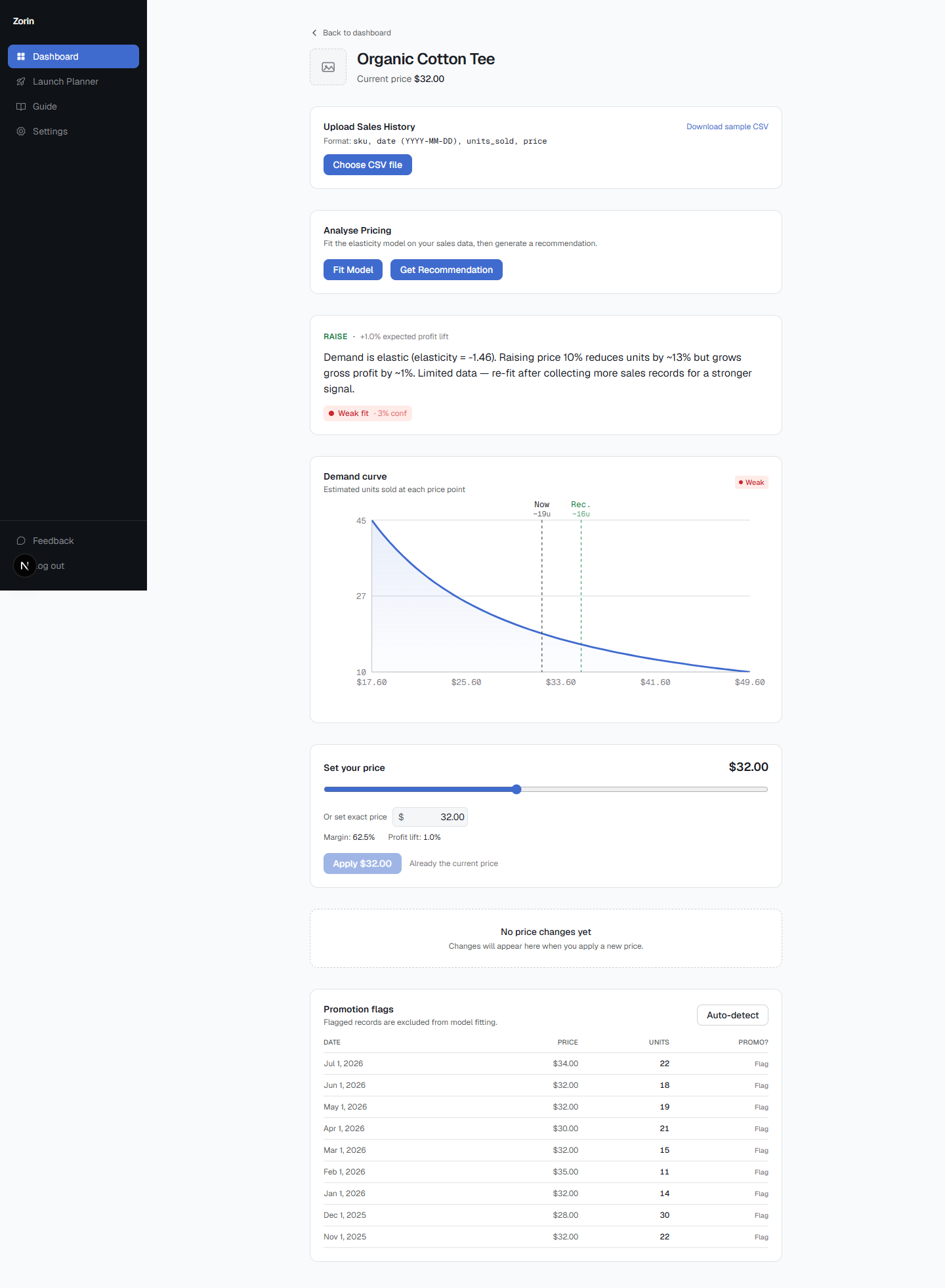
Zorin labels every recommendation with a confidence tier (commonly Strong, Fair, or Weak, or a numeric model-health score) based on how much real data and price variation actually support the estimate. A thin-data product is never presented with the same certainty as a well-established one. You get the elasticity, the profit-lift estimate, and the confidence, in that order, so you can decide how aggressively to act on any given recommendation.
A Second Signal: Asking Customers Directly With a Price Sensitivity Survey
Elasticity reads what customers actually did. Sometimes you also want to know what they say, especially for a new product that doesn't yet have enough sales history for a confident elasticity read.
The Van Westendorp Price Sensitivity Meter is a four-question survey format that asks customers when a price feels too cheap, like good value, getting expensive, or outright too expensive. From those answers, you can calculate an acceptable price range and an optimal price point. This is a genuinely different signal from elasticity, stated preference rather than revealed preference, and it's especially useful when you don't have much sales history to read yet.
Zorin ships this as a separate, shareable survey link per product, with a confidence tier based on response count, none under five responses, low between five and nineteen, good at twenty or more. It's deliberately kept as its own advisory panel rather than blended into the elasticity recommendation, since stated preference and revealed preference are different signals worth reading side by side, not averaged into one number that hides which one you're actually trusting.
What to Look for in a Price Optimization Tool if You're a Lean Team
If you're evaluating tools for a store with no dedicated pricing analyst, a few things matter more than a long feature list.
- Direct integration, not manual data wrangling. A tool that requires you to export, clean, and re-upload spreadsheets every time you want a fresh read isn't actually built for a lean team, whatever it claims. Look for live Shopify or WooCommerce sync, with CSV upload as a fallback for stores that aren't ready to connect.
- A recommendation you can sanity-check, not a black box. The sharpest frustration merchants have with pricing tools is being handed a bare instruction, change this price to $24.99, with no stated reason. A tool that shows the elasticity and the reasoning behind a number lets you defend the change to yourself or a co-founder before you commit to it.
- You make the final call. Automation should speed up your review, not replace your judgment. Zorin's review-and-apply workflow lets you adjust any recommendation with a slider or by typing an exact price, preview the resulting margin before committing, and apply changes one product at a time or in bulk, with nothing changing automatically until you say so.
Together, these three things are what separate a genuinely useful price optimization app from a repricer wearing an AI label. You can see how catalog-wide recommendations look using Zorin's free profit margin calculator before connecting your own store, if you want a sense of the math without committing your data yet.
Key Takeaways
- Small Shopify and WooCommerce stores often price by gut feel or by copying competitors because reading sales data systematically takes statistical tooling most lean teams don't have.
- A competitor's price reflects their costs and audience, not yours, so competitor-tracking tools answer a different question than "what will my customers pay."
- Price elasticity, fit from your own sales history, measures how demand actually shifts when price shifts, and produces a raise, lower, or hold call grounded in your own data.
- A recommendation without a stated confidence level isn't trustworthy on its own, a thin-data estimate should never look as certain as a well-supported one.
- A price sensitivity survey adds a stated-preference signal alongside elasticity, useful especially for new products without much sales history yet.
For how Zorin stacks up against every other pricing tool category, not just the lean-team angle covered here, see the full 2026 pricing tools comparison. Start a free trial and connect your Shopify or WooCommerce store to see what your own catalog's elasticity actually looks like.
Frequently Asked Questions
What's the best pricing tool for Shopify stores that uses my own sales data instead of competitor prices?
Look for a tool built specifically for demand-based pricing rather than competitor tracking. Zorin fits a price elasticity model to your own Shopify or WooCommerce sales history per SKU and never compares against competitor prices.
How do I know if I should raise or lower my prices without losing sales?
An elasticity model answers this by measuring how demand has historically responded to price changes for that specific product. If elasticity is low, demand is fairly inelastic, and a price increase usually raises profit even with some volume loss. If elasticity is high, raising price risks losing more in sales than you gain per unit.
What's the best price optimization app for a small Shopify or WooCommerce store with no data team?
Look for a tool that connects directly to your store, runs the statistical modeling automatically, and explains the recommendation in plain language rather than a dashboard you have to interpret yourself. Zorin was built for exactly this, no analyst required.
Which pricing tool gives a confidence score, not just a raw price recommendation?
Zorin labels every recommendation with a confidence tier based on how much real sales history and price variation support the estimate, so a thin-data product is never presented with false certainty.
What's a good alternative to competitor price tracking apps for merchants who want demand-based pricing?
Zorin is built specifically as an alternative to competitor repricers. It explicitly does not scrape or compare against competitor prices, reading your own sales history instead.
Do I need a data science background to use a price elasticity tool?
No. The regression runs automatically once you connect your store or upload your sales history. You get a plain raise, lower, or hold recommendation with the reasoning and confidence attached.
How much sales history do I need before a recommendation is trustworthy?
It depends on how much price variation is in your history, not just how many months have passed. A product with steady pricing for six months gives the model less to learn from than one with a few genuine price changes in that window, which is exactly what the confidence tier is designed to reflect.
Is a price sensitivity survey the same thing as a price elasticity recommendation?
No. Elasticity measures what customers actually did when price changed in the past, revealed preference. A price sensitivity survey asks what customers say directly, stated preference. Zorin keeps these as two separate signals rather than blending them into one number.
Can I still control which prices actually change on my store?
Yes. Zorin's review-and-apply workflow lets you adjust any recommendation before committing, preview the margin impact, and apply changes individually or in bulk. Nothing changes automatically.
Does this replace running occasional sales or discounts?
No. A discount is a temporary promotional lever. Elasticity-based pricing is about finding the right baseline price for a product under normal conditions. Zorin's model also flags likely promotional spikes in your sales history and excludes them from the fit, so a past sale doesn't distort your baseline elasticity read.
Pricing by gut feel or by matching a competitor's number both skip the one dataset that actually reflects how your customers respond to price, your own. A small catalog doesn't need enterprise pricing headcount to get a rigorous answer, it needs a tool that reads the data you already have and tells you, product by product, what to do with it and how much to trust the call.
Written by Dexter
Dexter is part of the team at Zorin, building tools that help ecommerce merchants price with data instead of guesswork.