What's a Good Profit Margin for an Online Store?
A commonly cited benchmark for online stores is 60 to 70% gross margin and 10 to 20% net margin, though this varies meaningfully by category and business model. The more useful answer, though, is that a "good" margin for your specific store is whatever your own cost structure and demand curve actually support, not an industry average copied from a blog post. Benchmarks are a sanity check, not a target to force your pricing toward.
Key Takeaways
- Commonly cited ecommerce benchmarks run 60-70% gross margin and 10-20% net margin, varying meaningfully by category and business model.
- An industry average tells you roughly where stores like yours tend to land, not what your specific margin should be.
- The gap between gross and net margin is often 35-40 percentage points, so tracking gross margin alone can hide a real profitability problem.
- Your own elasticity and cost structure, not a benchmark, determine the actual profit-maximizing price for each product.
- A margin that matches the industry average on paper can still be leaving profit on the table for your specific customer base.
What the Commonly Cited Numbers Actually Say
Industry benchmarks suggest average ecommerce stores run somewhere around 60-65% gross margin, with dropshipping models often higher (65-70%) and private-label or self-produced goods slightly lower (60-65%). On the net margin side, 5% is generally considered low, 10% average, and 20% or higher considered strong for sustainable long-term growth. These numbers are a reasonable starting orientation, especially if you have no other reference point yet.
| Margin type | Commonly cited range | What it measures |
|---|---|---|
| Gross margin | 60-70% | Revenue minus cost of goods sold, before operating expenses |
| Net margin | 10-20% | What's left after all operating costs, the real bottom-line profitability |
These figures are general industry benchmarks, not a guarantee for any specific store; actual healthy margins vary by product category and business model.
Why the Gap Between Gross and Net Margin Matters
The difference between gross and net margin commonly runs 35 to 40 percentage points, meaning a store with an impressive-looking 65% gross margin might still only be netting 10-15% after everything else is accounted for. Tracking gross margin alone can create a false sense of security. The number that actually determines whether your business is healthy is net margin, not the more flattering gross figure.
Why a Benchmark Can't Tell You Your Actual Number
An industry average describes where stores like yours tend to land on average, not what your specific product, cost structure, and customer base can actually support. Two stores selling similar products can have meaningfully different optimal margins if their customers have different price sensitivity, their supplier costs differ, or their acquisition channels bring in different kinds of buyers. Chasing a benchmark number as a target can mean underpricing a product whose actual demand would support a higher margin, or overpricing one where your specific customers are more price-sensitive than the category average.
What Actually Determines Your Real Optimal Margin
Your true landed cost (including fees, shipping, and returns) sets the floor. Your product's elasticity, how much demand shifts with price, calculated from your own sales history, tells you how far above that floor you can reasonably price without losing more in volume than you gain in margin. Neither number comes from an industry average. Both come from your own store's actual data.
Using Benchmarks the Right Way
Treat an industry benchmark as a sanity check, not a target. If your margin is dramatically below the typical range for your category, that's worth investigating, maybe your costs are unusually high, or your pricing is more conservative than your customers would actually tolerate. If your margin already sits within a normal range, that alone doesn't mean it's optimal for your specific catalog; it just means it's not an outlier.
A More Useful Question Than "What's a Good Margin"
Rather than asking what margin is generically good, ask whether your current margin, for each specific product, matches what your own elasticity and cost data would recommend. That's a more precise question with a more actionable answer, one product can genuinely support a higher margin than the industry average, and another might need to sit lower to move at the volume your business needs.
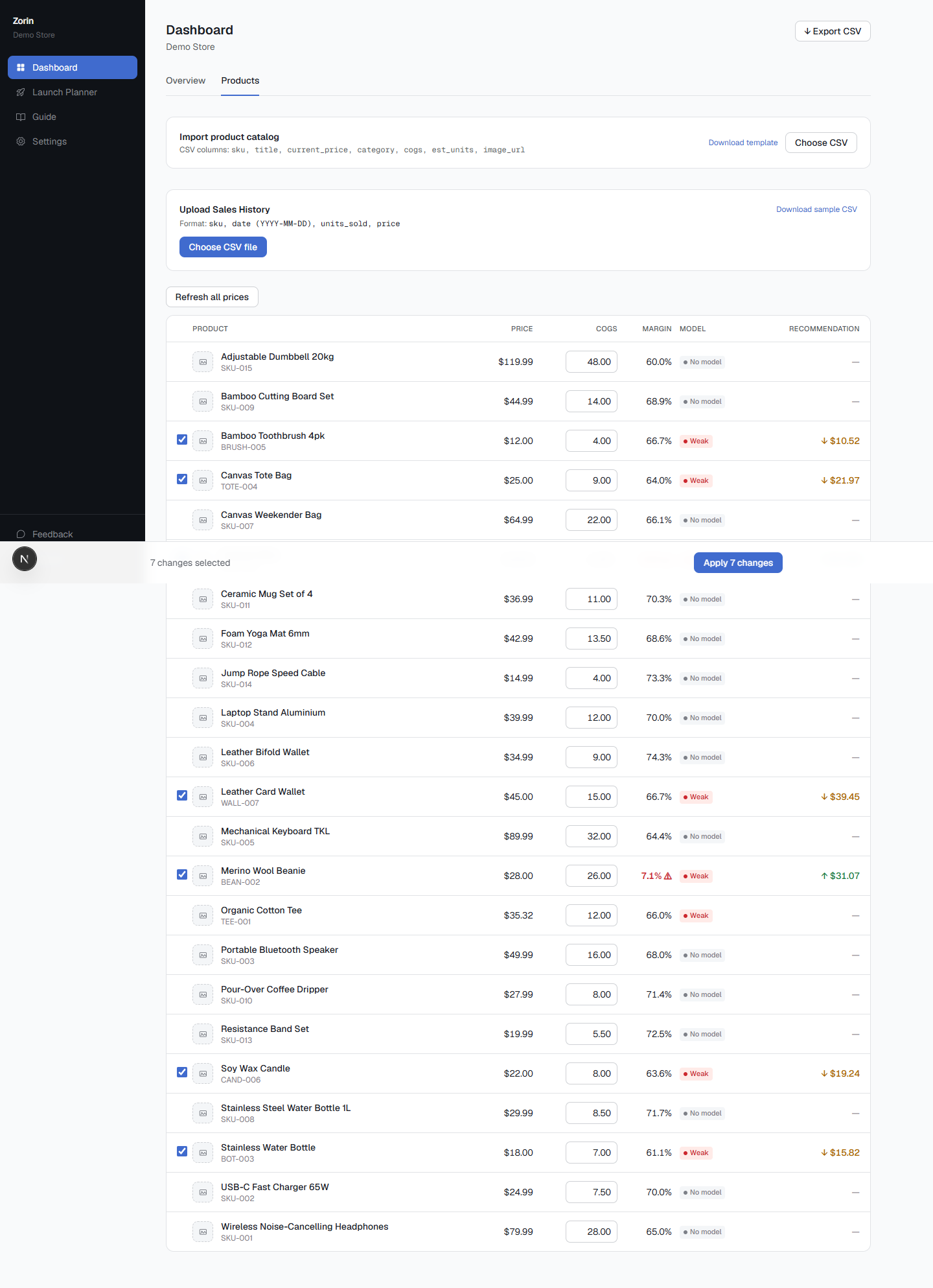
If you want to see where your own products actually sit relative to their profit-maximizing price, rather than an industry average, here's how to check, or connect your sales history directly.
Frequently Asked Questions
What's a good profit margin for an online store?
Commonly cited benchmarks run 60-70% gross margin and 10-20% net margin, though your own optimal number depends on your specific costs and customer demand, not the industry average alone.
What's the difference between gross and net margin?
Gross margin is revenue minus cost of goods sold. Net margin subtracts all other operating costs too, and is a more accurate measure of actual profitability.
Why might my margin be within the normal range but still not optimal?
An industry average describes where stores like yours typically land, not what your specific demand curve and cost structure can support. Being "normal" doesn't mean it's your profit-maximizing number.
Should I aim to match the industry average margin?
Use it as a sanity check rather than a target. Your own elasticity and cost data determine your actual optimal margin, which may sit above or below the average.
Why do gross and net margin sometimes look so different?
Operating costs beyond cost of goods sold (fees, overhead, returns) commonly eat 35-40 percentage points between the two, so a strong gross margin can still mask a weak net margin.
Does margin vary a lot by product category?
Yes, significantly. Benchmarks differ meaningfully across categories and business models (dropshipping vs. private label, for example), so a single universal number rarely applies well.
How do I find my actual optimal margin instead of guessing from a benchmark?
Calculate your true landed cost as a floor, then use your product's own elasticity, from its actual sales history, to determine how far above that floor your specific customers will support.
Industry benchmarks are a reasonable starting orientation, not a substitute for your own numbers. Your actual optimal margin lives in your own cost structure and your own customers' demand, not in an average calculated across thousands of stores that aren't yours.
Written by Dexter
Dexter is part of the team at Zorin, building tools that help ecommerce merchants price with data instead of guesswork.