Is Your Store Leaving Money on the Table?
Your store is very likely leaving money on the table if you can't remember the last time you deliberately changed a price based on data, rather than a hunch, a competitor's move, or simply not touching it since launch. The signs are rarely dramatic. Healthy sales volume can sit right on top of a real pricing problem without anything obviously breaking.
Key Takeaways
- Steady sales volume doesn't mean your pricing is optimal, it only means enough customers accept the current price.
- No price changes in six months or more, competitor-copied prices, and no price-testing history are the clearest warning signs.
- Checking means comparing your live price against what your own historical demand data says the profit-maximizing price would be.
- There's no alert for quietly under-optimized pricing, so it has to be checked deliberately, not assumed away by healthy revenue.
Why "Sales Are Fine" Doesn't Mean Pricing Is Fine
Revenue and profit are not the same signal. A product can sell steadily at a price that's meaningfully below what your actual demand curve would support, and you'd never see it in your top-line numbers, because the sales are still happening. The only way to know if a specific price is leaving profit on the table is to compare it against what your own historical demand data says the profit-maximizing price would be, not against whether units are moving.
Four Signs Worth Checking
You haven't changed a price in six months or more
Costs shift. Your product mix changes. Customer acquisition sources change, and different channels often bring in buyers with different price sensitivity. A price that was correct when you set it can quietly drift out of alignment with all of that, and nothing forces you to notice unless you're actively checking.
You set prices by copying a competitor
Matching a competitor's price assumes your buyers are identical to theirs. They found you through different marketing, in a possibly different market, expecting a possibly different value proposition. If your customers are actually less price-sensitive than a competitor's, matching their number means giving away margin you didn't need to give up.
You've never tested a different price point
Without price variation in your own history, there's no signal to read. If a product has had exactly one price its entire life, you have no data telling you whether $10 more would have cost you volume or simply added profit. This is the single biggest blind spot: no experiment means no evidence either way.
Some products convert well and others don't, with no clear pattern
Inconsistent conversion across similar products, with pricing set the same generic way for all of them, is often a sign that some are underpriced relative to what customers would actually pay, and others are overpriced relative to what the market will bear for that specific item.
What "Checking" Actually Looks Like
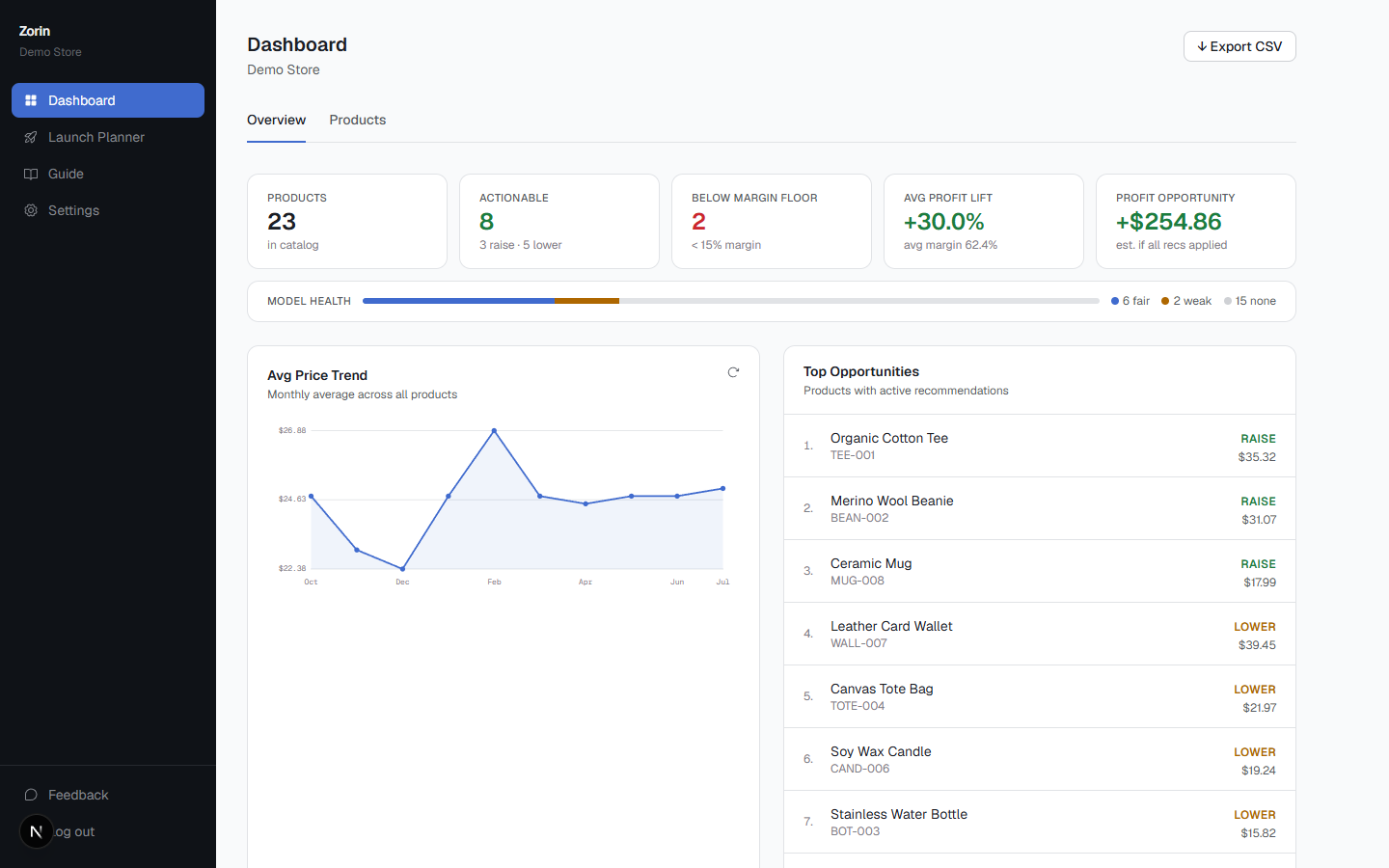
Checking isn't guessing harder. It's reading your own price-and-quantity history to calculate elasticity per product, the measurable relationship between a price change and the resulting change in demand. Zorin runs this calculation automatically from an uploaded sales history (or a live Shopify or WooCommerce sync) and returns a raise, lower, or hold recommendation for every SKU, along with an estimated profit lift and a confidence score based on how much reliable data supports it.
| What the old approach sounds like | What the data actually says |
|---|---|
| "I'll try $79 and see what happens." | "Your elasticity is -1.2. Raising to $85 lifts profit an estimated 14%." |
| "My competitor charges $89 so I'll charge $89." | "Your customers are less price-sensitive than that. You can likely charge $97." |
| "I haven't touched prices in six months." | "Three products are under-priced relative to their own demand curve." |
Why This Is Easy to Miss Without a Systematic Check
Nobody gets an alert when a price is quietly leaving 10 to 15% of achievable profit on the table. There's no error message, no dip in sales, nothing that forces the question. The only way to catch it is to periodically compare your live prices against what your own demand data says the profit-optimal price would be, product by product, rather than assuming steady sales means the pricing decision was correct.
A Simple Way to Check Yourself
Pick your five best-selling products. For each one, ask honestly: when did I last change this price, and was that decision based on anything other than a guess or a competitor's number? If the honest answer is "I don't remember" for more than a couple of them, that's the practical version of the sign to watch for, before you ever look at a formal elasticity number.
Once you've spotted a likely gap, here's how to actually calculate the right price from your own sales data. And if a sale is part of the picture, here's how to run one without corrupting that same data.
Frequently Asked Questions
How do I know if I'm leaving money on the table with my prices?
Check whether you've ever deliberately tested a different price point for a product, backed by data. If a price has sat unchanged since launch or was copied from a competitor, there's a good chance it isn't optimized for your actual demand.
Can healthy sales volume hide a pricing problem?
Yes. Steady sales just mean the price is acceptable to enough customers, not that it's the price that maximizes profit. Those are different questions.
What are the clearest warning signs?
No price changes in six months or more, prices copied from competitors, no price testing history, and inconsistent conversion across similar products with no clear explanation.
How often should I check my pricing?
Often enough to catch cost or demand shifts, without reacting to every minor fluctuation. Reviewing your full catalog against fresh elasticity estimates on a regular cadence, such as monthly, is a reasonable default for most small catalogs.
What metrics actually show whether a price change worked?
Compare the estimated profit lift the model projected against what you actually observed in sales afterward, not just whether units sold. Volume alone doesn't tell you whether the change improved total profit.
Do I need a lot of historical sales data to check this?
More data and more price variation produce a more confident estimate, but even limited history gives a starting signal, flagged with a lower confidence score so you know to treat it cautiously.
The honest test isn't whether your store is profitable today. It's whether you can point to a reason, grounded in your own sales data, that your current prices are the ones that maximize that profit. If the answer is a shrug, there's very likely money sitting on the table you haven't measured yet.
Written by Dexter
Dexter is part of the team at Zorin, building tools that help ecommerce merchants price with data instead of guesswork.